
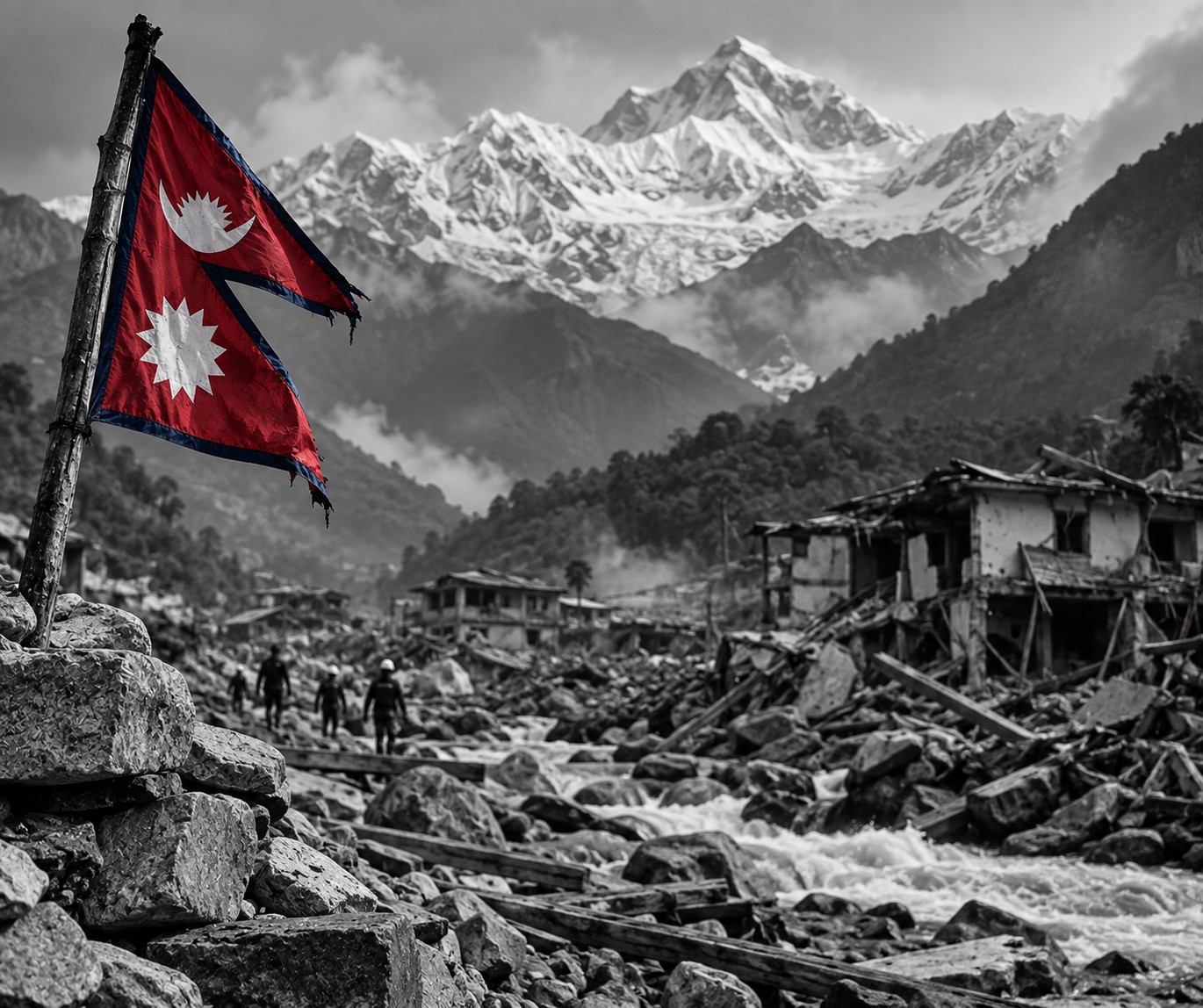
Nepal is confronting the accelerating consequences of climate change after a catastrophic flash flood devastated Himalayan communities, killing more than 1,200 people and leaving thousands unaccounted for. Scientists warn that warming temperatures and increasingly unstable glaciers could make similar disasters more frequent across one of the world’s most climate-vulnerable regions.
A disaster in the mountains
The 26 August flood struck the Bhotekoshi river system in Rasuwa before surging downstream through settlements and critical infrastructure. By Wednesday, Nepalese authorities reported 1,204 deaths, while 4,216 people remained out of contact.
Around 1.6 million people in Rasuwa and Nuwakot were directly affected. Dozens of bridges were swept away and thousands of homes were destroyed or damaged.

Warming destabilises the Himalayas
Scientists are still investigating the precise sequence that triggered the disaster. Evidence points towards a massive rock and ice collapse in the high Himalayas, producing a destructive cascade of water, debris and sediment.
Climate change is increasing the underlying danger. Rising temperatures are accelerating glacier melt and weakening frozen mountain terrain, increasing the potential for rockslides, avalanches, glacial lake failures and sudden floods.
Nepal calls for international action
Prime Minister Balendra Shah has described the disaster as a warning to the international community, arguing that countries such as Nepal face disproportionate consequences despite making a very small contribution to global greenhouse gas emissions.
The government has approached the Fund for Responding to Loss and Damage for assistance following the catastrophe.
A wider emerging-market challenge
Nepal’s experience illustrates a growing economic problem for developing countries. Climate disasters increasingly threaten roads, bridges, hydropower facilities, agriculture, tourism and entire communities while governments face limited financial resources for adaptation and reconstruction.
For the Himalayan region, climate change is therefore becoming more than an environmental issue. It is an infrastructure, development and financial stability challenge – and the August disaster demonstrates how quickly that risk can become reality.
Newshub Editorial in Asia – 4 September 2026

Ask NF GPT
If you have an account with ChatGPT you get deeper explanations,
background and context related to what you are reading.
Recent Comments