
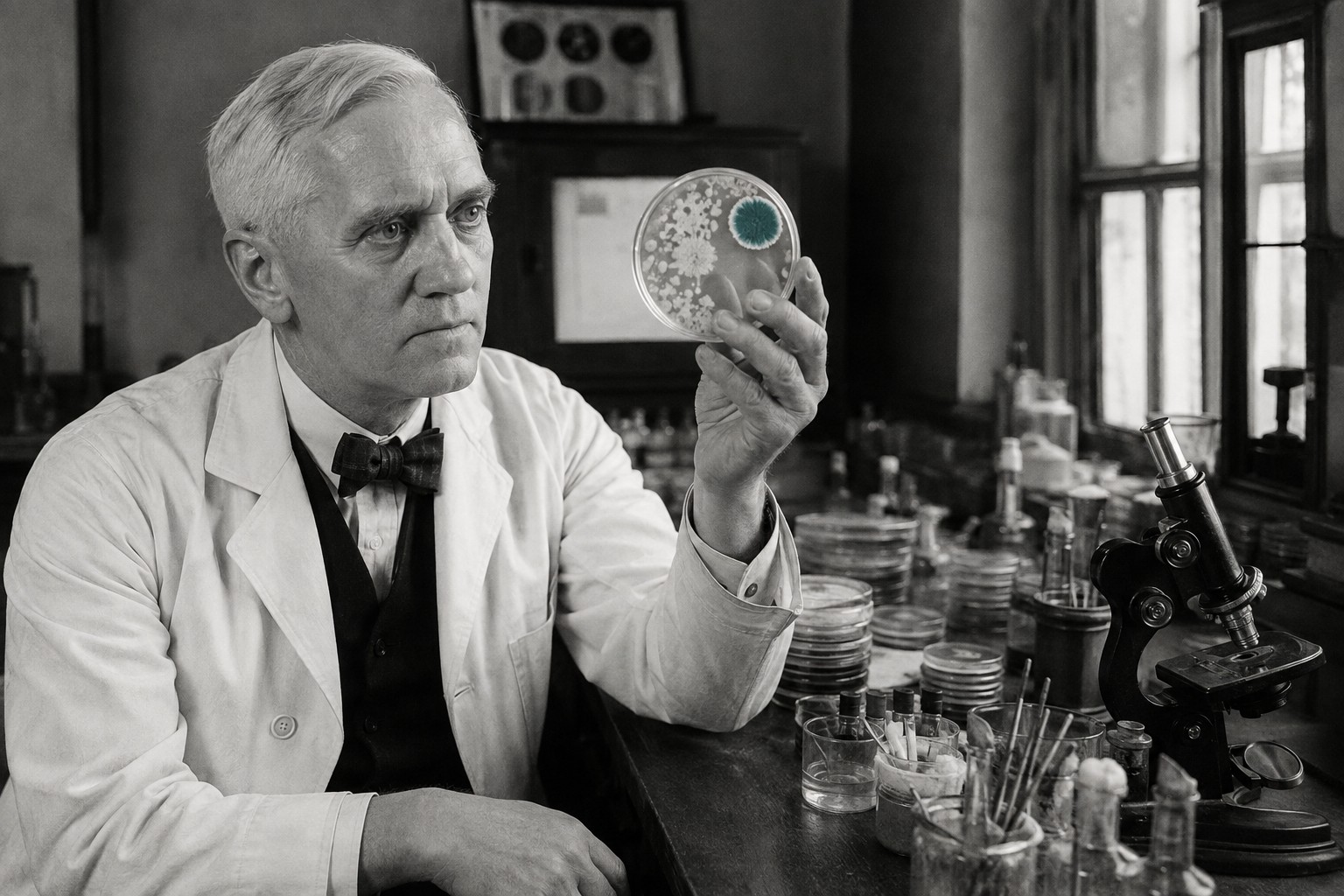
On this day in 1928, Scottish bacteriologist Alexander Fleming returned to his laboratory at St Mary’s Hospital in London and noticed something unusual in a contaminated culture dish. His observation would lead to the discovery of penicillin and transform modern medicine.
An accidental breakthrough
Fleming had been studying Staphylococcus bacteria before leaving his laboratory for a holiday. When he returned on 3 September, he found that mould had grown in one of the dishes.

More importantly, the bacteria surrounding the mould had disappeared. Fleming realised that the fungus was producing a substance capable of preventing bacterial growth.
He later identified the mould as belonging to the Penicillium genus and named the antibacterial substance penicillin.
From observation to medicine
Fleming published his findings in 1929, but initially struggled to isolate and produce penicillin in sufficient quantities. The medical potential of the discovery consequently received limited attention for several years.
The decisive advance came during the late 1930s and early 1940s, when scientists including Howard Florey, Ernst Chain and Norman Heatley developed methods for purifying and manufacturing the drug.
Large-scale production expanded during the Second World War, allowing penicillin to treat infected wounds and illnesses that had previously killed large numbers of patients.
A revolution in healthcare
Penicillin became the foundation of the antibiotic era. It transformed the treatment of pneumonia, blood poisoning, wound infections and numerous other bacterial diseases, while making surgery and childbirth significantly safer.
In 1945, Fleming, Florey and Chain jointly received the Nobel Prize in Physiology or Medicine for the discovery and development of penicillin.
Fleming also warned that careless or insufficient use could allow bacteria to become resistant. Nearly a century later, antimicrobial resistance has become one of the world’s most serious health challenges.
What began with a contaminated laboratory dish remains one of history’s clearest examples of how scientific curiosity can turn an accident into a discovery that changes humanity.
Newshub Editorial in Europe – 3 September 2026

Ask NF GPT
If you have an account with ChatGPT you get deeper explanations,
background and context related to what you are reading.
Recent Comments