
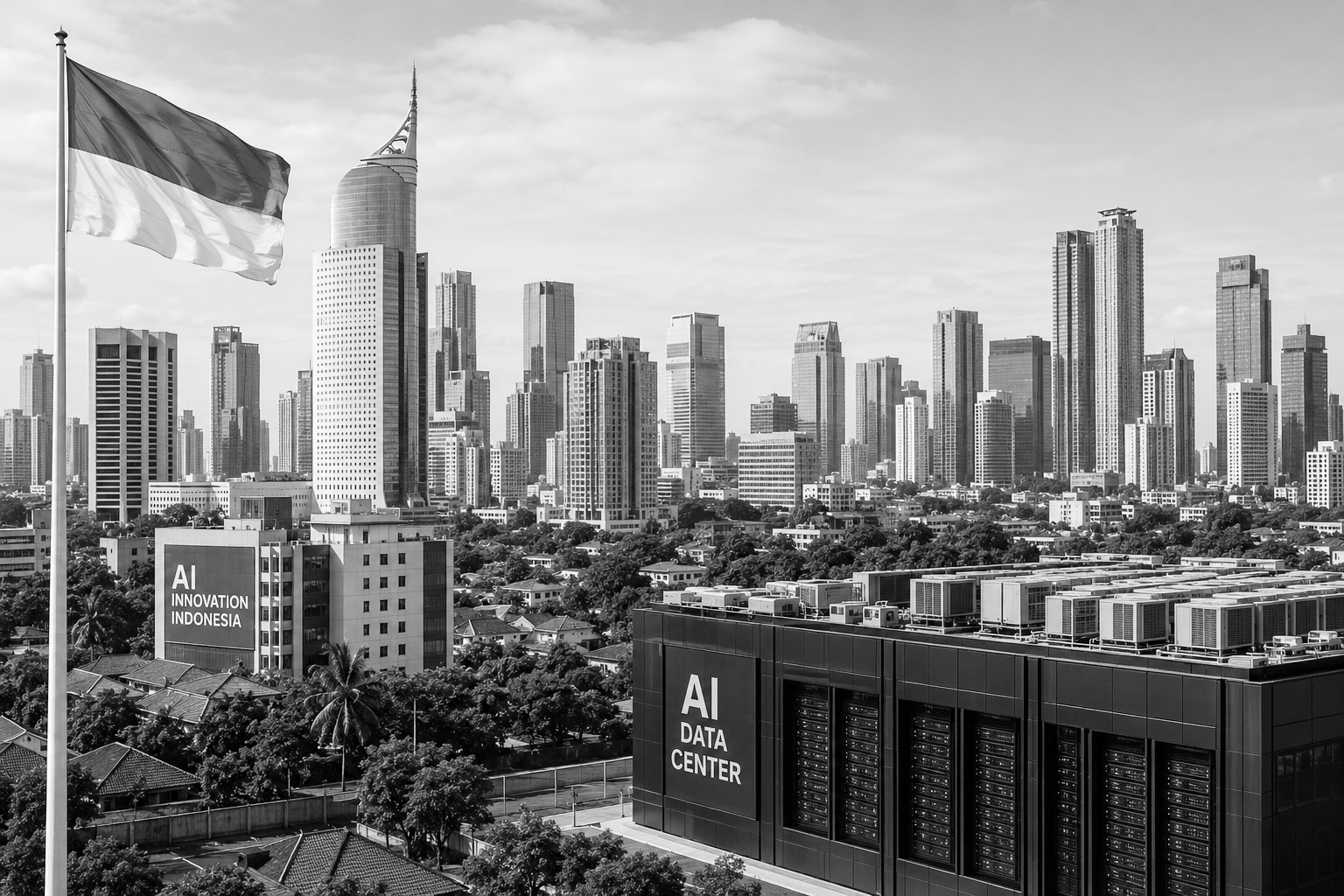
Indonesia is rapidly emerging as one of Asia’s most important new artificial intelligence infrastructure markets, as international technology companies expand computing capacity into Southeast Asia. Recent investments and partnerships are placing the region’s largest economy in a stronger position to participate directly in the global AI boom rather than simply consuming technology developed elsewhere.
AI infrastructure moves into emerging Asia
One of the clearest signals has been the expansion of specialised AI computing infrastructure into Indonesia. US-based AI cloud company CoreWeave announced this month that Indonesia would become its first data-centre presence in the Asia-Pacific region, extending high-performance computing capacity into one of the world’s largest emerging digital economies.
The development comes as several international technology groups build partnerships around AI inference and computing in Indonesia. Analysts increasingly see the country as part of a broader shift in which AI infrastructure is moving beyond the established Asian technology centres of Singapore, Taiwan, South Korea and Japan.

Southeast Asia attracts record capacity
The expansion is part of a much larger investment cycle. Asia-Pacific’s data-centre development pipeline reached a record 26.5 gigawatts during the first half of 2026, with Southeast Asia accounting for approximately half of the regional development pipeline. Around 7.1GW was added to planned capacity during the period.
AI is an important driver. Training and operating increasingly sophisticated models requires enormous computing capacity, creating demand for data centres, advanced processors, electricity networks, cooling systems and high-speed connectivity.
For emerging markets such as Indonesia, that investment can create an economic multiplier extending considerably beyond the technology industry.
Indonesia could capture more of the AI value chain
Indonesia already possesses several advantages: a population of more than 280 million, a rapidly expanding digital economy and one of Southeast Asia’s largest pools of consumers and businesses moving online.
Greater domestic computing capacity could allow Indonesian companies to deploy AI applications with lower latency while helping financial services, telecommunications, healthcare, manufacturing and government services introduce AI-based systems locally.
It could also encourage development of a domestic ecosystem of engineers, software companies and AI start-ups instead of leaving much of the underlying infrastructure concentrated overseas.
Infrastructure becomes an economic issue
The opportunity nevertheless comes with significant challenges. AI data centres consume substantial quantities of electricity and require reliable grids, fibre connectivity and sophisticated cooling infrastructure. Southeast Asian governments therefore face increasingly important decisions concerning energy supply, data sovereignty and the environmental consequences of rapid data-centre construction.
These constraints could ultimately determine which emerging Asian economies capture the greatest share of future AI investment.
A broader shift across emerging markets
Indonesia’s development also illustrates how the geography of artificial intelligence is changing. The first phase of the AI investment boom was heavily concentrated around American technology companies and North Asian semiconductor producers. The next phase is increasingly about where the computing infrastructure required to operate AI will actually be located.
Southeast Asia now has an opportunity to become one of those locations.
For Indonesia, attracting AI infrastructure could therefore mean more than another wave of foreign investment. If accompanied by reliable energy, digital skills and domestic innovation, it could help move the country further up the technology value chain and establish one of Asia’s largest emerging economies as a meaningful participant in the AI era.
Newshub Editorial in Asia – 15 August 2026

Ask NF GPT
If you have an account with ChatGPT you get deeper explanations,
background and context related to what you are reading.
Open article chat
Indonesia is rapidly emerging as one of Asia’s most important new artificial intelligence infrastructure markets, as international technology companies expand computing capacity into Southeast Asia. Recent investments and partnerships are placing the region’s largest economy in a stronger position to participate directly in the global AI boom rather than simply consuming technology developed elsewhere.
Recent Comments