
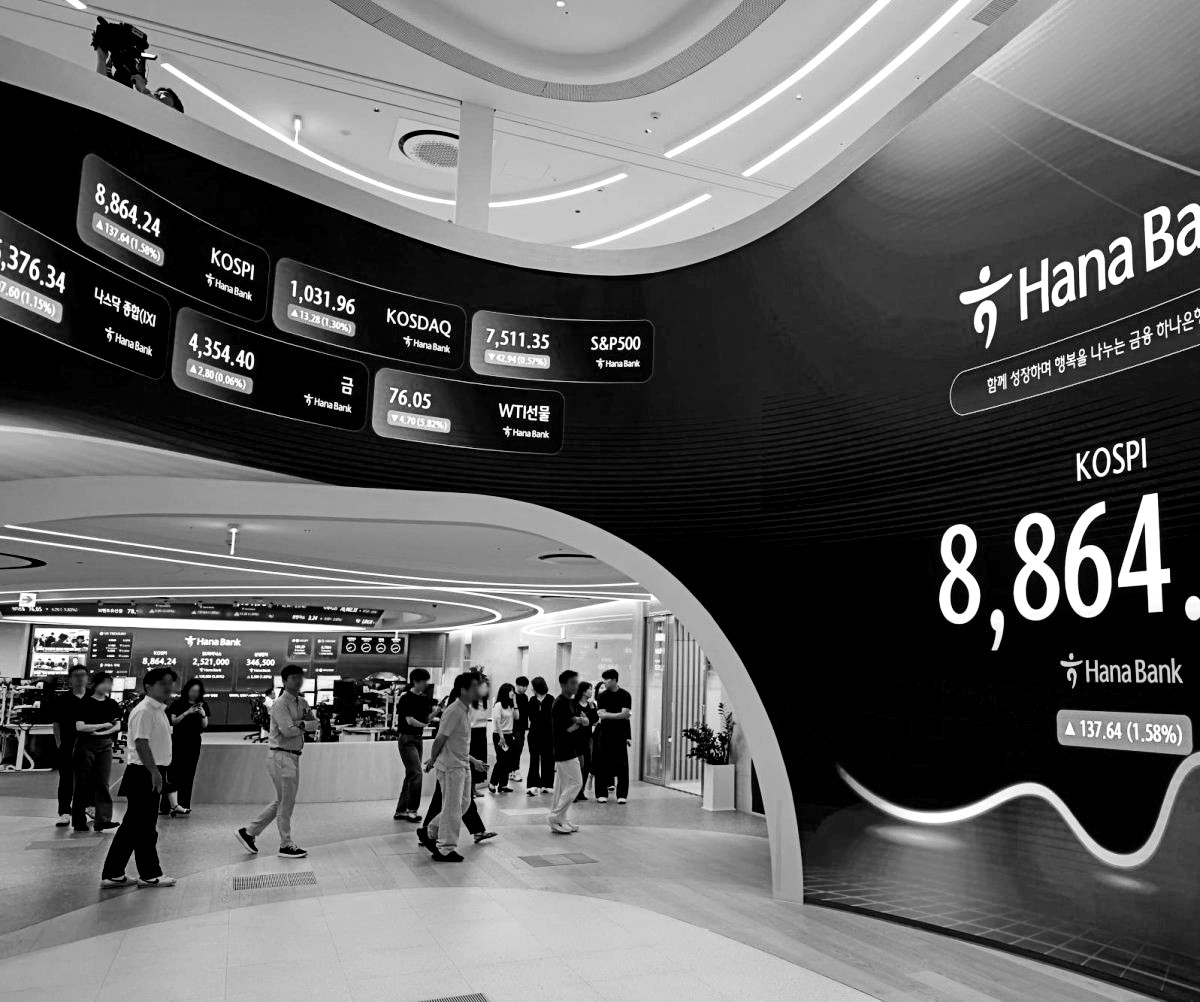
South Korean shares opened sharply lower on Monday as investors moved to secure profits following Friday’s extraordinary market rally. The Kospi began the session at 6,358.27 points, falling 237.18 points, or 3.6%, from the previous close.
Selling intensified immediately after the opening bell. By 9.15am in Seoul, the benchmark had dropped 280.05 points, or 4.25%, to 6,315.40.
The index subsequently recovered part of the decline but remained deeply negative. By late morning, the Kospi was trading at 6,379.39, down 216.06 points, or 3.28%.

The fall came despite gains on Wall Street, where strong results from Amazon had renewed optimism surrounding artificial intelligence and technology spending.
Record rally invites profit-taking
The Korean market had surged by almost 18% during Friday’s session, one of the largest single-day increases in its history. Foreign investors purchased approximately 7.2tn won worth of shares, more than double the previous daily record.
That rally followed a period of severe volatility in which the Kospi had fallen sharply from its June peak. Leveraged investment products connected to Korean technology companies amplified both the decline and the subsequent recovery.
Assets held in leveraged exchange-traded funds linked to Samsung Electronics and SK Hynix reportedly fell from approximately $50bn in late June to around $17bn by the end of July. Forced selling and rapid deleveraging contributed to unusually large movements in the index.
Monday’s fall therefore reflected both conventional profit-taking and continued instability following the recent liquidation of leveraged positions.
Chipmakers lead the decline
Technology heavyweights were at the centre of the retreat. Samsung Electronics and SK Hynix were both down approximately 6.3% during late morning trading as investors reduced exposure following their strong gains on Friday.
Battery manufacturer LG Energy Solution declined by 2.4%, while Samsung Biologics lost 2.7%. Internet and technology group Naver performed comparatively better but still slipped by around 0.5%.
The Korean won strengthened to approximately 1,427.4 against the US dollar, gaining 8.1 won from Friday’s stock-market close. A stronger currency can reduce the translated overseas earnings of Korean exporters, although it also lowers the cost of imported energy and raw materials.
Fundamentals remain stronger than trading suggests
The market decline contrasted with encouraging economic data. A survey released on Monday indicated that South Korea’s manufacturing activity accelerated during July as new export orders increased.
International investors also continue to express confidence in the long-term earnings prospects of Samsung Electronics and SK Hynix. Demand for advanced memory chips used in artificial intelligence infrastructure remains an important source of potential growth.
The central question is whether recent losses represent a fundamental reassessment of the semiconductor industry or a market correction caused mainly by excessive leverage and rapid profit-taking.
Monday’s opening suggested that volatility has not disappeared. South Korean equities may continue experiencing unusually wide movements until leveraged positions are reduced and investors establish a clearer valuation for the country’s dominant technology companies.
Newshub Editorial in Asia – 3 August 2026

Ask NF GPT
If you have an account with ChatGPT you get deeper explanations,
background and context related to what you are reading.
South Korean shares opened sharply lower on Monday as investors moved to secure profits following Friday’s extraordinary market rally. The Kospi began the session at 6,358.27 points, falling 237.18 points, or 3.6%, from the previous close.
Recent Comments