
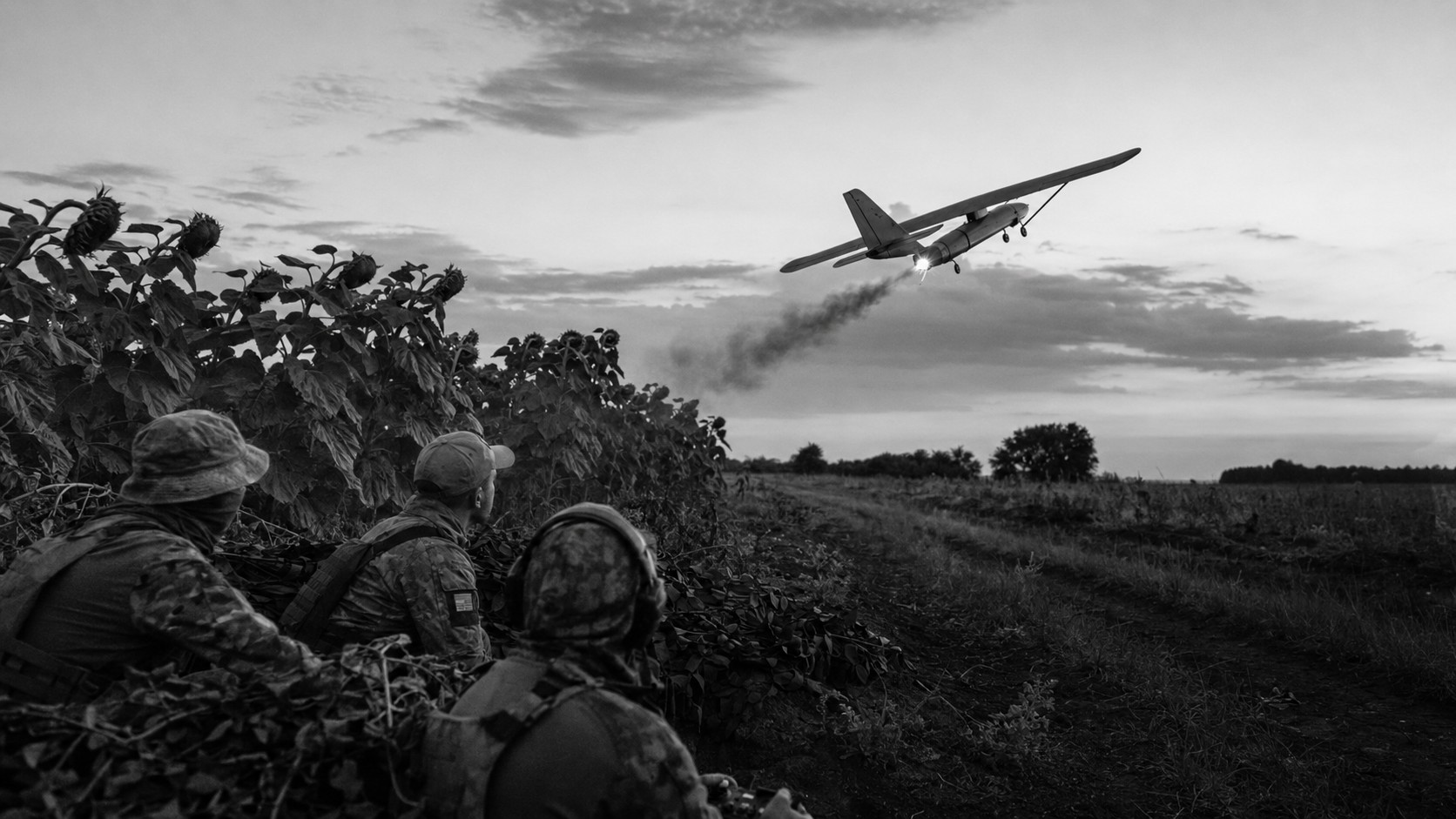
Ukraine has transformed long-range drones into one of its most important weapons against Russia, using domestically produced aircraft to strike military logistics, energy facilities and transport networks far beyond the frontline. A report from inside the secretive operation reveals how small, mobile teams are attempting to compensate for Russia’s greater size and conventional firepower through speed, technology and decentralised innovation.
A war increasingly fought in the sky
Guardian correspondent Luke Harding witnessed soldiers from Ukraine’s 414th aviation brigade launching long-range drones from a concealed rural position.
The aircraft, resembling small propeller-driven planes, carried between 50kg and 100kg of explosives. Some Ukrainian models can reportedly travel more than 2,500km, placing targets across European Russia and parts of Siberia within range.

The crews leave their launch sites within minutes. Coordinates are provided shortly before take-off, while operators elsewhere guide the aircraft towards their targets. The system is designed to make the launch teams difficult for Russian intelligence to locate.
The drones observed by Harding were sent towards occupied Crimea. One later struck a 110kV electricity substation in Alushta as part of a wider Ukrainian operation intended to disrupt the peninsula’s power and logistics networks.
Innovation born from necessity
Ukraine relied heavily on foreign military assistance during the early stages of Russia’s full-scale invasion. It has since built an expanding domestic defence industry involving engineers, technology start-ups, military units and civilian specialists.
The 414th brigade includes a unit known as Kairos, which operates as part of the wider formation popularly called Magyar’s Birds. The organisation is associated with Robert Brovdi, commander of Ukraine’s unmanned systems forces.
According to Ukrainian commanders, its long-range missions have targeted Russian oil refineries, ammunition depots, military warehouses, ports, railways and roads used to supply occupying forces.
Ukrainian drones have also reached Moscow and St Petersburg. Such attacks have forced Russia to defend locations previously considered safely beyond the battlefield and reportedly move some air-defence systems away from the frontline.
One commander summarised the conflict as a contest in which “democracy beats totalitarianism”, arguing that Ukraine’s flexible networks of soldiers, volunteers and private developers can innovate more quickly than Russia’s centralised military structure.
Pressure on Crimea and Russian logistics
Crimea has become a central target of the campaign. Russia seized and annexed the Ukrainian peninsula in 2014 and subsequently developed it into an important military base for operations across southern Ukraine and the Black Sea.
Ukraine is attempting to weaken that position by attacking electricity nodes, fuel supplies, air defences and maritime transport. Its forces have also targeted tankers and other vessels in the Black Sea and Sea of Azov.
Ukrainian commanders claim hundreds of Russian air-defence systems have been destroyed and that fuel shortages are restricting some military activity in Crimea. These claims cannot all be independently confirmed.
The campaign also carries risks for civilians. Strikes on electricity infrastructure and commercial warehouses can disrupt ordinary life and damage businesses, even when Ukraine says the facilities contribute to Russia’s war effort.
Technology cannot decide everything
Not every Ukrainian drone reaches its destination. Approximately one-third are reportedly intercepted over occupied territory, while losses are considerably higher during missions deep inside Russia.
Russian forces also continue to advance in parts of the eastern Donbas and maintain a substantial advantage in manpower, missiles and artillery. Russia has developed its own extensive drone industry and continues launching large aerial attacks against Ukrainian cities.
Ukraine’s long-range campaign has not ended those attacks or reversed every Russian advance. It has, however, changed the geography of the war. Distance no longer guarantees security, and Russia’s enormous territory has become increasingly difficult to defend.
Newshub Editorial in Europe – 2 August 2026

Ask NF GPT
If you have an account with ChatGPT you get deeper explanations,
background and context related to what you are reading.
Ukraine has transformed long-range drones into one of its most important weapons against Russia, using domestically produced aircraft to strike military logistics, energy facilities and transport networks far beyond the frontline. A report from inside the secretive operation reveals how small, mobile teams are attempting to compensate for Russia’s greater size and conventional firepower through speed, technology and decentralised innovation.
Recent Comments