
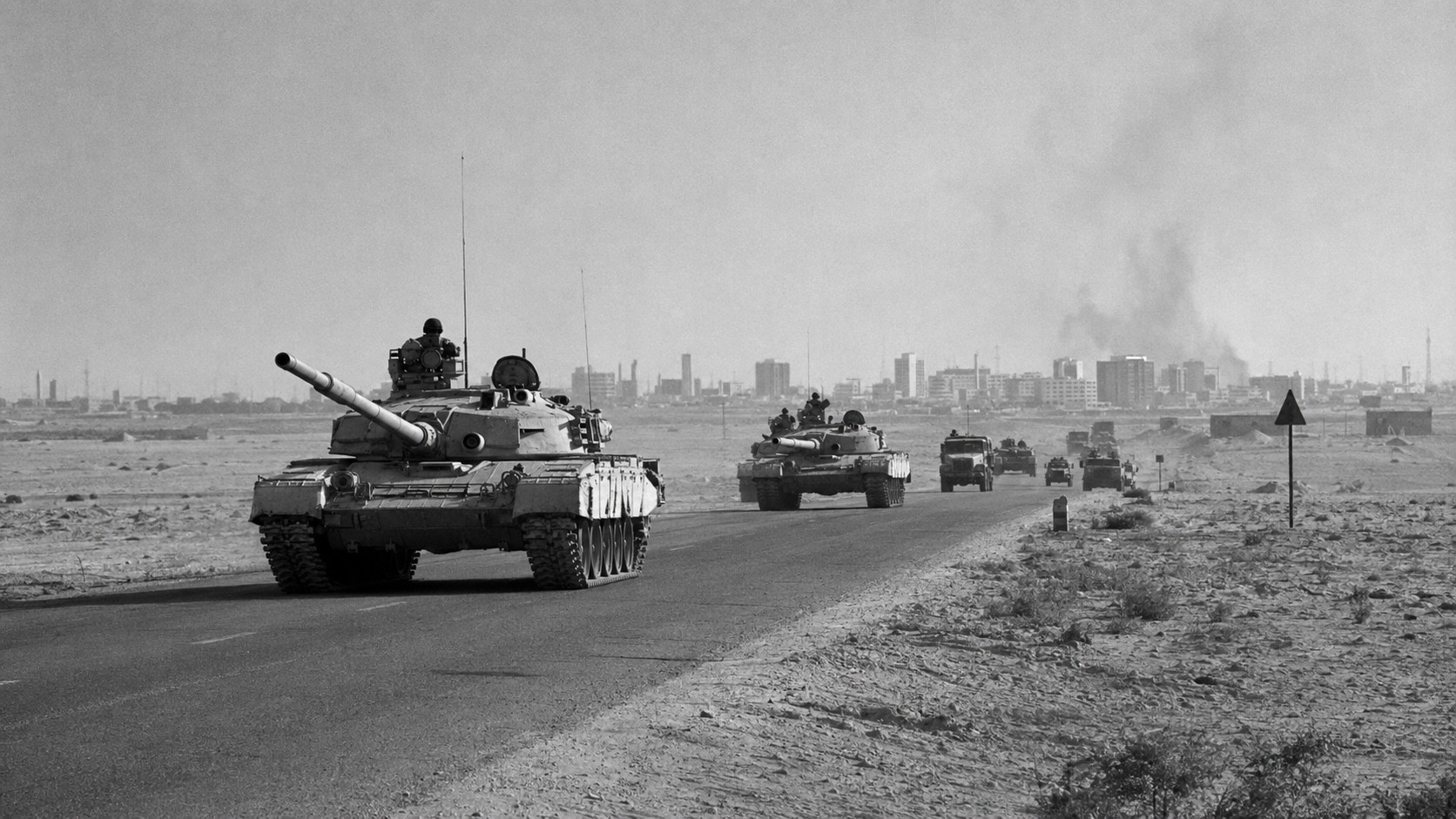
On this day in 1990, Iraqi forces invaded neighbouring Kuwait, beginning an international crisis that would lead to the Persian Gulf War. Saddam Hussein’s refusal to withdraw his troops prompted the formation of a vast US-led military coalition and transformed the political and security landscape of the Middle East.
A rapid assault
In the early hours of 2 August 1990, tens of thousands of Iraqi soldiers crossed the border into Kuwait. Supported by tanks, aircraft and helicopters, they quickly overwhelmed the much smaller Kuwaiti armed forces.
Within hours, Iraqi troops had reached Kuwait City. Kuwait’s emir, Sheikh Jaber al-Ahmad al-Sabah, escaped to Saudi Arabia, while members of the ruling family and government established themselves in exile.

Saddam Hussein presented the invasion as a response to economic and territorial disputes. Iraq accused Kuwait of exceeding oil production quotas, driving down prices and damaging an Iraqi economy already weakened by the eight-year Iran-Iraq War.
Baghdad also claimed that Kuwait had extracted oil from the disputed Rumaila oilfield through slant drilling. Kuwait rejected the allegations.
International condemnation
The invasion was swiftly condemned by governments around the world. On the same day, the United Nations Security Council adopted Resolution 660, demanding Iraq’s immediate and unconditional withdrawal.
When Baghdad refused, the Security Council imposed sweeping economic sanctions. Saddam instead tightened his control over Kuwait and formally declared it part of Iraq, describing the country as Iraq’s nineteenth province.
The annexation was recognised by almost no other government.
Concern rapidly spread beyond Kuwait. Saudi Arabia feared that Iraqi forces could continue south towards its oilfields, giving Saddam control over a substantial share of the world’s petroleum reserves.
US President George H. W. Bush responded by launching Operation Desert Shield, deploying American forces to Saudi Arabia. Other countries soon contributed troops, aircraft and naval vessels, creating a coalition that eventually included more than 30 nations.
From crisis to war
Months of diplomacy failed to persuade Saddam to retreat. The United Nations authorised coalition members to use “all necessary means” if Iraq had not withdrawn by 15 January 1991.
The deadline passed without compliance.
On 17 January, the coalition began Operation Desert Storm with an extensive air campaign against Iraqi military positions, communications systems and infrastructure. A ground offensive followed on 24 February.
Coalition forces broke through Iraqi defences and liberated Kuwait with remarkable speed. After approximately 100 hours of ground fighting, President Bush declared a suspension of offensive operations on 28 February.
A lasting legacy
The war ended Iraq’s occupation of Kuwait but did not remove Saddam Hussein from power. His government survived another 12 years, while Iraq faced sanctions, weapons inspections and repeated confrontations with the United States and its allies.
The invasion also brought a permanent expansion of Western military involvement in the Gulf. American forces remained in the region, while tensions created by the conflict contributed to later wars and political upheaval.
The events that began on 2 August 1990 therefore became far more than a border dispute. They marked the beginning of a new and deeply unstable era in the modern Middle East.
Newshub Editorial in Asia – 2 August 2026

Ask NF GPT
If you have an account with ChatGPT you get deeper explanations,
background and context related to what you are reading.
Recent Comments