
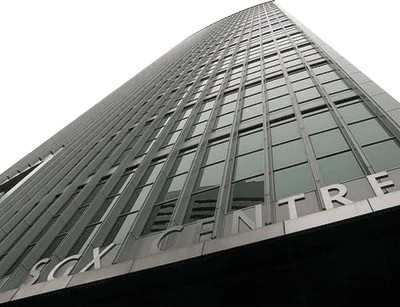
Singapore shares opened lower on Friday as losses among heavily weighted banking stocks outweighed gains across the wider market. By 9.06am, the Straits Times Index had fallen 31.70 points, or 0.56%, to 5,641.88, diverging from the powerful technology-led rebound elsewhere in Asia.
Banks pull the index down
DBS was one of the principal drags on the benchmark, falling 0.33% to S$74.60 during early trading. OCBC Bank and UOB were also among the most actively traded blue-chip companies, changing hands at approximately S$28.96 and S$43.35 respectively.
The three major banks account for a substantial proportion of the Straits Times Index. Even relatively modest declines in their share prices can therefore pull the benchmark lower despite gains among a larger number of smaller companies.

That effect was particularly visible on Friday. Market breadth remained positive, with 147 gainers compared with only 54 decliners during the opening minutes.
Approximately 70.5 million shares worth S$207.2 million were traded in early business, indicating that activity was not confined to a small number of defensive positions.
Broader market shows resilience
Other actively traded companies included ST Engineering at S$10.33, Singtel at S$4.43, AEM Holdings at S$8.46 and Seatrium at S$2.16.
The positive market breadth suggested that Singapore was not experiencing a general rush out of equities. Instead, weakness was concentrated in a small number of large index components.
The STI later moved closer to 5,627 points, a decline of around 0.8%, as banking pressure continued to outweigh advances elsewhere.
Singapore’s market composition helps explain its difference from South Korea and Japan. The STI has significant exposure to banks, telecommunications, industrial companies and property-related businesses, while semiconductor and AI companies have a smaller influence on the benchmark.
Asia rallies around Singapore
Elsewhere in the region, investors rushed back into technology shares after strong American corporate earnings eased concerns over the cost of artificial intelligence development.
South Korea’s KOSPI surged by double digits, while Japan’s Nikkei gained more than 4%. The recovery followed a 2.78% rise in the Nasdaq and an advance of more than 8% in the Philadelphia Semiconductor Index.
Microsoft’s shares jumped more than 15% after the company reported strong cloud growth. Amazon also provided encouragement by showing accelerating demand for its cloud computing services and continued investment in data-centre capacity.
Those results supported Singapore-listed technology and electronics companies, but their influence was insufficient to overcome weakness in the country’s dominant banking sector.
Currencies and global risks remain in focus
Currency markets also remained important for Singapore investors. The August US dollar-Singapore dollar futures contract traded near 1.2871, reflecting continued attention to the weaker American currency and shifting interest-rate expectations.
Oil prices fell during Asian trading, with Brent crude losing approximately 1%. Lower energy prices could provide some relief for Singapore, which imports most of its energy, although continuing conflict involving Iran and shipping risks around major trade routes remained a concern.
Friday’s opening therefore presented a divided picture. The headline index was clearly weaker, but the positive market breadth showed that investor confidence had not disappeared.
The direction of the market through the remainder of the session was expected to depend on whether gains among industrial, technology and telecommunications companies could eventually offset the pressure from Singapore’s heavyweight banks.
Newshub Editorial in Asia – 31 July 2026
Recent Comments