
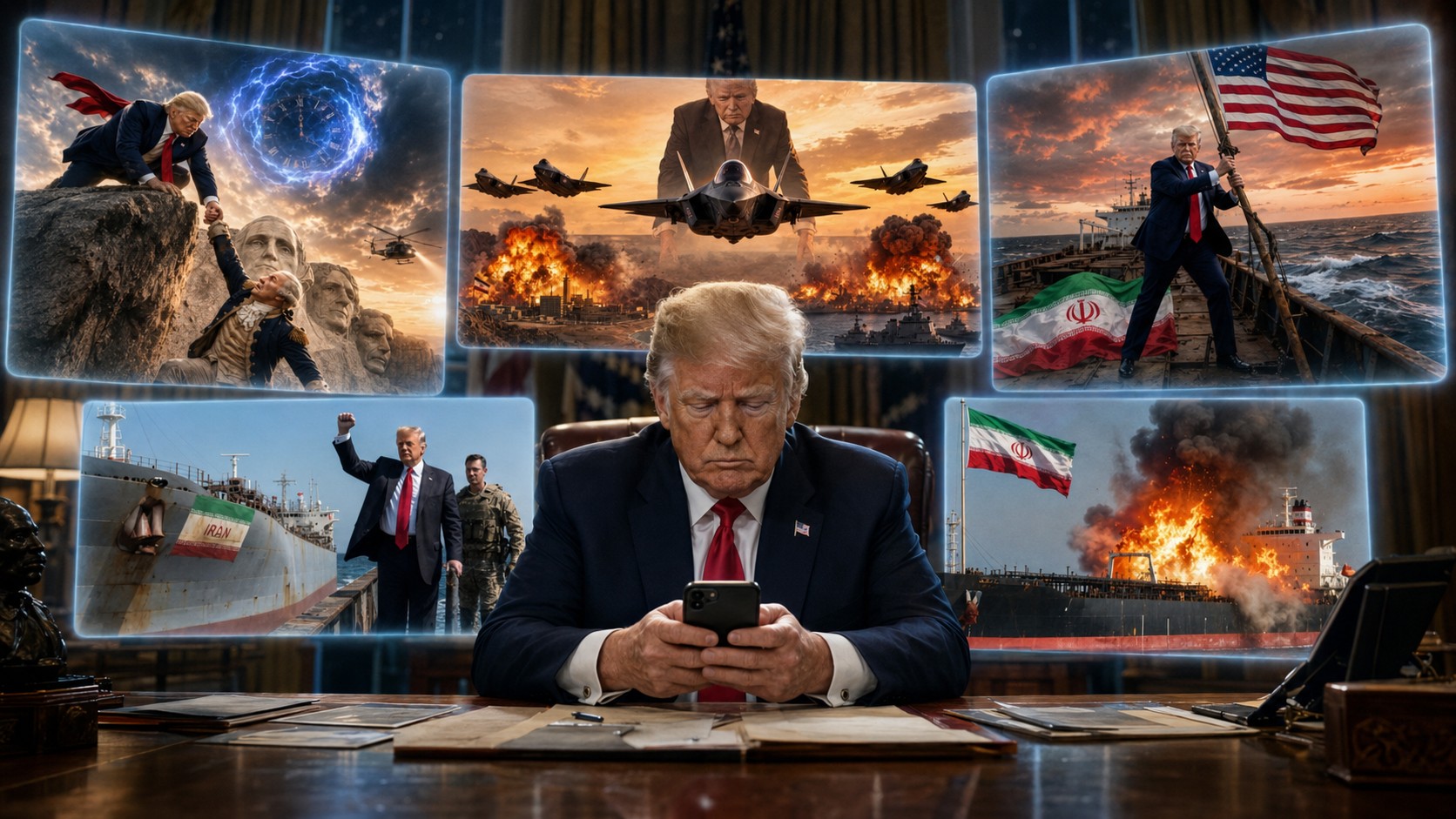
President Donald Trump spent several hours on Sunday publishing dozens of posts on Truth Social, including a stream of bizarre artificial-intelligence images portraying himself as a military commander, historical hero, global protector and possible candidate in the 2028 presidential election.
Trump reportedly published 43 posts over approximately six hours. At one stage, his account shared 16 consecutive AI-generated or digitally altered images, many without explanatory captions.
The posts ranged from attacks on journalists and celebrities to fictional film posters, military scenes and repeated “Trump 2028” references. Critics described the material as “AI slop”, a term commonly used for rapidly produced artificial content that prioritises spectacle and online engagement over accuracy or quality. Forbes

Historical figures and political enemies
One image showed Trump standing outside the White House beside President John F. Kennedy, who was assassinated in 1963.
Another appeared as a fictional Hollywood poster titled Trump X Washington, depicting Trump rescuing George Washington from Mount Rushmore while a glowing time portal opened above them.
Other images mocked CNN journalist Kaitlan Collins, musician Bruce Springsteen and television personality Rosie O’Donnell. Trump has repeatedly attacked all three, using Truth Social to target journalists, entertainers and political figures who criticise him.
Several posts showed Trump wearing “Trump 2028” clothing or appearing in campaign-style imagery. One depicted a giant coffee cup bearing the 2028 slogan towering above a crowd, while another showed the president smoking a cigar in a matching campaign hat.
The references revived questions about Trump’s repeated suggestions that he could seek another term. The US Constitution’s 22nd Amendment prohibits any person from being elected president more than twice, presenting a direct constitutional barrier to another Trump candidacy.
Military imagery dominates the feed
A substantial portion of the posting spree focused on the conflict with Iran and presented Trump and the United States as overwhelmingly powerful global actors.
Several images described America as the “Guardians of the World” or its military aircraft as “Guardian Angels of the World”. Others portrayed Trump standing on an Iranian oil tanker while holding a large American flag.
Three versions of the tanker image were reportedly published in quick succession. One showed Trump alone, another added American soldiers, and a third depicted men in stereotypical Middle Eastern clothing jumping from the vessel. The Nightly
The posts appeared as the United States paused its attacks on Iran after nearly two weeks of strikes. Iran subsequently indicated that it would suspend retaliatory attacks for as long as the American pause remained in place.
A deliberate communication strategy
Trump’s supporters frequently describe his social-media activity as humorous political trolling intended to provoke opponents and bypass traditional news organisations.
The White House has previously defended his extensive use of Truth Social as a form of direct and unfiltered communication with the public.
Critics, however, argue that the volume and increasingly fantastical nature of the imagery blur the boundaries between government communication, political propaganda and online entertainment.
The Sunday posting spree illustrated how AI-generated imagery has become a central part of Trump’s digital strategy: presenting exaggerated versions of political power, mocking opponents and ensuring that even the strangest images dominate the news cycle.
Newshub Editorial in North America – 27 July 2026

Ask NF GPT
If you have an account with ChatGPT you get deeper explanations,
background and context related to what you are reading.
Recent Comments