
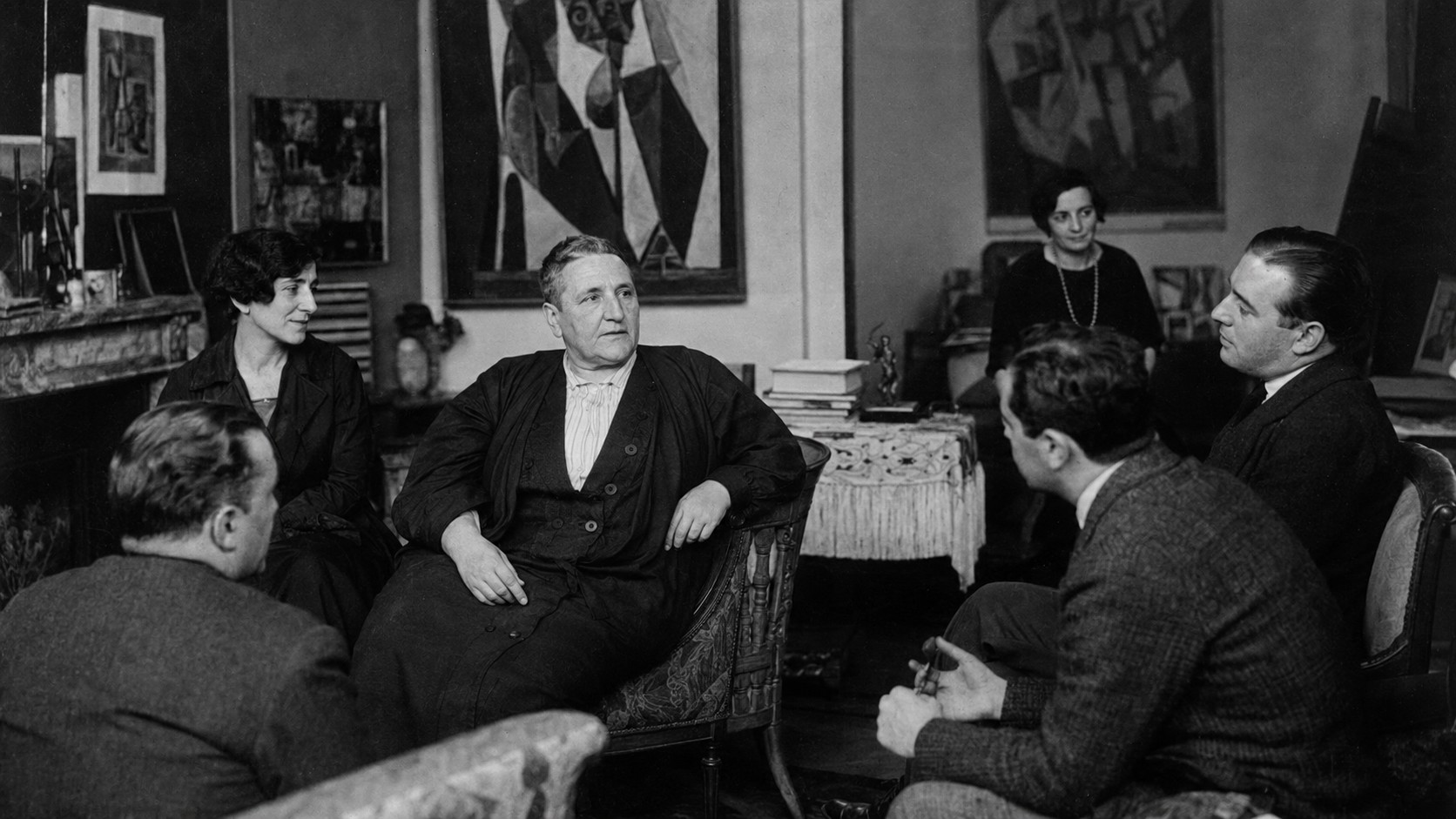
On this day in 1946, Gertrude Stein, the American writer whose Paris home became one of the most influential artistic meeting places of the early 20th century, died at the age of 72.
Stein died on 27 July 1946 in Neuilly-sur-Seine, near Paris, following surgery for stomach cancer. By the time of her death, she had become both a central figure in literary modernism and an important supporter of the artists who transformed European art.
Her experimental prose divided critics and readers, but her influence extended far beyond her own writing. Stein’s home at 27 rue de Fleurus became a celebrated salon where painters, writers, collectors and intellectuals gathered to exchange ideas and encounter new forms of artistic expression.

A gathering place for the avant-garde
Stein moved to Paris in 1903, joining her brother Leo Stein, an art critic and collector. Together, they began acquiring works by artists who were still largely unknown to the wider public.
Their collection included paintings by Pablo Picasso, Henri Matisse, Paul Cézanne and Pierre-Auguste Renoir. At a time when many critics rejected the emerging modernist movements, the Steins offered financial support, encouragement and an audience.
Saturday evening gatherings at rue de Fleurus attracted many of the leading cultural figures of the period. Picasso, Matisse, Georges Braque, Ernest Hemingway, F. Scott Fitzgerald and Ezra Pound were among those associated with Stein’s circle.
The salon became a meeting point between the visual arts and literature, helping to shape the cultural identity of Paris before and after the First World War.
An experimental literary voice
Stein approached language in much the same way that Cubist painters approached form. She disrupted traditional grammar, repeated words and phrases, and attempted to separate language from conventional narrative expectations.
Her major works included Three Lives, Tender Buttons and The Making of Americans. Although her writing was often considered difficult, it challenged established ideas about how stories, objects and identities could be represented.
Stein also wrote the phrase “Rose is a rose is a rose is a rose”, which became one of the most recognisable lines associated with literary modernism.
Her most commercially successful book was The Autobiography of Alice B. Toklas, published in 1933. Written in the voice of her lifelong partner, Alice B. Toklas, it offered an accessible and often humorous account of their lives among the artists and writers of Paris.
A complicated legacy
Stein’s position in cultural history remains complex. She was an influential woman, a Jewish American expatriate and an openly lesbian writer who created an unconventional life with Toklas. At the same time, aspects of her conduct and political associations during the German occupation of France have remained subjects of historical debate.
Nevertheless, her role in connecting artists, writers and collectors was extraordinary. Her Paris salon did not merely observe the birth of modernism; it helped provide the environment in which modernism could develop.
Gertrude Stein’s life demonstrated that cultural influence does not always come from a single masterpiece. It can also emerge from creating a space where new ideas, new people and new artistic languages are allowed to meet.
Newshub Editorial in Europe – 27 July 2026

Ask NF GPT
If you have an account with ChatGPT you get deeper explanations,
background and context related to what you are reading.
Recent Comments