
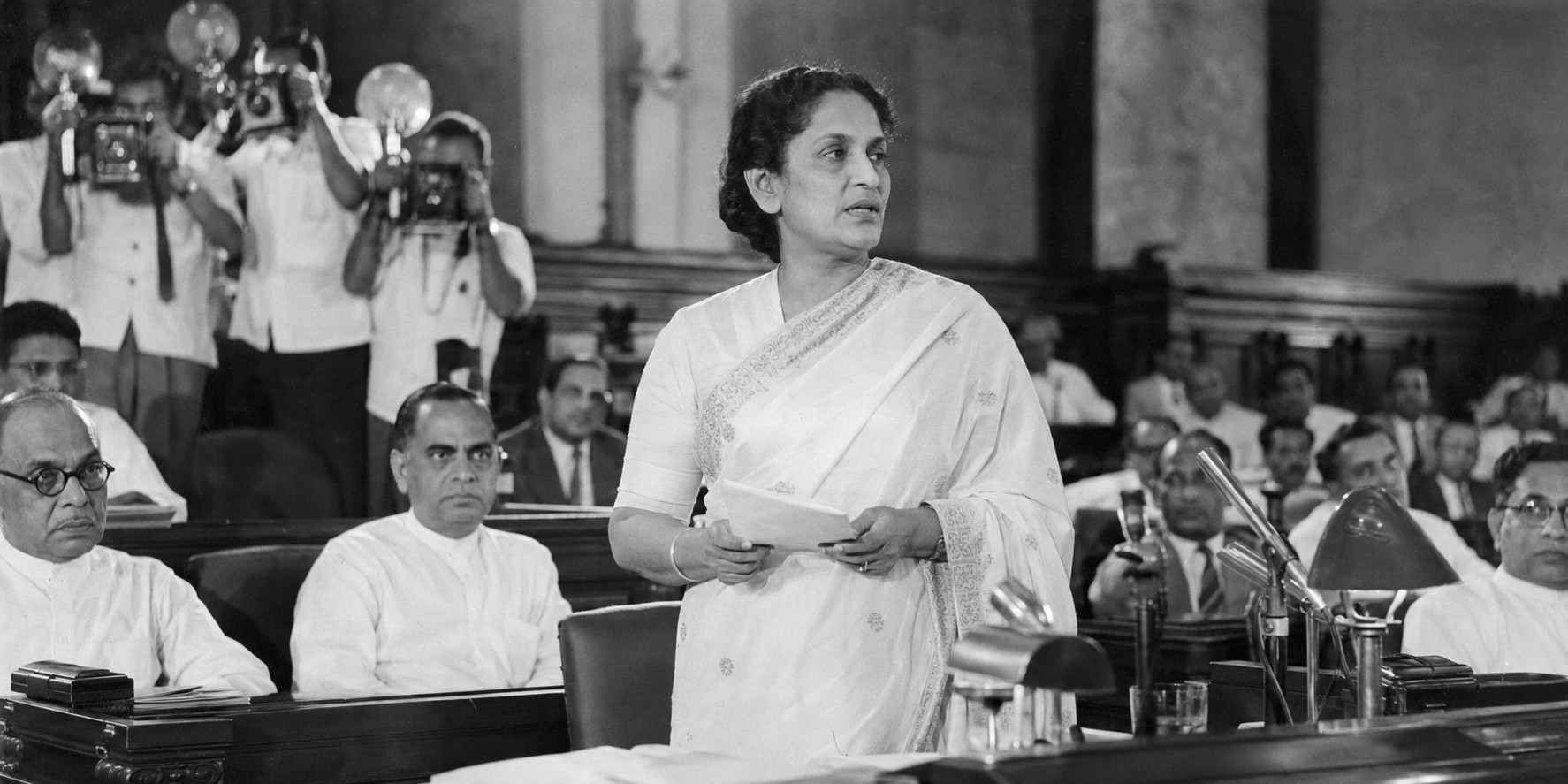
On 21 July 1960, Sirimavo Bandaranaike took office as prime minister of Ceylon, becoming the first woman in the world to lead a national government. Her appointment marked a historic breakthrough for women in politics and began a long, influential and sometimes controversial career at the centre of Sri Lankan public life.
From political widow to party leader
Bandaranaike entered frontline politics following the assassination of her husband, Prime Minister Solomon Bandaranaike, in September 1959. Although she had previously supported his political career and participated in social and charitable organisations, she had never held elected office.
After his death, the Sri Lanka Freedom Party faced internal divisions and declining public support. Party leaders persuaded Bandaranaike to assume its leadership, believing that she could preserve her husband’s political legacy and reunite the movement. Critics initially dismissed her as an inexperienced widow whose appeal rested largely on public sympathy.

Her campaign nevertheless attracted considerable support, particularly among rural voters. Bandaranaike frequently became emotional while speaking about her late husband, leading opponents to refer mockingly to her as the “weeping widow”. The description failed to prevent her from emerging as a formidable political figure.
A landmark election victory
In the parliamentary election held on 20 July 1960, the Sri Lanka Freedom Party secured a working majority. Bandaranaike was sworn in as prime minister the following day, although she was not yet a member of parliament. She subsequently entered the Senate, as permitted under Ceylon’s constitutional arrangements at the time.
Her appointment carried global significance. Women had already served in cabinets and legislatures in several countries, but no woman had previously become the head of an elected national government. Bandaranaike’s rise challenged assumptions about political leadership during an era when senior government positions remained overwhelmingly dominated by men.
A transformative and divisive programme
Bandaranaike pursued a socialist and nationalist agenda. Her government expanded state control over important parts of the economy, nationalised several industries and continued efforts to reduce the influence of institutions inherited from British colonial rule.
Her administration promoted Sinhala as the country’s principal official language and strengthened Buddhism’s position in national life. These policies appealed to many members of the Sinhalese Buddhist majority but intensified concerns among Tamil communities and contributed to ethnic and political tensions that would have lasting consequences.
Internationally, Bandaranaike became an important voice in the Non-Aligned Movement. She sought to maintain Ceylon’s independence from both Western and communist blocs during the Cold War while developing closer relations with countries across Asia and Africa.
A lasting political legacy
Bandaranaike served three separate terms as prime minister: from 1960 to 1965, from 1970 to 1977 and from 1994 to 2000. During her second administration, Ceylon adopted a new constitution and became the Republic of Sri Lanka in 1972.
Her daughter, Chandrika Kumaratunga, later became president, while Bandaranaike returned as prime minister in a role that had become less powerful under the presidential system.
Sirimavo Bandaranaike’s record remains debated, particularly because of her economic policies and the ethnic divisions associated with Sinhala nationalism. Yet her place in history is undisputed. By becoming the world’s first woman prime minister, she established a precedent that transformed perceptions of who could hold the highest levels of political power.
Newshub Editorial in Asia – 21 July 2026

Ask NF GPT
If you have an account with ChatGPT you get deeper explanations,
background and context related to what you are reading.
Recent Comments