
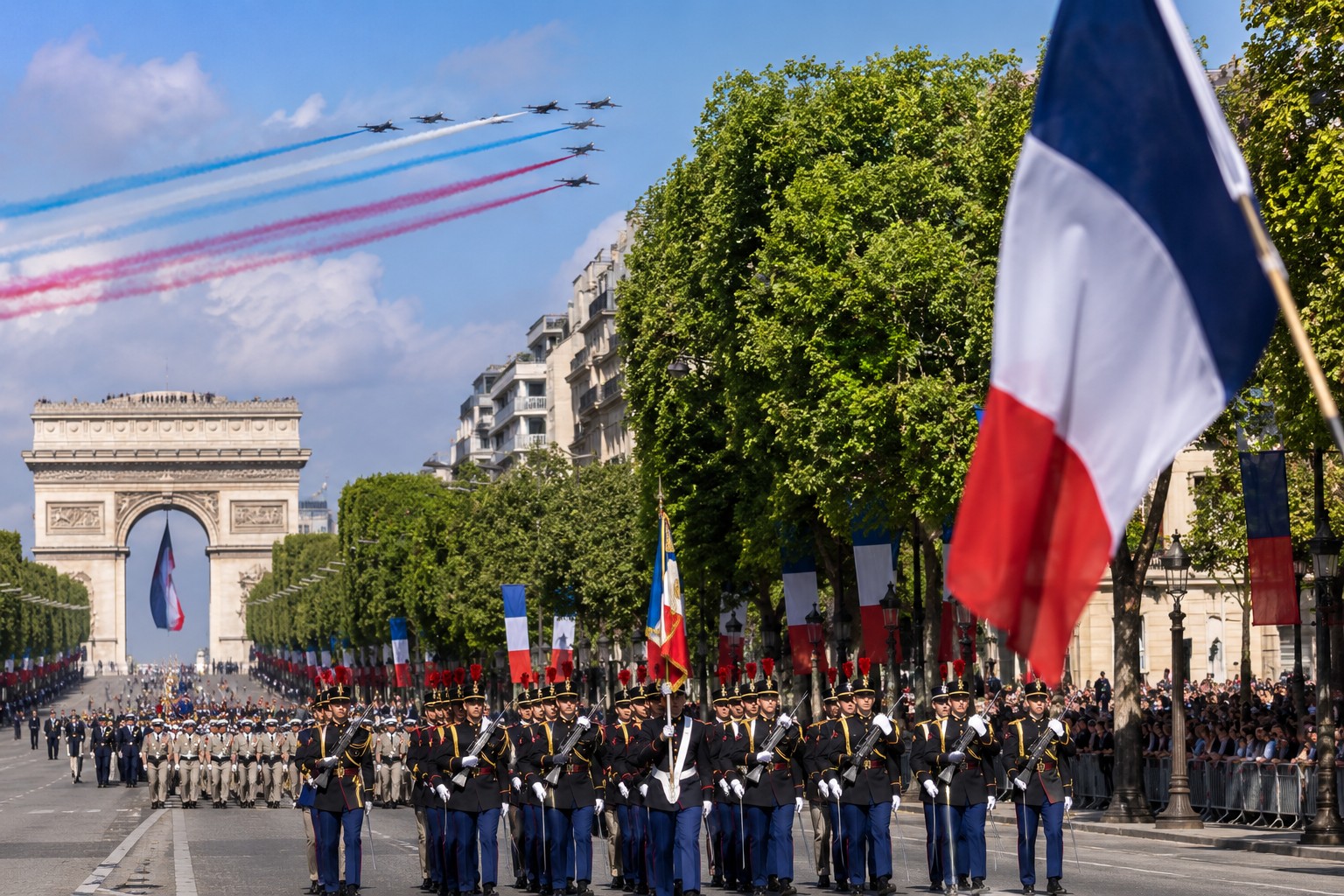
France marked Bastille Day with its traditional blend of military pageantry and national celebration on Monday, but festivities across the country were overshadowed by growing concerns over wildfires as scorching temperatures and dry conditions prompted authorities to cancel fireworks displays in several regions. While thousands gathered in Paris to watch the annual military parade along the Champs-Élysées, many communities opted for caution, reflecting a summer increasingly shaped by climate-related risks.
Paris parade showcases defence priorities
The Bastille Day parade remained the centrepiece of France’s national holiday, drawing large crowds and international attention. French President Emmanuel Macron used the occasion to underline the country’s renewed defence ambitions, describing the armed forces as central to both France’s security and what he called Europe’s “strategic awakening.”
The parade featured thousands of military personnel, armoured vehicles, cavalry units and aircraft from the French Air and Space Force, demonstrating France’s expanding investment in defence capabilities amid heightened geopolitical tensions across Europe and beyond.

Officials said this year’s event was intended not only to commemorate the storming of the Bastille in 1789 but also to highlight France’s commitment to strengthening European security in an increasingly uncertain global environment.
Fireworks cancelled in high-risk areas
Away from the capital, many municipalities scaled back or cancelled their traditional evening fireworks displays as wildfire risks continued to rise.
Regional authorities cited prolonged heat, strong winds and exceptionally dry vegetation as creating dangerous conditions that could allow even small sparks to ignite fast-moving fires. Local officials instead encouraged residents to attend concerts, cultural performances and community gatherings that posed less risk to surrounding forests and countryside.
Emergency services remained on high alert throughout the holiday, deploying additional firefighters and surveillance resources to vulnerable regions across southern and western France.
Climate pressures reshape summer traditions
France has experienced increasingly severe wildfire seasons in recent years, mirroring trends seen across southern Europe as climate change contributes to hotter temperatures, prolonged droughts and more frequent extreme weather events.
Government agencies have expanded prevention campaigns, introduced stricter fire restrictions and invested in additional firefighting aircraft and emergency response capabilities. Despite these measures, authorities continue to urge residents and tourists to exercise caution when visiting forests, national parks and rural areas during the summer months.
The changing climate has begun to influence long-standing public celebrations, with local governments increasingly weighing public safety against tradition.
Balancing celebration and resilience
Despite the cancellations, Bastille Day retained its symbolic importance as a celebration of the French Republic, bringing together communities through concerts, ceremonies and public events across the country.
The contrast between the confidence displayed during the Paris military parade and the caution exercised elsewhere illustrated the complex challenges facing modern France. Alongside geopolitical uncertainty and rising defence spending, climate resilience has become an equally prominent national priority.
As Europe continues to confront both security concerns and environmental pressures, this year’s Bastille Day served as a reminder that national strength is increasingly measured not only by military capability but also by a country’s ability to adapt to a rapidly changing world.
Newshub Editorial – Europe – July 14, 2026

Ask NF GPT
If you have an account with ChatGPT you get deeper explanations,
background and context related to what you are reading.
Open an account
Recent Comments