
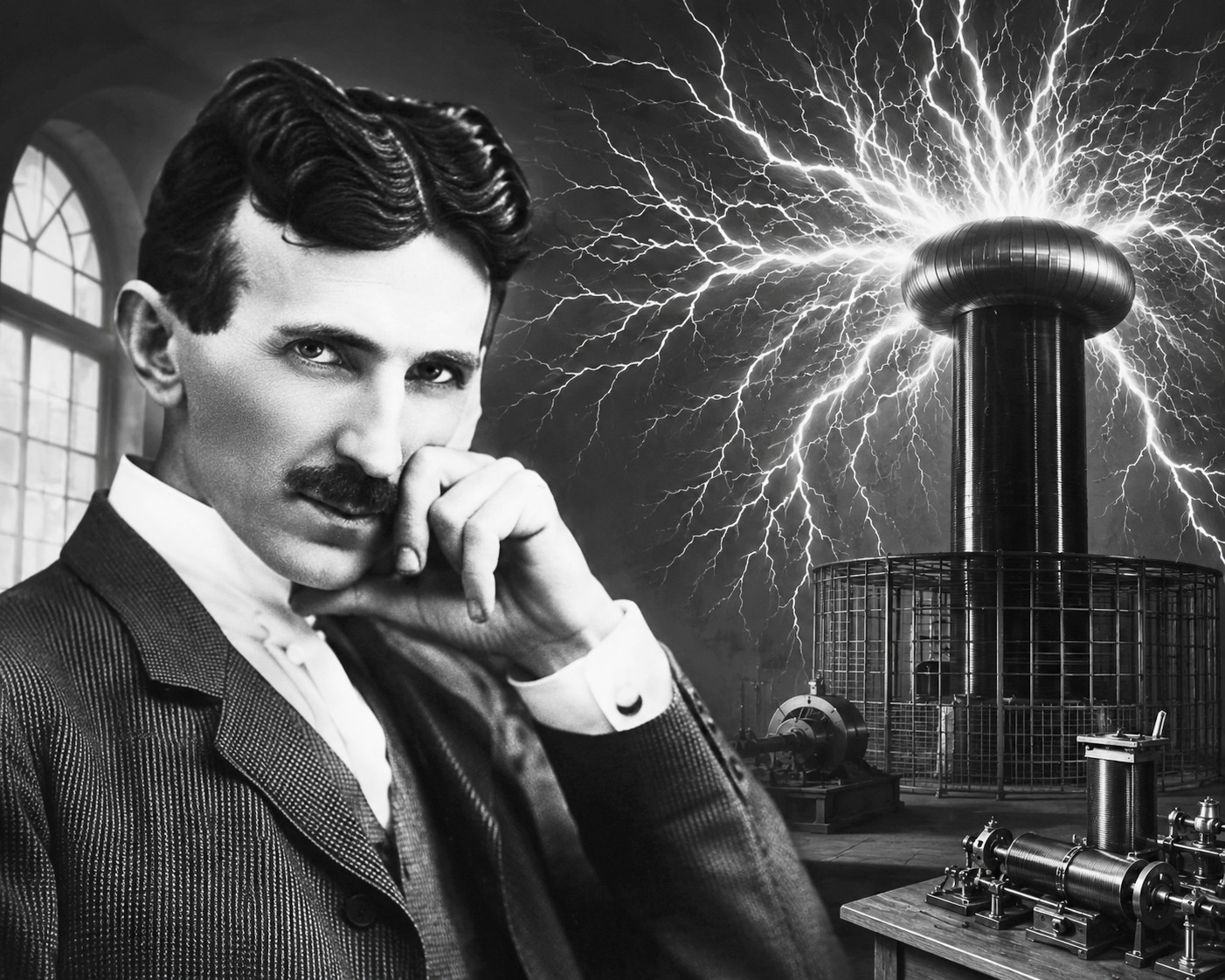
Long before the digital age transformed daily life, Nikola Tesla was imagining a world connected by wireless communication, renewable energy and intelligent machines. Although many of his ideas were considered impossible during his lifetime, the Serbian-American inventor laid much of the scientific foundation for the electrical systems that power modern civilisation. Today, more than 80 years after his death, Tesla remains one of history’s most celebrated innovators and an enduring symbol of scientific imagination.
From a small village to global influence
Nikola Tesla was born on 10 July 1856 in the village of Smiljan, then part of the Austrian Empire and today located in Croatia. Raised in a family that valued education and intellectual curiosity, he displayed an extraordinary memory and an early fascination with engineering. After studying electrical engineering in Europe, Tesla emigrated to the United States in 1884 with little more than a letter of recommendation and a vision for the future.
His arrival in New York marked the beginning of one of the most remarkable scientific careers in modern history.

The battle of the currents
Tesla initially worked for Thomas Edison, whose direct current (DC) electrical system dominated early power distribution. However, Tesla believed that alternating current (AC) offered a far more efficient method of transmitting electricity over long distances.
The disagreement led to one of history’s greatest technological rivalries, often referred to as the “War of the Currents”. Backed by industrialist George Westinghouse, Tesla developed the AC induction motor and a complete alternating current system that eventually became the global standard.
The successful use of AC power at the Niagara Falls hydroelectric project in 1895 demonstrated its superiority and helped establish the electrical grid model still used across much of the world.
A mind decades ahead of its time
Tesla’s work extended far beyond electrical power. Throughout his career he registered more than 300 patents covering a wide range of inventions and concepts.
His pioneering research included wireless energy transmission, radio communication, remote control technology, high-frequency electricity, X-ray experimentation and resonant transformers, leading to the famous Tesla Coil. In 1898 he astonished audiences by demonstrating a radio-controlled boat, effectively introducing the concept of remote-controlled machines decades before they became commercially viable.
Many historians now view Tesla as one of the earliest visionaries of robotics, wireless communication and automated systems.
Brilliance overshadowed by financial struggle
Despite his scientific achievements, Tesla was not a successful businessman. He often prioritised research over commercial success, investing his own resources into ambitious projects that failed to secure lasting financial backing.
One of his most famous ventures, Wardenclyffe Tower on Long Island, was intended to transmit wireless electricity and global communications. Funding collapsed before the project could be completed, and the tower was eventually demolished.
During his later years Tesla lived modestly in New York hotels, continuing to work on theoretical concepts while attracting both admiration and scepticism from the scientific community.
A legacy that continues to grow
Nikola Tesla died on 7 January 1943 at the age of 86, leaving behind a body of work that has only become more appreciated with time. Today his name is associated with scientific innovation, creativity and technological progress.
The SI unit of magnetic flux density, the tesla (T), bears his name, while numerous research institutions, museums and engineering awards commemorate his achievements. His influence can also be seen in the electric vehicle manufacturer Tesla, Inc., which chose his name to honour the inventor’s pioneering contributions to electrical engineering.
More than a century after his greatest discoveries, Tesla’s vision of an interconnected, electrically powered world has become reality. His inventions continue to shape industries ranging from renewable energy and telecommunications to robotics and artificial intelligence, ensuring that his extraordinary legacy remains firmly embedded in the foundations of modern technology.
Newshub Editorial – Europe, 9 July 2026

Ask NF GPT
If you have an account with ChatGPT you get deeper explanations,
background and context related to what you are reading.
Recent Comments