
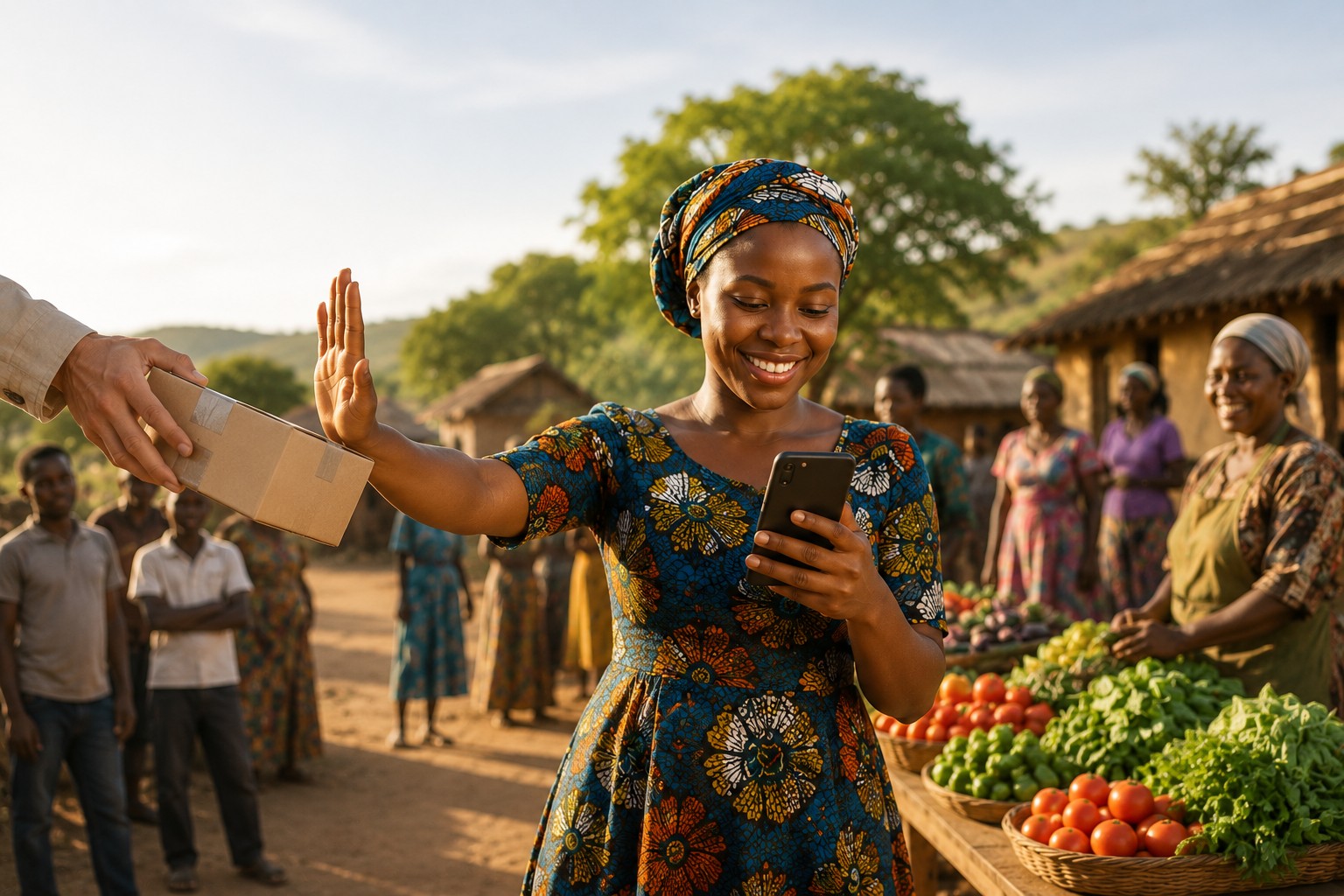
Why financial inclusion deserves to stand alongside roads, schools and electricity as essential development infrastructure
Every generation eventually discovers that lasting development is not created by a single project. It is created by systems.
During the twentieth century, governments and development institutions invested heavily in what became known as development infrastructure. Roads connected villages to markets, ports connected nations to trade, schools developed human capital, hospitals protected health, electricity powered industry, and telecommunications connected people and information.
No serious nation would consider these investments optional. They are recognised as the foundations upon which modern economies are built. Yet one essential form of infrastructure has often remained largely absent from the discussion: financial infrastructure.
This is not about banks as buildings, nor finance as speculation. It is about the everyday systems that allow ordinary people to receive payments, save securely, build financial histories, access responsible credit, insure against risk and participate fully in economic life. In other words, it is about financial inclusion. Perhaps it deserves to be recognised as infrastructure in exactly the same way as roads, electricity and communications.

Throughout this series we have followed the journey of development itself. We began beside a rusty sign marking a project that had disappeared. We followed development funding through increasingly complex systems, examined why good intentions do not always become lasting change and discovered that millions of people—especially women—are already building businesses every day. The missing ingredient was rarely ambition. It was access, and that distinction changes everything.
If poverty were simply a lack of motivation, the solution would be inspiration. If it were simply a lack of knowledge, the solution would be education alone. If it were simply a lack of money, the solution would be transfers of resources.
Experience suggests something more complex. People work, trade, save, innovate, cooperate and solve problems every single day. Yet millions remain disconnected from the systems that allow effort to become lasting prosperity. The challenge is therefore not simply one of income; it is one of connection—connection to markets, finance, opportunity and trust, and connection to institutions that recognise people’s work. That is why financial inclusion matters: it connects effort with opportunity.
A road allows a farmer to transport crops. A mobile network allows customers to communicate. A payment system allows value to move. A savings account allows today’s earnings to become tomorrow’s investment. A financial identity allows reliability to replace assumptions. Responsible credit allows businesses to grow steadily instead of depending upon luck, while insurance allows families to recover instead of beginning again after every crisis.
Each of these systems reinforces the others. Together they create resilience, and that is the true purpose of infrastructure. Infrastructure does not create development by itself; it makes development possible.
Emergency assistance and long-term development
This is also why financial inclusion should never be presented as a replacement for humanitarian assistance. When earthquakes destroy cities, when war forces families to flee, when drought destroys harvests or epidemics spread, the world has both a moral obligation and a practical responsibility to respond. Emergency assistance saves lives, and nothing in this series argues otherwise.
Humanitarian assistance and long-term development, however, pursue different objectives. One protects life; the other builds opportunity. Both are indispensable, and neither replaces the other. Perhaps that is the most important lesson.
Development should ultimately be measured not by how much assistance arrives, but by how little permanent assistance eventually becomes necessary. The greatest success of any development programme should be that people no longer depend upon it. That is not failure; it is success. It means local businesses are growing, families are managing risk, women are expanding enterprises, young people are creating opportunities close to home, markets are functioning and communities are financing their own future. Development has become self-sustaining, and that should always be the goal.
Measuring what really matters
Perhaps this also requires a different way of measuring success. For decades, development has often been evaluated by the scale of the intervention rather than by the durability of its results. Reports have counted the amount of money spent, the number of workshops delivered or the quantity of equipment distributed. Those indicators are easy to measure, but they do not necessarily tell us whether development has actually taken root.
A more meaningful approach would begin with different questions. Instead of asking, “How much money did we spend?”, we might ask: How many businesses became sustainable? How many women achieved lasting financial independence? How many young entrepreneurs created employment? How many farming families became resilient to climate shocks? How many communities can now continue without external support?
Those questions measure something more valuable than delivery. They measure freedom. Because freedom is not only political; freedom is also economic. It is the freedom to choose, to save and to invest. It is the freedom to recover after failure instead of being permanently trapped by it. It is the freedom to support one’s family, to plan beyond tomorrow and, ultimately, to build rather than merely survive.
This understanding changes the way we think about development itself. It shifts the focus away from dependency and towards capability. It recognises that the objective is not to keep people within programmes indefinitely, but to equip them with the tools that allow them to leave those programmes behind.
Connecting people to opportunity
This is why financial inclusion deserves to stand alongside roads, schools, electricity and communications as one of the essential foundations of modern development. Not because it solves every problem—it does not. Good governance still matters. Education still matters. Healthcare still matters. Justice still matters. Peace still matters.
But without inclusive financial systems, millions of productive people remain disconnected from the very economy they are already helping to build. They may produce goods, provide services, cultivate land or operate small businesses, yet still remain invisible to the financial institutions capable of supporting their growth.
Infrastructure has always existed for one purpose: to connect. Roads connect places. Electricity connects energy. Telecommunications connect information. Financial inclusion connects people to opportunity.
That simple observation may prove to be one of the most important lessons in modern development policy. Throughout this series, the recurring challenge has never been the absence of human potential. It has been the absence of systems capable of unlocking that potential. Again and again, we have seen that people already possess the willingness to work, innovate and improve their lives. What they often lack is access to the institutions that transform effort into lasting economic progress.
Perhaps the future of development will therefore not be defined by choosing between aid and markets, nor by choosing between governments and entrepreneurs, or compassion and commerce. Those are increasingly false choices. The more important task is to build systems that allow each of those elements to reinforce one another.
Development succeeds when governments create stable institutions, when markets provide opportunity, when finance is inclusive rather than exclusive and when humanitarian assistance supports people through crises without becoming a permanent substitute for economic participation.
In such a system, opportunity no longer depends upon geography, wealth or social status. It depends upon whether people can participate fully in the economy around them.
That is the true purpose of infrastructure.
Development becomes freedom
If development is ultimately about expanding people’s opportunities, then the measure of success cannot simply be the number of projects completed or the volume of aid distributed. Success must instead be judged by whether people gain the ability to shape their own future.
When that future is built on dignity instead of dependency, participation instead of exclusion and opportunity instead of permanent assistance, development becomes something greater than a collection of projects. It becomes a process through which individuals, families and communities acquire the capacity to determine their own economic destiny.
That is the broader argument running through this entire series. Development is not a product that can be delivered, nor is it a destination that can be reached through funding alone. It is a system of relationships, institutions and opportunities that allows people to convert their own effort into lasting prosperity. Financial inclusion is one of the critical components of that system because it enables people to participate rather than merely observe.
When people can save securely, borrow responsibly, insure against risk, receive digital payments and establish a financial identity, they are no longer operating at the margins of the economy. They become recognised participants within it. They can invest with greater confidence, withstand setbacks more effectively and plan for the future with a degree of certainty that was previously impossible.
That transformation does not remove the need for effective government, functioning markets or international cooperation. On the contrary, it depends upon them. Financial inclusion cannot compensate for conflict, corruption or weak institutions. Nor can it replace education, healthcare or the rule of law. These remain essential pillars of sustainable development.
What financial inclusion can do is connect those pillars. It provides the mechanism through which education leads to employment, entrepreneurship leads to investment, agricultural production leads to expanding markets and economic growth reaches people who have traditionally remained outside the formal financial system.
Infrastructure has always existed to create connections. Roads connect places. Electricity connects energy. Telecommunications connect information. Financial inclusion connects people to opportunity.
Perhaps the future of development will therefore not be defined by choosing between aid and markets, governments and entrepreneurs or compassion and commerce. Those are increasingly false choices. The real challenge is to build systems that allow all of these elements to reinforce one another, creating societies that are more resilient, more inclusive and ultimately more self-sustaining.
If that can be achieved, development ceases to be measured by the scale of external assistance and begins to be measured by the strength of local capability. Communities finance their own future. Businesses expand because opportunity exists rather than because subsidies continue indefinitely. Families accumulate assets instead of merely coping with crisis. Young people create employment rather than waiting for it to arrive.
Development then becomes something greater than projects.
It becomes freedom. And perhaps that has been the real objective all along.
Epilogue
This series has explored ideas. The next step is to explore people.
In the articles that follow, theory will give way to reality. We will meet women who transformed small market stalls into thriving businesses, farmers who expanded production through access to finance, families who built resilience through savings and entrepreneurs who proved what becomes possible when opportunity is connected to effort.
These are not extraordinary people. They are ordinary people whose potential became visible once the right systems were in place.
Their stories may become the strongest argument of all. Statistics can explain development. Policies can shape development. Technology can enable development. But in the end, it is people who build development, and it is their stories that prove it.
Peter Rinaldo
Facts Behind This Article
- OECD – Official Development Assistance
- World Bank – Global Findex Database
- International Labour Organization – Informal Economy Reports
- United Nations Development Programme
- Paris Declaration on Aid Effectiveness (2005)

Ask NF GPT
If you have an account with ChatGPT you get deeper explanations,
background and context related to what you are reading.
Recent Comments