
• Global
    • Africa
      • Burundi
      • Ghana
      • Gambia
      • Senegal
    • Asia
      • Indonesia
      • Laos
      • Malaysia
      • South Korea
    • Caribbean
      • Central America
    • Climate & energy
      • Climate
      • Carbon
      • Coal
      • Disruptive
      • Gas
      • Nuclear
      • Oil
      • Solar
      • Water
      • Waves
      • Wind
      • Renewable
      • South America
    • Lifestyle
      • Best chefs
      • Cocktail of the week
      • History
      • Influential women
      • Newshub long-read
    • US politics
      • Epstein
    • War
  • Finance
    • Africa finance
    • Australia
    • Asia finance
    • Banking
    • Business of the week
    • Central Banks
    • China
    • Commodities
    • Corporate
    • Europe
    • Investment
    • Japan
    • MSTRpay
    • Neobanking
    • South East Asia
    • UK
    • US
  • Fintech
    • Tech
    • AI
    • Blockchain
  • Financial inclusion
  • Editorial services
  • Press releases
Sunday, July 5, 2026
  • Login
No Result
View All Result
Newshub Finance
  • Global
    • Africa
      • Burundi
      • Ghana
      • Gambia
      • Senegal
    • Asia
      • Indonesia
      • Laos
      • Malaysia
      • South Korea
    • Caribbean
      • Central America
    • Climate & energy
      • Climate
      • Carbon
      • Coal
      • Disruptive
      • Gas
      • Nuclear
      • Oil
      • Solar
      • Water
      • Waves
      • Wind
      • Renewable
      • South America
    • Lifestyle
      • Best chefs
      • Cocktail of the week
      • History
      • Influential women
      • Newshub long-read
    • US politics
      • Epstein
    • War
  • Finance
    • Africa finance
    • Australia
    • Asia finance
    • Banking
    • Business of the week
    • Central Banks
    • China
    • Commodities
    • Corporate
    • Europe
    • Investment
    • Japan
    • MSTRpay
    • Neobanking
    • South East Asia
    • UK
    • US
  • Fintech
    • Tech
    • AI
    • Blockchain
  • Financial inclusion
  • Editorial services
  • Press releases
  • Global
    • Africa
      • Burundi
      • Ghana
      • Gambia
      • Senegal
    • Asia
      • Indonesia
      • Laos
      • Malaysia
      • South Korea
    • Caribbean
      • Central America
    • Climate & energy
      • Climate
      • Carbon
      • Coal
      • Disruptive
      • Gas
      • Nuclear
      • Oil
      • Solar
      • Water
      • Waves
      • Wind
      • Renewable
      • South America
    • Lifestyle
      • Best chefs
      • Cocktail of the week
      • History
      • Influential women
      • Newshub long-read
    • US politics
      • Epstein
    • War
  • Finance
    • Africa finance
    • Australia
    • Asia finance
    • Banking
    • Business of the week
    • Central Banks
    • China
    • Commodities
    • Corporate
    • Europe
    • Investment
    • Japan
    • MSTRpay
    • Neobanking
    • South East Asia
    • UK
    • US
  • Fintech
    • Tech
    • AI
    • Blockchain
  • Financial inclusion
  • Editorial services
  • Press releases
No Result
View All Result
Newshub Finance
No Result
View All Result
Download MSTRpay app Download MSTRpay app Download MSTRpay app
ADVERTISEMENT

3. Where the Aid Money Goes

3. Where the Aid Money Goes

Following the journey from donor to beneficiary
Every year, governments and international organisations announce billions of dollars for development. Millions for education. Millions for healthcare. Millions for food security. Millions for women’s empowerment. Millions for rural development.

To the public in donor countries, the message is simple: money has been allocated to help people in need. To the communities meant to benefit, the expectation is equally simple: help is coming. Between those two points lies a much longer journey. The obvious question is therefore not how much money is committed. It is how much of that money reaches the people whose lives it was intended to improve.

Development funding rarely moves directly from donor to beneficiary
It commonly passes through ministries, development agencies, embassies, international organisations, consulting firms, contractors, procurement systems, international NGOs, local NGOs, local authorities and implementing partners before reaching the community itself.


Download the MSTRpay app Download the MSTRpay app Download the MSTRpay app
  • Each layer performs an important function.
  • Each layer also consumes resources.

Administration is necessary. Professional staff must be paid. Security must be managed. Audits matter.

Monitoring is essential
Development work in fragile states is often difficult, expensive and dangerous. None of these realities should be ignored. But every additional layer also creates something else.

Distance
Distance from the original purpose. Distance from the people. Distance from accountability. And distance is often where development loses much of its power. This does not mean that aid is inherently corrupt. That would be both inaccurate and unfair.

Humanitarian organisations save lives every day under extremely difficult conditions. Vaccination campaigns, disaster relief, refugee protection and emergency medical programmes have transformed millions of lives.

The question is not whether aid can do good
The question is why so much development funding produces less lasting change than many had hoped.

Part of the answer lies in the structure of the system itself.

Aid is often presented as a direct act of solidarity: one society helping another. In reality, it is also an industry. It has budgets. Institutions. Consultants. Conferences. Procurement systems. Reporting requirements. Career structures. Subcontractors. And organisational interests.

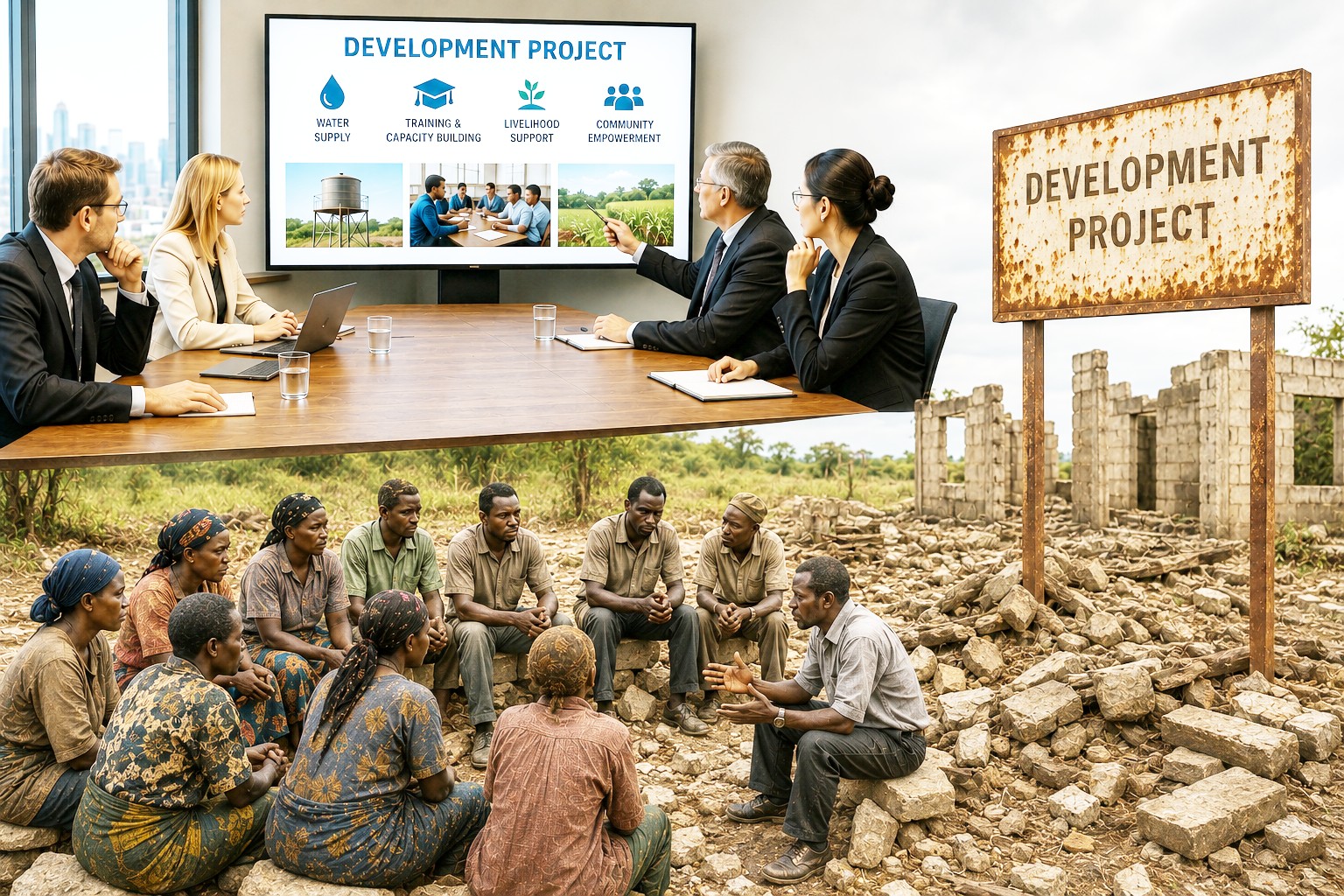
A project may be designed in one country, approved in another, implemented by an international agency, subcontracted to a national partner and finally delivered through local organisations. By the time it reaches the village, it has already passed through many hands.

Sometimes the losses are simply administrative
Sometimes they appear as consultancy costs, procurement expenses, international travel, hotels, workshops and reporting systems. Sometimes they are more direct. Kickbacks. Ghost beneficiaries. Inflated procurement. Fake invoices. Invented workshops. Political patronage. Local gatekeepers controlling access to projects. Reports written to satisfy donors rather than describe reality.

Perhaps the most important observation is that this is not only a problem on one side. Corruption in development is not a story of honest donors and dishonest recipients. It is a systemic risk that exist throughout the entire chain.

In donor countries, development budgets may support domestic consultants, contractors and political priorities. Some aid remains tied—formally or informally—to goods and services purchased from the countries providing the funding.

In recipient countries, projects may be captured by political elites, professional intermediaries or local gatekeepers who have become experts in the language of development.Between these two worlds, an aid economy can emerge that sometimes serves itself as effectively as it serves the people it was created to help.

This is where corruption becomes something more than theft. It becomes a development structure that rewards access instead of productivity. Connections instead of competence. Gatekeepers instead of entrepreneurs. Those who control the flow of money rather than those who create economic value.

At the local level, this may mean that funding intended for a women’s cooperative is reduced by informal fees, inflated procurement or political influence. The women receive training. Perhaps a few tools. But not the working capital, customers or financial systems needed to build a sustainable business.

At the national level, the picture can become even more complex. Development assistance does not operate in isolation from geopolitics. In parts of Africa, the economic structures established during the colonial period have often evolved rather than disappeared. Questions of resource extraction, strategic influence, security cooperation and economic dependency continue to shape international relationships.

Countries such as Niger, Mali and Burkina Faso illustrate how debates about natural resources, sovereignty and development remain closely connected.

The point is not that every aid project serves geopolitical interests. The point is that development never exists entirely outside politics or power. This is an uncomfortable reality but ignoring it does not make it disappear.

Corruption also has another consequence that receives too little attention
It destroys trust. Communities lose confidence in institutions. Donors become suspicious of local organisations. Local organisations spend increasing amounts of time proving themselves to donors instead of serving the communities they exist to support. Development gradually becomes an exercise in reporting rather than an exercise in transformation.

For women trying to build businesses, the consequences are often particularly severe. Limited access to capital is already difficult. Limited collateral. Irregular income. Cash-based trading. Family responsibilities. Weak infrastructure. Corruption makes every obstacle larger.

A licence may require an informal payment. A market stall may depend upon political connections. A project intended to support women may become captured by those who administer it rather than those it was meant to benefit. Corruption therefore does more than divert money. It diverts opportunity. It changes the rules under which development takes place. Simply increasing development budgets cannot solve this problem if the underlying structures remain unchanged. The real challenge is not only how much money is spent. It is how transparently it moves. How much authority reaches local communities. How much ownership remains after donors leave. How much trust is created instead of dependency. Development funding should therefore become more transparent. Communities should know how much money has been allocated. Who received it. What it was intended to achieve. Who is responsible for maintaining the result.

Local organisations should increasingly become genuine partners rather than the final subcontractors in a long administrative chain. Reports should measure what survives—not only what was delivered. Because in the end, development is not measured by the number of projects completed -it is measured by the number of communities that no longer need those projects.

This investigation has followed the money
The next article follows something far more important.

The people!

Because perhaps the greatest untapped development resource in the world has never been hidden inside aid budgets at all. Perhaps it has been working every morning in the markets, workshops, farms and small businesses of the developing world. The question is not whether these people are capable.

The question is why the financial system has never truly learned to see them.

Peter Rinaldo

Facts Behind This Article

  • OECD – Official Development Assistance
  • World Bank – Global Findex Database
  • International Labour Organization – Informal Economy Reports
  • United Nations Development Programme
  • Paris Declaration on Aid Effectiveness (2005)
No Result
View All Result

Recent Posts

  • Trump hails ‘golden age of America’ at 250th anniversary celebration
  • 3. Where the Aid Money Goes
  • On this day in 1975: 1975 Arthur Ashe defeated Jimmy Connors in four sets of tennis at the 89th Wimbledon Championships.
  • The invisible infrastructure: The standards that make the world work
  • US senator proposes ban on elected officials issuing memecoins

Recent Comments

    Archives

    • July 2026
    • June 2026
    • May 2026
    • April 2026
    • March 2026
    • February 2026
    • January 2026
    • December 2025
    • November 2025
    • October 2025
    • September 2025
    • August 2025
    • July 2025
    • June 2025
    • May 2025
    • April 2025
    • March 2025
    • February 2025
    • January 2025
    • December 2024
    • November 2024
    • October 2024
    • September 2024
    • August 2024
    • July 2024
    • June 2024
    • May 2024
    • April 2024
    • March 2024
    • February 2024
    • January 2024
    • December 2023
    • November 2023
    • October 2023
    • September 2023
    • August 2023
    • July 2023
    • June 2023
    • May 2023
    • April 2023
    • March 2023
    • February 2023
    • January 2023
    • December 2022
    • November 2022
    • October 2022
    • September 2022
    • August 2022

    Categories

    • Africa
    • Africa finance
    • AI
    • An diesem Tag
    • Asia
    • Asia finance
    • Australia
    • Banking
    • Best chefs
    • Biden
    • Blockchain
    • Burundi
    • Business of the week
    • Carbon
    • Caribbean
    • Central America
    • Central Banks
    • China
    • Climate
    • Climate & Energy
    • Coal
    • Cocktail of the week
    • Commodities
    • Corporate
    • Deutsch
    • Deutsch PR
    • Digital Banking
    • DRC
    • English PR
    • Epstein
    • Europe
    • Financial inclusion
    • Financial insights
    • Focus on neobanking
    • Gambia
    • Gas
    • Ghana
    • Global news
    • Harris
    • History
    • India
    • India
    • Indonesia
    • Influential women
    • Invest and Rest
    • Investment
    • Italiano PR
    • Jamaica
    • Japan
    • Kenya
    • Kenya
    • Laos
    • Laos
    • LATAM
    • Lifestyle
    • Malaysia
    • Metaverse
    • MSTRpay
    • Neobanking
    • News
    • Newshub long-read
    • newshub special
    • newshub-special
    • NFT
    • Nobel Prizes 2024
    • Nuclear
    • Oil
    • Philippines
    • Press
    • Press releases
    • Pressroom
    • Renewable
    • Russia
    • Senegal
    • Senegal
    • Solar
    • South America
    • South East Asia
    • South Korea
    • South Korea
    • Stocks
    • Svensk PR
    • Tech
    • Trump
    • Trump trials
    • UFO
    • Uganda
    • UK
    • UK News
    • Ukraine
    • US
    • US politics
    • Vietnam
    • Vietnam
    • War
    • Waves
    • WEX
    • Wind
    • World safety

    Meta

    • Log in
    • Entries feed
    • Comments feed
    • WordPress.org

    Recent Posts

    • Trump hails ‘golden age of America’ at 250th anniversary celebration
    • 3. Where the Aid Money Goes
    • On this day in 1975: 1975 Arthur Ashe defeated Jimmy Connors in four sets of tennis at the 89th Wimbledon Championships.
    • The invisible infrastructure: The standards that make the world work
    • US senator proposes ban on elected officials issuing memecoins

    Categories

    • Africa
    • Africa finance
    • AI
    • An diesem Tag
    • Asia
    • Asia finance
    • Australia
    • Banking
    • Best chefs
    • Biden
    • Blockchain
    • Burundi
    • Business of the week
    • Carbon
    • Caribbean
    • Central America
    • Central Banks
    • China
    • Climate
    • Climate & Energy
    • Coal
    • Cocktail of the week
    • Commodities
    • Corporate
    • Deutsch
    • Deutsch PR
    • Digital Banking
    • DRC
    • English PR
    • Epstein
    • Europe
    • Financial inclusion
    • Financial insights
    • Focus on neobanking
    • Gambia
    • Gas
    • Ghana
    • Global news
    • Harris
    • History
    • India
    • India
    • Indonesia
    • Influential women
    • Invest and Rest
    • Investment
    • Italiano PR
    • Jamaica
    • Japan
    • Kenya
    • Kenya
    • Laos
    • Laos
    • LATAM
    • Lifestyle
    • Malaysia
    • Metaverse
    • MSTRpay
    • Neobanking
    • News
    • Newshub long-read
    • newshub special
    • newshub-special
    • NFT
    • Nobel Prizes 2024
    • Nuclear
    • Oil
    • Philippines
    • Press
    • Press releases
    • Pressroom
    • Renewable
    • Russia
    • Senegal
    • Senegal
    • Solar
    • South America
    • South East Asia
    • South Korea
    • South Korea
    • Stocks
    • Svensk PR
    • Tech
    • Trump
    • Trump trials
    • UFO
    • Uganda
    • UK
    • UK News
    • Ukraine
    • US
    • US politics
    • Vietnam
    • Vietnam
    • War
    • Waves
    • WEX
    • Wind
    • World safety

    Archives

    • July 2026
    • June 2026
    • May 2026
    • April 2026
    • March 2026
    • February 2026
    • January 2026
    • December 2025
    • November 2025
    • October 2025
    • September 2025
    • August 2025
    • July 2025
    • June 2025
    • May 2025
    • April 2025
    • March 2025
    • February 2025
    • January 2025
    • December 2024
    • November 2024
    • October 2024
    • September 2024
    • August 2024
    • July 2024
    • June 2024
    • May 2024
    • April 2024
    • March 2024
    • February 2024
    • January 2024
    • December 2023
    • November 2023
    • October 2023
    • September 2023
    • August 2023
    • July 2023
    • June 2023
    • May 2023
    • April 2023
    • March 2023
    • February 2023
    • January 2023
    • December 2022
    • November 2022
    • October 2022
    • September 2022
    • August 2022
    • Global
    • Finance
    • Fintech
    • Financial inclusion
    • Editorial services
    • Press releases
    Legal - Disclosure - Cookies

    © 2022-2026
    MSTRpay/Newshub Finance

    Welcome Back!

    Login to your account below

    Forgotten Password?

    Retrieve your password

    Please enter your username or email address to reset your password.

    Log In

    Add New Playlist

    No Result
    View All Result
    • Global
      • Africa
        • Burundi
        • Ghana
        • Gambia
        • Senegal
      • Asia
        • Indonesia
        • Laos
        • Malaysia
        • South Korea
      • Caribbean
        • Central America
      • Climate & energy
        • Climate
        • Carbon
        • Coal
        • Disruptive
        • Gas
        • Nuclear
        • Oil
        • Solar
        • Water
        • Waves
        • Wind
        • Renewable
        • South America
      • Lifestyle
        • Best chefs
        • Cocktail of the week
        • History
        • Influential women
        • Newshub long-read
      • US politics
        • Epstein
      • War
    • Finance
      • Africa finance
      • Australia
      • Asia finance
      • Banking
      • Business of the week
      • Central Banks
      • China
      • Commodities
      • Corporate
      • Europe
      • Investment
      • Japan
      • MSTRpay
      • Neobanking
      • South East Asia
      • UK
      • US
    • Fintech
      • Tech
      • AI
      • Blockchain
    • Financial inclusion
    • Editorial services
    • Press releases

    © 2022-2026
    MSTRpay/Newshub Finance