
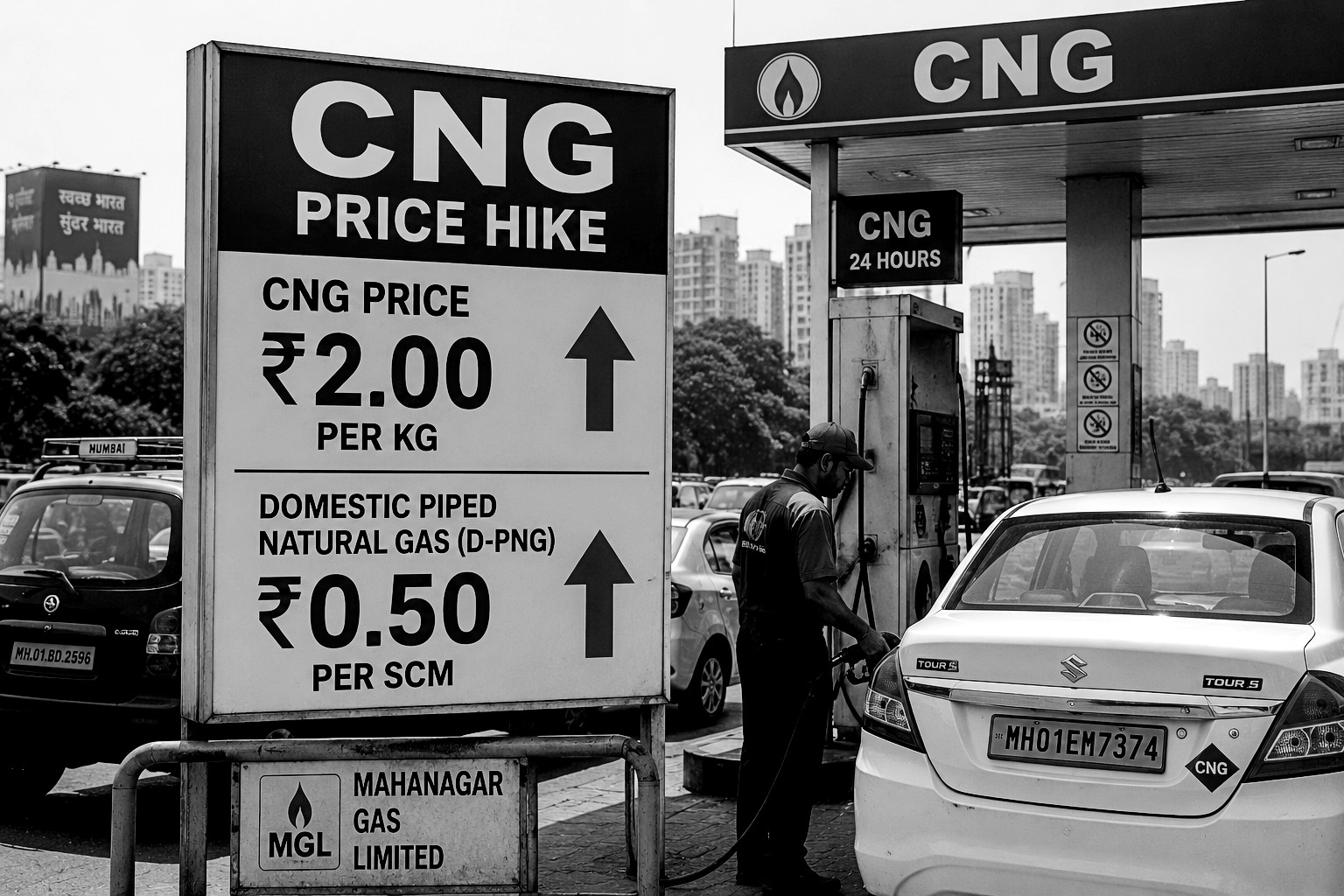
Consumers in Mumbai will face higher fuel and household energy costs after authorities approved an increase in compressed natural gas (CNG) prices by ₹2 per kilogram. At the same time, domestic piped natural gas (D-PNG) rates have been raised by ₹0.5 per standard cubic metre, adding to the cost burden for households and businesses across India’s financial capital.
Higher costs for motorists
The latest price adjustment will directly affect thousands of motorists who rely on CNG-powered vehicles for daily transportation. CNG has long been viewed as a more affordable and environmentally friendly alternative to petrol and diesel, making it particularly popular among taxi operators, commercial fleets and private vehicle owners.
While the increase may appear modest on a per-kilogram basis, transport operators warn that cumulative fuel expenses could rise significantly over time, especially for vehicles covering long distances each day.

Public transport providers and logistics companies are also expected to monitor the impact on operating costs.
Households also affected
Alongside the increase in CNG prices, domestic piped natural gas rates have been raised by ₹0.5 per standard cubic metre. The adjustment will affect households that use piped gas for cooking and other domestic purposes.
For many urban families, D-PNG has become an essential utility due to its convenience and relatively stable pricing compared with bottled liquefied petroleum gas (LPG). The latest increase is therefore likely to be felt across a broad segment of consumers.
Utility providers noted that gas pricing remains influenced by broader market conditions and supply costs.
Global energy markets remain influential
India’s energy pricing continues to be affected by developments in international natural gas markets. Global demand, geopolitical tensions, shipping costs and currency fluctuations all play a role in determining domestic energy costs.
Although natural gas prices have stabilised compared with the extreme volatility experienced during recent global energy crises, market conditions remain sensitive to supply disruptions and changing demand patterns.
Energy analysts note that India remains heavily dependent on imported energy resources, making domestic pricing vulnerable to international market movements.
Balancing affordability and sustainability
Natural gas occupies an important position within India’s energy transition strategy. Policymakers view CNG and piped gas as cleaner alternatives to traditional fossil fuels and a bridge towards a lower-emission energy system.
However, maintaining affordability remains crucial for encouraging wider adoption among consumers and businesses. Significant price increases could slow the transition if users perceive the cost advantages over conventional fuels to be diminishing.
Authorities therefore face the challenge of balancing environmental goals, energy security and consumer affordability.
Economic implications
The latest adjustments are unlikely to have a major immediate impact on inflation, but they contribute to broader cost pressures affecting transportation, logistics and household budgets.
Businesses that rely heavily on natural gas may review operating costs, while consumers could become more sensitive to future energy price movements.
As India continues its rapid economic expansion and urbanisation, energy pricing decisions will remain closely watched by investors, policymakers and consumers alike.
Newshub Editorial in Asia – 30 May 2026

If you have an account with ChatGPT you get deeper explanations,
background and context related to what you are reading.
Open an account:
Open an account
Recent Comments