
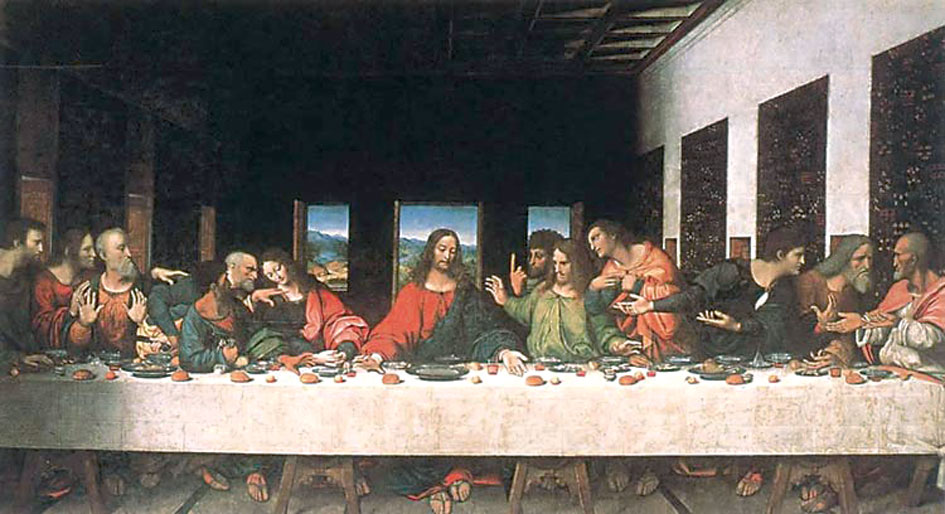
On 28 May 1999, Leonardo da Vinci’s The Last Supper was reopened to the public in Milan after one of the longest and most delicate restoration projects in art history. The work, housed in the refectory of Santa Maria delle Grazie, had undergone more than 20 years of conservation, scientific analysis and debate before visitors were again allowed to see it under strict environmental controls.
A fragile masterpiece
Painted between 1495 and 1498 for Ludovico Sforza, Duke of Milan, The Last Supper was never a conventional fresco. Leonardo used an experimental dry-wall technique, applying pigments over a prepared surface rather than into wet plaster. That choice gave him painterly freedom, but it also made the mural extremely vulnerable to damp, pollution and decay.
Centuries of damage
The painting deteriorated soon after completion. Over the centuries it suffered from humidity, poor restoration attempts, structural changes to the wall and wartime damage. During the Second World War, the refectory was bombed, although the mural survived behind protective barriers. By the late twentieth century, layers of repainting, dirt and earlier conservation materials had obscured much of Leonardo’s original work.


The restoration challenge
The modern restoration, led by Pinin Brambilla Barcilon, began in the late 1970s and was completed in 1999. Conservators removed later additions, stabilised surviving paint and used scientific tools including infrared reflectography and microscopic analysis to distinguish original material from later interventions. Areas too damaged to recover were treated carefully so they would not falsely imitate Leonardo’s hand.
A controversial reopening
When the restored mural was unveiled, the reaction was mixed. Many praised the return of colour, detail and spatial clarity. Others argued that the restoration had changed the painting’s appearance too dramatically. The debate reflected a wider question in conservation: whether restoration should reveal what remains of the original or preserve the accumulated historical surface of an artwork.
A controlled future
Since reopening, access has remained tightly managed. Visitors must book ahead, pass through climate-controlled chambers and view the mural for only a short period. These restrictions underline the central lesson of the restoration: The Last Supper is not only a Renaissance masterpiece, but also a fragile survivor whose future depends on constant protection.
Newshub Editorial in Europe – 28 May 2026

If you have an account with ChatGPT you get deeper explanations,
background and context related to what you are reading.
Open an account:
Open an accountOn 28 May 1999, Leonardo da Vinci’s The Last Supper was reopened to the public in Milan after one of the longest and most delicate restoration projects in art history. The work, housed in the refectory of Santa Maria delle Grazie, had undergone more than 20 years of conservation, scientific analysis and debate before visitors were again allowed to see it under strict environmental controls.
Recent Comments