
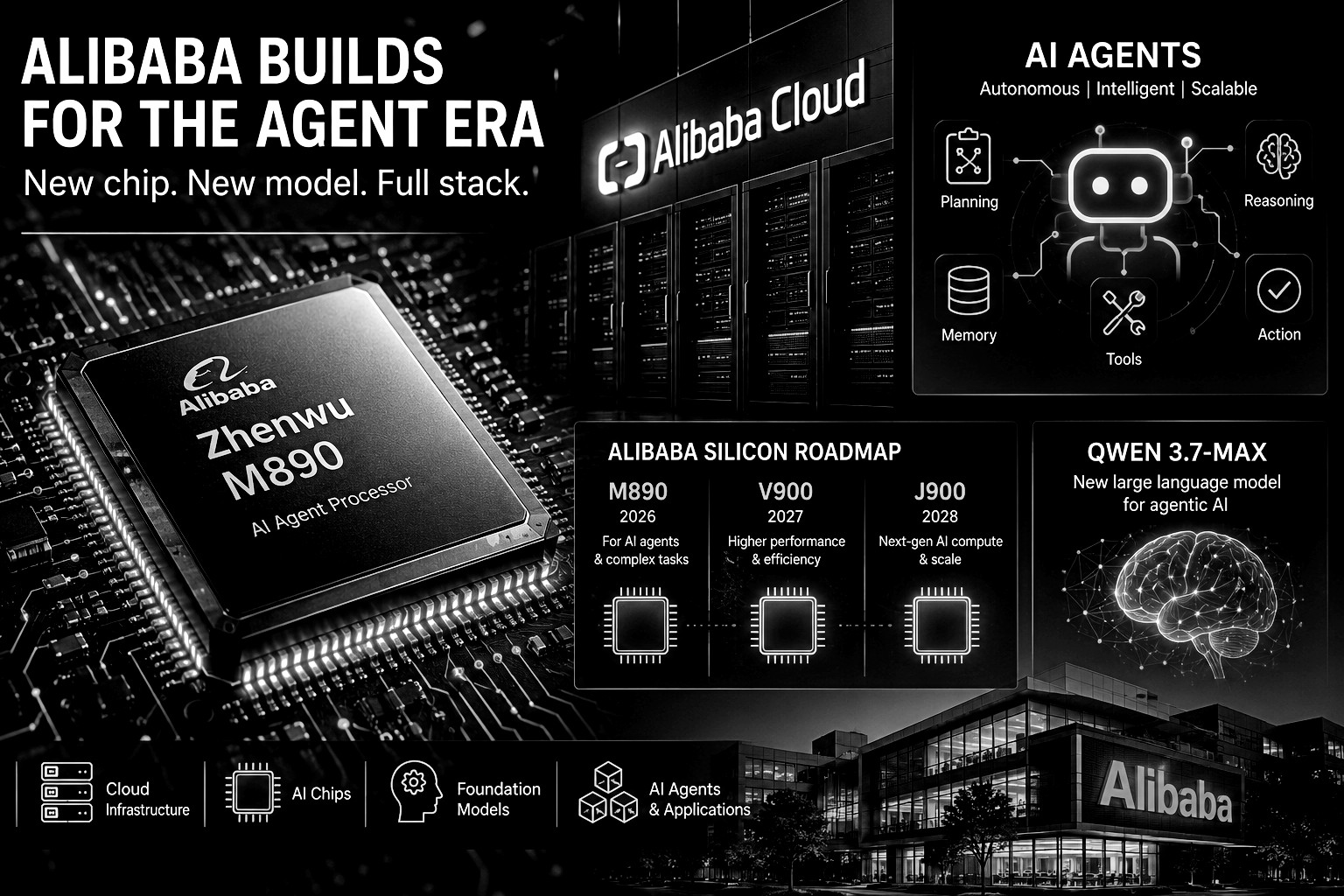
Alibaba has unveiled a new AI processor designed specifically for AI agents, signalling that the next phase of the artificial intelligence race is not only about faster chips. It is about building complete systems where silicon, cloud infrastructure and large language models work together.
Built for agent workloads
The new Zhenwu M890 chip, developed by Alibaba’s T-Head unit, is designed for AI agents that perform complex, multi-step tasks with limited human supervision. Alibaba says the processor delivers around three times the performance of its predecessor and is built for heavy memory and communication demands.
A roadmap, not a reaction
The announcement came with a multi-year silicon plan, including the V900 in 2027 and J900 in 2028. That matters because it suggests Alibaba is not simply responding to US export controls on Nvidia chips, but creating a sustained domestic upgrade cycle for AI infrastructure.

The stack becomes the strategy
Alibaba also introduced Qwen 3.7-Max, a new large language model aimed at long-running agent tasks and advanced coding. Combined with its cloud platform and server systems, the company is positioning itself as a full-stack AI provider rather than a chip supplier alone.
China’s self-reliance accelerates
US restrictions have made domestic chips more strategically important for Chinese technology companies. But Alibaba’s move shows the competition is shifting from raw semiconductor access to integrated execution: who can run agents reliably, cheaply and at scale inside enterprise systems.
A different race is emerging
The AI chip race is therefore becoming a platform race. Nvidia still leads globally, but Alibaba is betting that agent-era computing will reward companies that control more of the chain, from processor design to cloud deployment and model behaviour.
Newshub Editorial in Asia – 21 May 2026

If you have an account with ChatGPT you get deeper explanations,
background and context related to what you are reading.
Open an account:
Open an account
Recent Comments