
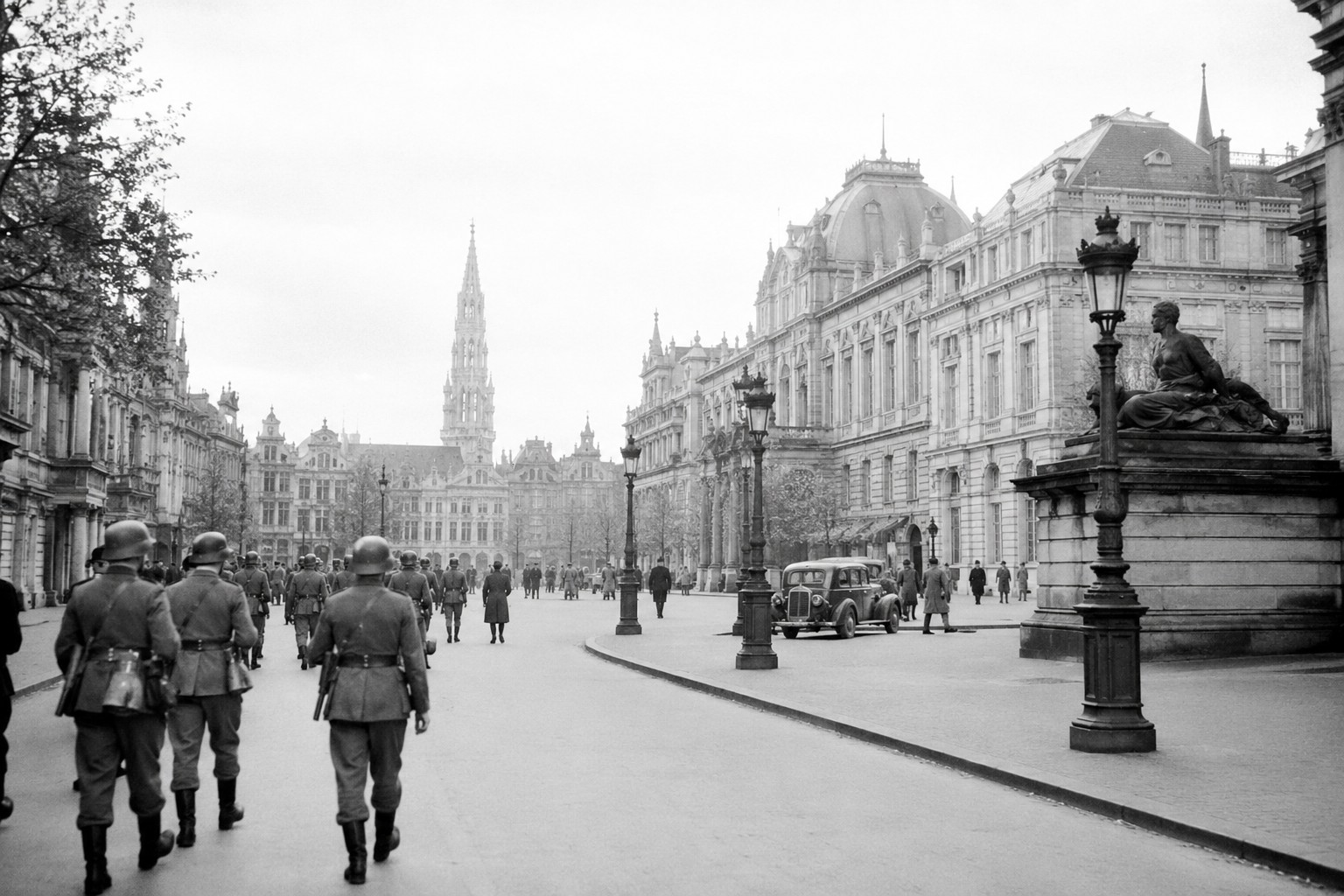
On 17 May 1940, Brussels fell to the advancing German army during one of the most dramatic phases of the Second World War, marking the beginning of four years of occupation that would reshape Belgium politically, economically and socially. The occupation introduced censorship, food shortages, deportations and growing resistance activity, while ordinary citizens struggled to survive under increasingly harsh conditions imposed by Nazi Germany.
The collapse of Belgium
The German invasion of Belgium began on 10 May 1940 as part of Adolf Hitler’s wider western offensive across Europe. German forces moved rapidly through the Low Countries using highly coordinated mechanised warfare, overwhelming Belgian and Allied defensive positions in a matter of days. Brussels, despite its political and symbolic importance, was unable to resist the speed of the German advance.
Belgian authorities declared Brussels an open city in an attempt to avoid widespread destruction and civilian casualties. German troops entered the capital with relatively limited fighting compared with other European cities later devastated during the war. Nevertheless, the fall of Brussels represented a profound national shock and highlighted the vulnerability of smaller European states confronted by Germany’s military power.

King Leopold III surrendered the Belgian army less than two weeks later, on 28 May 1940, a decision that remained deeply controversial for decades.
Life under German occupation
The occupation authorities quickly established strict administrative control over Belgium. German military governance imposed censorship on newspapers and radio broadcasts, restricted political activity and monitored public life closely. Curfews, identity checks and surveillance became part of daily existence for citizens in Brussels and across the country.
Food shortages emerged as the war intensified. Rationing systems were introduced, and black markets expanded throughout occupied Belgium. Industrial production increasingly served German wartime needs, while many Belgian workers were later forced into labour programmes connected to the German war economy.
Jewish communities faced particularly brutal persecution. Anti-Jewish laws were introduced gradually before mass deportations accelerated during the later years of the occupation. Thousands of Belgian Jews were deported to concentration and extermination camps.
Resistance and repression
Despite the risks, resistance movements developed throughout Belgium. Underground newspapers circulated secretly, intelligence networks assisted Allied forces and sabotage operations targeted German infrastructure. Brussels became an important centre for clandestine resistance activity, although the Gestapo and German security services responded with arrests, torture and executions.
The occupation also created difficult moral and political divisions inside Belgian society. Some individuals collaborated with German authorities for ideological, political or economic reasons, while others attempted simply to survive amid extreme uncertainty.
As the war progressed, Allied bombing campaigns and German military pressures further strained civilian life across occupied Belgium.
Liberation and historical memory
Brussels was liberated by Allied forces in September 1944 following the rapid collapse of German positions after the Normandy landings. Liberation brought celebrations but also exposed the deep scars left by four years of occupation, collaboration and wartime hardship.
Today, the occupation of Brussels remains a defining chapter in Belgian history and in the broader European memory of the Second World War. Memorials, museums and archives across Brussels continue to document the experiences of civilians, resistance fighters and victims of Nazi persecution during one of Europe’s darkest periods.
Newshub Editorial in Europe – May 18, 2026

If you have an account with ChatGPT you get deeper explanations,
background and context related to what you are reading.
Open an account:
Open an account
Recent Comments