
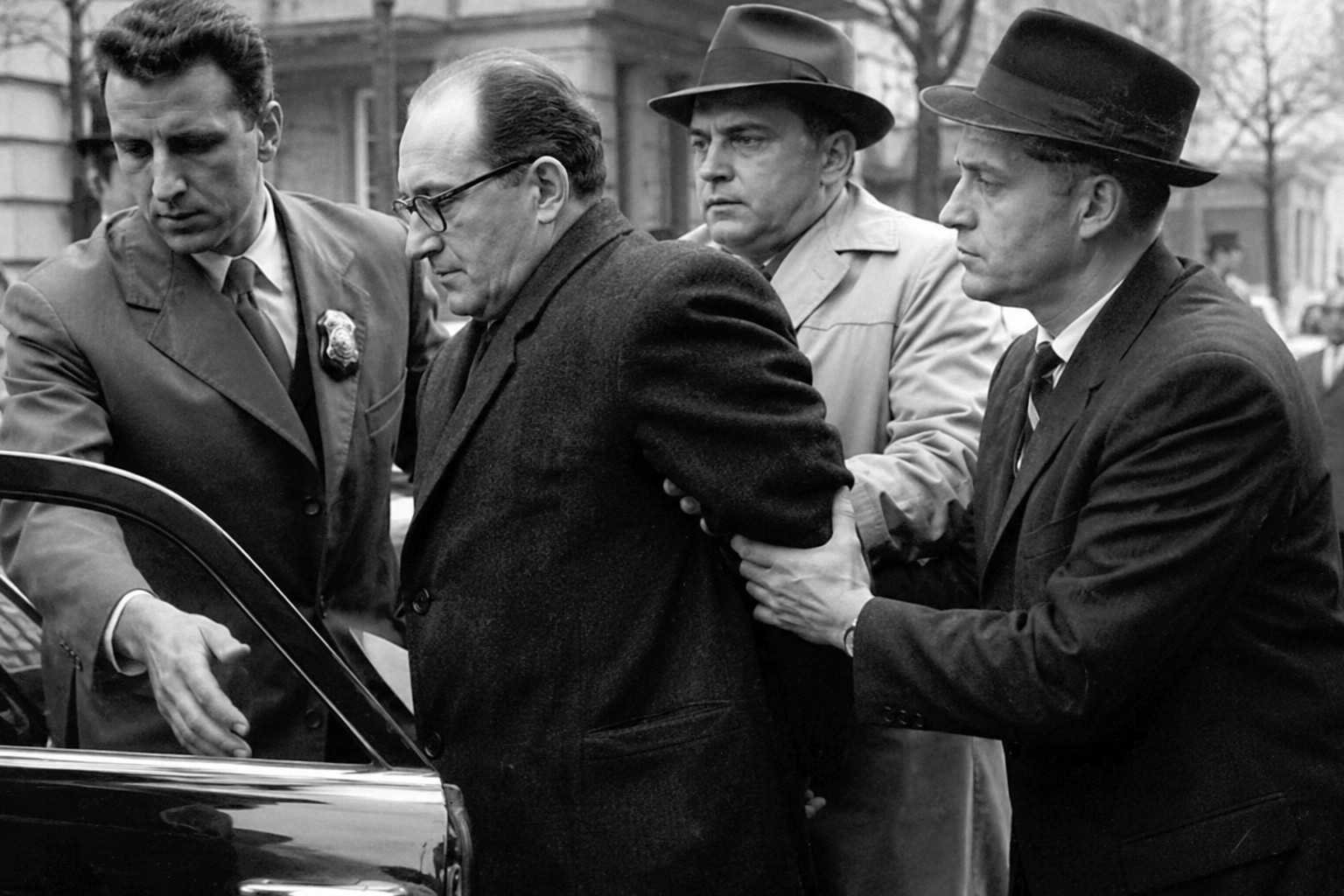
On this day in 1960, Israeli intelligence agents captured Nazi official Adolf Eichmann near Buenos Aires, Argentina, in a covert operation that became one of the most consequential manhunts of the twentieth century. Eichmann, one of the central organisers behind the Holocaust, had played a major role in coordinating the deportation and systematic murder of approximately six million Jews during the Second World War.
Following the collapse of Nazi Germany in 1945, many senior Nazi officials attempted to disappear across Europe and South America using false identities and underground escape networks commonly referred to as “ratlines”.
Eichmann managed to evade capture for more than a decade.

Living under the alias Ricardo Klement, he settled in Argentina, where he worked in various industrial jobs while attempting to avoid international attention.
However, survivors, investigators and intelligence networks continued searching for high-ranking Nazi officials connected to the Holocaust.
Israeli intelligence agency Mossad eventually received information suggesting Eichmann was living near Buenos Aires.
After months of surveillance and verification, Israeli operatives launched a secret mission to abduct him.
On May 11, 1960, agents intercepted Eichmann as he returned home from work in a suburb outside the Argentine capital. He was quietly restrained and transported to a secure location while Israeli authorities prepared a covert extraction plan.
Days later, Eichmann was secretly flown to Israel aboard an aircraft connected to an official Israeli delegation attending celebrations marking Argentina’s independence anniversary.
The operation generated immediate global attention once Israel publicly announced the capture.
Argentina protested the violation of its sovereignty, triggering diplomatic tensions between the two countries. Nevertheless, the operation was widely viewed internationally as a major breakthrough in bringing Holocaust perpetrators to justice.
The trial that exposed the Holocaust to the world
Eichmann’s trial began in Jerusalem in 1961 and became one of the most closely followed legal proceedings of the post-war era.
The hearings included testimony from Holocaust survivors, historians and witnesses who described the mechanics of Nazi deportations, concentration camps and extermination programmes.
For many around the world, the trial provided one of the first detailed public accounts of how the Holocaust had been organised and implemented.
Eichmann attempted to portray himself as a bureaucrat merely following orders, a defence that became central to later debates surrounding personal responsibility, authoritarian systems and crimes against humanity.
Israeli prosecutors argued that Eichmann had been a key architect of the Nazi deportation machinery that enabled mass extermination across occupied Europe.
In December 1961, the court found Eichmann guilty on multiple charges, including crimes against humanity, war crimes and crimes against the Jewish people.
He was sentenced to death and executed in 1962.
A defining moment in modern history
The capture of Eichmann marked a turning point in international justice and global awareness surrounding the Holocaust.
The operation demonstrated that even years after the end of the war, efforts to pursue accountability for genocide and crimes against humanity would continue.
It also reinforced the growing international principle that individuals involved in mass atrocities could be pursued across borders and brought to trial regardless of how much time had passed.
More than six decades later, the Eichmann case remains one of the most significant examples of post-war justice and intelligence coordination in modern history.
Newshub Editorial in Europe – May 11, 2026

If you have an account with ChatGPT you get deeper explanations,
background and context related to what you are reading.
Open an account:
Open an account
Recent Comments