
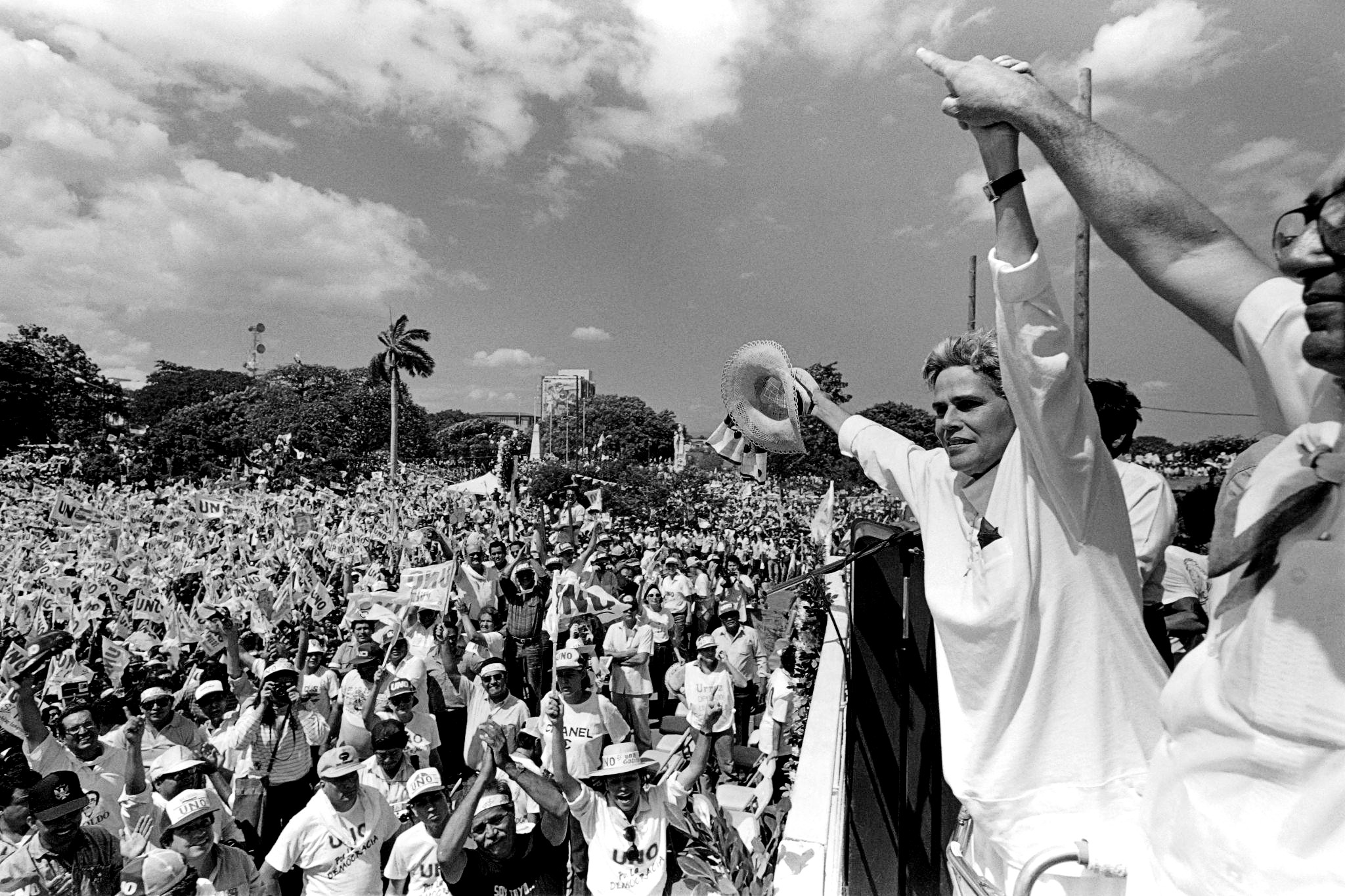
In a landmark moment for Central America, Violeta Barrios de Chamorro was sworn in as President of Nicaragua, marking the country’s first peaceful transfer of power in decades and signalling a decisive shift away from revolutionary rule toward democratic governance.
A historic electoral upset
Chamorro’s inauguration followed her unexpected victory in the February 1990 elections, where she defeated incumbent leader Daniel Ortega of the Sandinista National Liberation Front. Running as the candidate of the broad opposition coalition National Opposition Union (UNO), Chamorro capitalised on widespread public fatigue after years of civil conflict, economic instability and international isolation. Her victory surprised observers both domestically and internationally, given the Sandinistas’ entrenched political and military position.
End of a turbulent era
The transition represented the culmination of a decade marked by the Nicaraguan Revolution and the subsequent Contra war, a conflict that had devastated the country’s economy and infrastructure. Chamorro’s rise to power effectively ended Sandinista rule that began in 1979 and opened the door to reconciliation efforts. Her administration faced the immediate challenge of demobilising armed groups, stabilising the economy and rebuilding trust in state institutions.

A presidency focused on reconciliation
Chamorro positioned her leadership around national unity and pragmatic reform. Her government prioritised ceasefire agreements, reintegration of former combatants and negotiations aimed at reducing political tensions. Economically, the administration moved toward market-oriented policies, seeking international support to address hyperinflation, unemployment and debt burdens. The shift marked a significant ideological pivot from the previous socialist framework toward a mixed economic model.
International implications and support
Chamorro’s presidency was closely watched by global actors, particularly the United States and regional partners, who viewed the transition as a stabilising development in Central America. Her government received diplomatic recognition and financial assistance, reflecting broader geopolitical interest in consolidating democratic institutions in the region following the Cold War’s final phase. The peaceful handover also strengthened Nicaragua’s standing within international organisations and development frameworks.
Challenges ahead for a fragile democracy
Despite the optimism surrounding her inauguration, Chamorro’s administration inherited deep structural challenges. Political divisions remained pronounced, and the Sandinistas retained influence within the military and key state institutions. Balancing reform with stability required careful negotiation, particularly in managing relations with Ortega’s supporters while implementing economic adjustments that carried social costs.
Legacy of a pivotal transition
Chamorro’s swearing-in stands as a defining moment in Nicaragua’s modern history, representing both the end of armed ideological confrontation and the beginning of a democratic experiment under complex conditions. Her leadership set the foundation for subsequent electoral processes and remains a reference point in discussions about peaceful political transitions in post-conflict societies.
Newshub Editorial in South America – April 25, 2026

If you have an account with ChatGPT you get deeper explanations,
background and context related to what you are reading.
Open an account:
Open an account
Recent Comments