
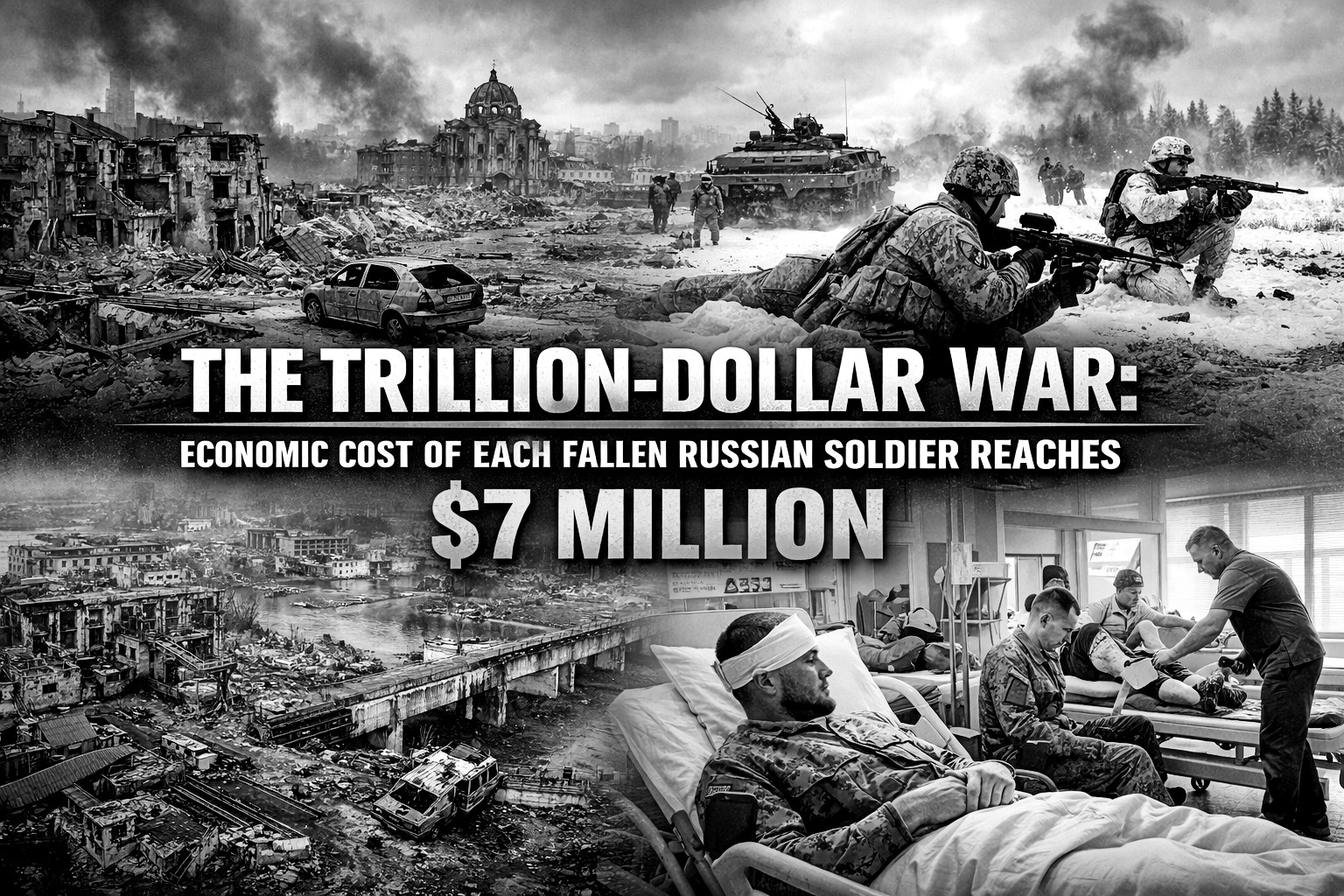
As the war in Ukraine enters its fourth year, the mounting human toll is increasingly reflected in stark economic terms, with new estimates suggesting that each fallen Russian soldier represents a macroeconomic loss of up to $7 million.
A trillion-dollar burden
Russia’s total economic cost of the war is widely assessed to be approaching $1.5 trillion. This figure incorporates direct military expenditure, the impact of international sanctions, discounted energy exports, and broader economic disruption. When this aggregate cost is distributed across an estimated 250,000 Russian fatalities, the implied economic burden reaches approximately $6 million per fallen soldier.
This calculation does not indicate a direct cost per individual combatant, but rather frames the broader financial impact of the conflict in relation to its human losses. It translates a vast macroeconomic figure into a more tangible metric, highlighting the scale of the war’s economic consequences.


The hidden cost of lost productivity
Beyond military spending and fiscal strain, the loss of human capital significantly compounds the overall impact. Assuming an average remaining working life of 20 to 25 years and annual productivity of roughly $10,000, each deceased soldier represents an additional $200,000 to $300,000 in lost economic output.
When combined with the broader cost of the war, the total societal impact per fallen soldier rises to an estimated range of $6.2 million to $7.3 million. This underscores how the long-term erosion of the workforce contributes to the cumulative economic burden.
A simplified perspective for readers
To contextualise these figures, the estimated $6–7 million per soldier is broadly comparable to several decades of economic productivity for an average worker. It also aligns with the concept of the “value of a statistical life”, a framework commonly used by economists to evaluate the societal cost of fatalities in large-scale events.
By translating aggregate losses into per-capita terms, the analysis provides a clearer understanding of how deeply the war affects both the economy and society at large.
Wounded soldiers and long-term fiscal pressures
While fatalities present a stark measure, the estimated 750,000 wounded soldiers represent a significant and ongoing financial obligation. Costs related to medical care, rehabilitation, disability pensions, and reduced workforce participation are expected to accumulate over time, potentially adding hundreds of billions of dollars to the total economic impact.
These long-term liabilities introduce structural fiscal pressures that extend well beyond the duration of active conflict.
Demographic and economic ripple effects
The war’s consequences extend into Russia’s demographic and economic future. The loss of a substantial number of working-age individuals contributes to labour shortages, declining productivity, and reduced growth potential. Over time, these structural shifts may reshape the country’s economic trajectory and exacerbate existing demographic challenges.
Such effects are not easily reversible and may persist for decades, amplifying the long-term cost of the conflict.
Understanding the numbers
A breakdown of the key estimates illustrates the scale of the economic burden:
- Total war cost: approximately $1.5 trillion
- Estimated Russian fatalities: approximately 250,000
- Estimated wounded: approximately 750,000
- Implied cost per fallen soldier: approximately $6 million
- Productivity loss per soldier: $200,000 to $300,000
- Total societal cost per soldier: approximately $6.2 million to $7.3 million
A human and economic reckoning
Quantifying the economic cost per fallen soldier is not intended to reduce human life to financial terms. Rather, it provides a framework for understanding the immense scale of the war’s consequences. By linking macroeconomic losses to individual outcomes, the analysis highlights the profound intersection between human tragedy and national economic burden.
Newshub Editorial in Europe – 14 April 2026

If you have an account with ChatGPT you get deeper explanations,
background and context related to what you are reading.
Open an account:
Open an accountAs the war in Ukraine enters its fourth year, the mounting human toll is increasingly reflected in stark economic terms, with new estimates suggesting that each fallen Russian soldier represents a macroeconomic loss of up to $7 million.
Recent Comments