
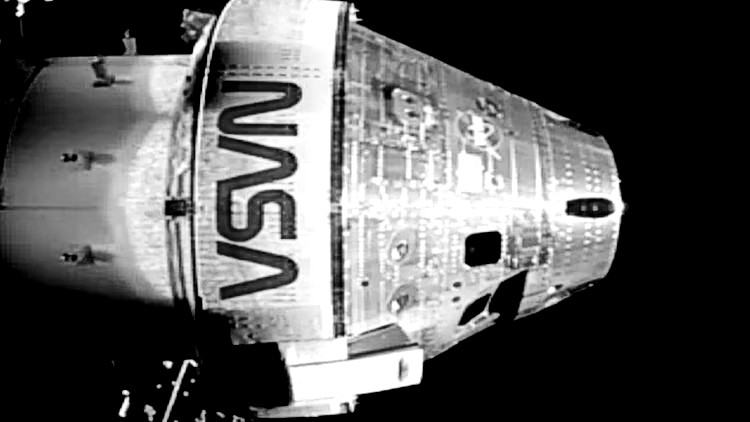
For the first time in more than half a century, humans have returned to the vicinity of the moon, as the crew of Artemis II completed a landmark lunar flyby, reigniting global interest in deep space exploration and raising a fundamental question: why did it take so long?
A record-breaking mission beyond Earth
The Artemis II crew travelled farther from Earth than any humans in history, surpassing distances achieved during the Apollo era. The astronauts also observed more of the moon’s far side than any previous mission, offering new perspectives on a region that remains largely unexplored.
The mission represents a major milestone for NASA, signalling a renewed commitment to lunar exploration after decades of relative inactivity. Unlike earlier missions, Artemis II is part of a broader long-term strategy aimed at establishing a sustained human presence on and around the moon.

Why the long pause after Apollo?
The last crewed mission to the moon before Artemis II was Apollo 17, which concluded in 1972. In the years that followed, the United States shifted its focus away from lunar exploration, driven largely by cost considerations and changing political priorities.
The Apollo programme had been extraordinarily expensive, developed under the intense geopolitical pressure of the Cold War. Once that urgency diminished, so too did the political appetite for funding similarly ambitious missions. Space exploration priorities shifted towards lower Earth orbit, leading to programmes such as the Space Shuttle and later the International Space Station.
Costs and complexity reshape ambitions
Returning to the moon is significantly more complex than maintaining operations in low Earth orbit. Advances in technology, safety standards and mission scope have increased both the cost and the engineering challenges involved.
Artemis missions are designed not just for brief visits, but for sustained operations, including potential lunar bases and future missions to Mars. This expanded ambition has required the development of new spacecraft, launch systems and international partnerships, all of which have taken years to materialise.
A new era of international and commercial spaceflight
Another key difference between the Apollo era and today is the broader ecosystem of space exploration. Artemis is not solely a national effort but involves collaboration with international partners and private companies.
This shift reflects a more complex but potentially more sustainable model of space exploration, where costs and risks are distributed across multiple stakeholders. However, it has also contributed to longer timelines, as coordination and development efforts become more intricate.
Renewed momentum with long-term implications
The successful lunar flyby of Artemis II signals that the United States is once again serious about deep space exploration. It also marks the beginning of a new phase in which the moon is seen not as a destination in itself, but as a stepping stone toward broader ambitions in the solar system.
After more than 50 years, the return to the moon is both a technological achievement and a strategic reset—one that reflects how priorities, capabilities and global dynamics have evolved since the Apollo era.
Newshub Editorial in North America – April 9, 2026

If you have an account with ChatGPT you get deeper explanations,
background and context related to what you are reading.
Open an account:
Open an account
Recent Comments