
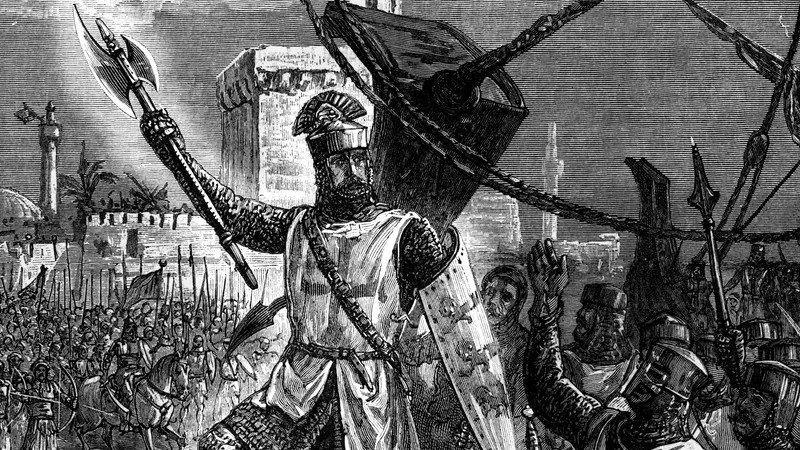
On 6 April 1199, Richard I of England died in Châlus in Aquitaine after succumbing to an infected crossbow wound — an abrupt and unexpected end to one of medieval Europe’s most formidable warrior-kings.
A reign defined by conflict
Richard I ruled England from 1189 to 1199, yet his legacy was shaped far more by warfare than by governance. From the outset, his reign was marked by military ambition, most notably his leadership during the Third Crusade, where he emerged as a central figure opposing Saladin.
Despite holding the English crown, Richard spent little time in England. His political and cultural base lay in his continental territories, particularly Aquitaine. His rule was characterised by near-constant conflict, including a prolonged rivalry with Philip II of France, as both monarchs sought to consolidate power across Western Europe.

The siege that proved fatal
In early 1199, Richard initiated a siege against the small fortress of Châlus-Chabrol. The campaign itself held limited strategic importance and was reportedly triggered by rumours of hidden treasure within the castle.
During the operation, Richard was struck by a crossbow bolt while inspecting the defences. Crucially, he was not wearing full armour at the time. Although the injury did not initially appear life-threatening, infection soon set in — a common and often fatal complication in medieval warfare.
Without effective medical treatment, the wound deteriorated into gangrene. After several days of decline, Richard died on 6 April 1199. Some contemporary accounts claim that he forgave the crossbowman responsible, contributing to his later portrayal as a chivalric figure, though the accuracy of this detail remains uncertain.
Succession and shifting power
Richard’s death created an immediate succession issue. With no legitimate heirs, the throne passed to his younger brother, John of England. His accession marked the beginning of a more turbulent period in English history.
Under King John, tensions between the monarchy and the nobility intensified, eventually culminating in the sealing of the Magna Carta in 1215. This development would have lasting implications for the evolution of constitutional governance in England.
At the same time, Richard’s absence removed a key military counterbalance in continental Europe. Philip II capitalised quickly, accelerating the erosion of English-held territories in France and reshaping the regional balance of power.
Legacy between myth and reality
Richard the Lionheart remains one of the most recognisable figures of the medieval period. His image as a fearless crusader and warrior-king has endured for centuries, reinforced by chronicles and later cultural portrayals.
However, modern historical analysis presents a more nuanced perspective. While a highly capable military leader, Richard’s campaigns imposed heavy financial demands on England, and his prolonged absences left governance in the hands of deputies.
His death at Châlus illustrates the fragility of medieval authority. Even a king of his stature could fall not in a decisive battle, but in a minor siege with limited strategic significance.
Newshub Editorial in Europe – April 6, 2026

If you have an account with ChatGPT you get deeper explanations,
background and context related to what you are reading.
Open an account:
Open an account
Recent Comments