
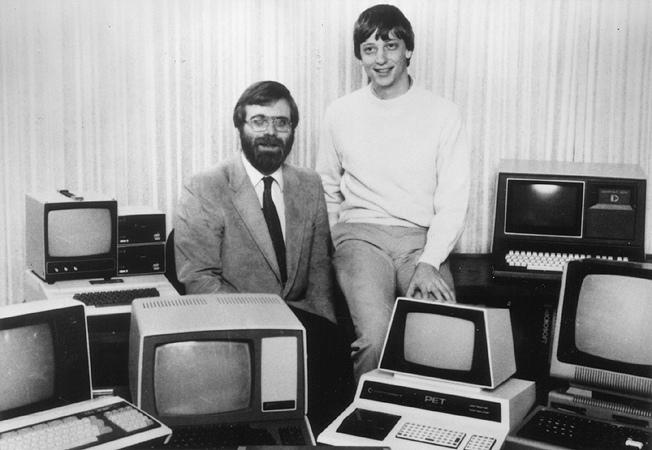
In 1975, two childhood friends from Seattle — Bill Gates and Paul Allen — laid the foundation for what would become one of the most influential technology companies in history, Microsoft. Their vision of putting a computer on every desk and in every home would not only define an era but fundamentally reshape how the world works, communicates, and does business.
A partnership rooted in curiosity and ambition
Gates and Allen met as students, united by a shared fascination with computing at a time when computers were rare, expensive, and largely confined to institutions. Allen, the more experienced programmer early on, introduced Gates to increasingly sophisticated systems. Together, they recognised a seismic shift underway: computing power was moving from large mainframes to smaller, more accessible personal machines.
Their breakthrough came with the arrival of the Altair 8800, an early personal computer kit. Spotting an opportunity, the duo developed a version of the BASIC programming language for the machine. This marked the creation of Microsoft, initially named “Micro-Soft,” reflecting its focus on microprocessors and software.

The software-first strategy that changed everything
While many early tech companies focused on hardware, Microsoft took a different path. Gates and Allen believed software would become the true engine of value in computing. This strategic clarity proved decisive.
The company’s pivotal moment came when it secured a contract to provide an operating system for IBM’s first personal computer. Microsoft delivered MS-DOS, retaining licensing rights rather than selling the software outright — a decision that would generate exponential returns as the PC market expanded globally.
This licensing model allowed Microsoft to scale rapidly, embedding its software across a growing ecosystem of hardware manufacturers. It established a template for platform dominance that would later be studied — and challenged — by generations of tech companies.
Windows and the rise of a global standard
In the 1980s and 1990s, Microsoft introduced Windows, a graphical operating system that made computers more intuitive and accessible. As Windows adoption surged, Microsoft became the central infrastructure provider for personal computing worldwide.
The company’s dominance extended into productivity software with the launch of Microsoft Office, further entrenching its position in both business and consumer markets. By the mid-1990s, Microsoft was not just a technology company — it was a global standard.
However, this dominance also drew regulatory scrutiny. Antitrust cases in the United States and Europe highlighted concerns about market power, marking a new phase in the relationship between big tech and governments.
Legacy, evolution, and enduring influence
Paul Allen stepped back from day-to-day operations in the 1980s due to health reasons, later becoming a prominent investor and philanthropist. Gates remained at the helm for decades, shaping Microsoft’s strategic direction before transitioning into philanthropic work through the Bill & Melinda Gates Foundation.
Today, Microsoft has evolved far beyond its original scope, with major positions in cloud computing, enterprise software, and artificial intelligence. Yet its foundational DNA — built on software scalability, platform control, and strategic licensing — remains intact.
The story of Gates and Allen is not merely one of entrepreneurial success. It is a case study in timing, vision, and execution — demonstrating how recognising a structural shift early, and committing to a clear strategic model, can redefine entire industries.
Newshub Editorial in North America – April 4, 2026

If you have an account with ChatGPT you get deeper explanations,
background and context related to what you are reading.
Open an account:
Open an account
Recent Comments