
On 3 April 1924, Marlon Brando was born in Omaha, Nebraska, a moment that would later be recognised as the starting point of a profound transformation in both stage and film acting. Over the following decades, Brando would redefine performance through emotional realism, psychological depth, and an entirely new relationship between actor and character.
early life and formative influences
Brando’s upbringing in Omaha was marked by instability, a factor widely cited as shaping his introspective and emotionally charged acting style. Moving to New York, he trained under Stella Adler, whose teachings emphasised imagination, emotional truth, and deep character analysis rather than rigid technique.
This approach aligned with the emerging philosophy of method acting, which sought to bring authenticity and lived experience into performance. Brando became one of its most powerful representatives, helping shift acting away from theatrical projection towards a more intimate, internalised form suited to the camera.

breakthrough on stage and screen
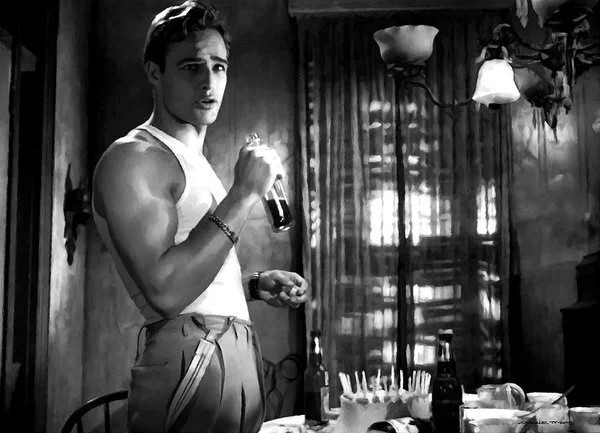
Brando’s breakthrough came with his portrayal of Stanley Kowalski in A Streetcar Named Desire. First performed on Broadway and later adapted for film, his performance was strikingly raw, physical, and emotionally unfiltered. It stood in sharp contrast to the polished style that had defined Hollywood’s golden era.
He followed this with a series of defining roles, including The Wild One and On the Waterfront. The latter earned him his first Academy Award and cemented his status as a leading force in American cinema. His delivery—often subdued, sometimes mumbled—brought a new level of realism that resonated strongly with audiences in the post-war period.
redefining screen presence and influence
By the 1970s, Brando’s influence had become deeply embedded in the industry. His portrayal of Don Vito Corleone in The Godfather is widely regarded as one of the most iconic performances in film history. The role earned him a second Academy Award, which he declined as a political statement, underscoring his willingness to challenge both industry norms and broader societal issues.
In Apocalypse Now, his portrayal of Colonel Kurtz further demonstrated his unconventional approach. Brando often relied on improvisation and instinct, pushing directors and co-actors into new creative territory. While this made productions more complex, it also elevated the depth and unpredictability of his performances.
legacy in modern acting
Brando’s legacy extends far beyond his own work. He fundamentally altered expectations of what acting could achieve, influencing generations of performers and reshaping training methods across the industry. Actors such as Al Pacino and Robert De Niro have built on the foundation he helped establish.
Today, the emphasis on psychological realism, emotional vulnerability, and character-driven storytelling remains central to both film and television. These principles can be traced directly to Brando’s influence.
What began with his birth in Omaha in 1924 ultimately evolved into a lasting transformation of global cinema. Marlon Brando did not simply act—he redefined the craft itself.
Newshub Editorial in North America – April 3, 2026

If you have an account with ChatGPT you get deeper explanations,
background and context related to what you are reading.
Open an account:
Open an account
Recent Comments