
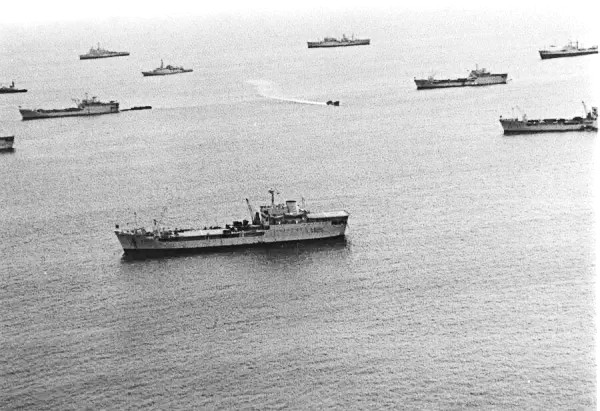
In April 1982, Argentine troops landed on the Falkland Islands, initiating a brief but consequential conflict with the United Kingdom that would alter political trajectories in both nations and leave a lasting imprint on global geopolitics.
The road to invasion
Tensions over the Falkland Islands, known as Islas Malvinas in Argentina, had simmered for decades. The remote South Atlantic archipelago, located roughly 500 kilometres off Argentina’s coast, had been under British control since 1833. Argentina, however, maintained a longstanding claim, framing the islands as an integral part of its national territory.
By early 1982, Argentina’s ruling military junta faced mounting domestic pressure. Economic instability, inflation, and civil unrest had weakened the regime’s standing. In this context, reclaiming the islands was seen as a strategic move to bolster national unity and divert attention from internal challenges.

Operation Rosario unfolds
On 2 April 1982, Argentine forces launched Operation Rosario, an amphibious assault aimed at swiftly capturing the islands. The operation was executed with relative speed and minimal initial resistance. British Governor Sir Rex Hunt and a small contingent of Royal Marines were quickly overwhelmed, leading to Argentina establishing control over the capital, Port Stanley.
The invasion marked a dramatic escalation in the dispute, transforming a long-standing diplomatic disagreement into an active military conflict. Argentina declared the islands under its administration, while domestic celebrations briefly surged across the country.
Britain responds with force
The United Kingdom, under Prime Minister Margaret Thatcher, reacted decisively. Viewing the invasion as a violation of sovereignty, Britain assembled a naval task force and dispatched it over 12,000 kilometres to the South Atlantic. The response underscored Britain’s determination to maintain control over its overseas territories and uphold international norms.
The conflict that followed lasted ten weeks, involving naval, air, and ground engagements. Despite the logistical challenges posed by distance and harsh weather conditions, British forces gradually regained the upper hand. Key battles, including those around Goose Green and Mount Tumbledown, paved the way for a final push towards Port Stanley.
Outcome and consequences
On 14 June 1982, Argentine forces surrendered, restoring British control over the Falkland Islands. The war resulted in the deaths of 649 Argentine military personnel, 255 British servicemen, and three Falkland Islanders.
The political consequences were profound. In Argentina, the defeat accelerated the collapse of the military junta, leading to a transition back to democratic governance. In the United Kingdom, the victory significantly boosted Margaret Thatcher’s political standing, contributing to her re-election the following year.
Enduring geopolitical implications
The Falklands conflict remains a sensitive and unresolved issue in international relations. Argentina continues to assert its claim over the islands, while Britain maintains its position, supported by the islanders’ preference to remain a British Overseas Territory.
Beyond sovereignty, the conflict highlighted broader themes of nationalism, resource control, and strategic positioning in the South Atlantic. It also reinforced the importance of rapid military response capabilities and international diplomacy in managing territorial disputes.
Today, the Falkland Islands stand as a symbol of contested identity and historical memory, with the events of April 1982 continuing to shape policy, rhetoric, and regional dynamics more than four decades later.
Newshub Editorial in South America – April 2, 2026

If you have an account with ChatGPT you get deeper explanations,
background and context related to what you are reading.
Open an account:
Open an account
Recent Comments