
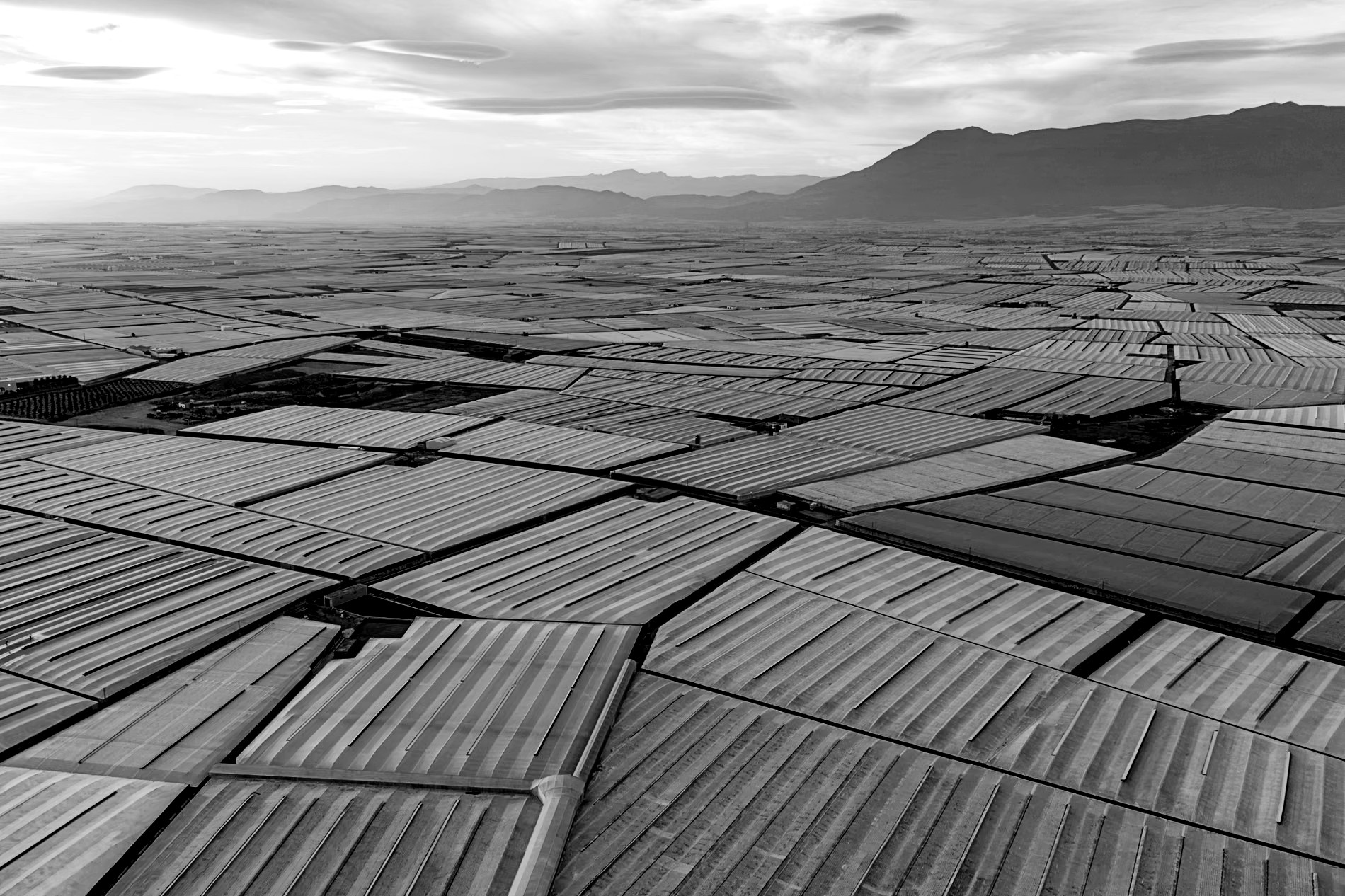
Southern Spain is home to the world’s largest concentration of greenhouses, a vast agricultural system so expansive it is visible from space, transforming the region into one of Europe’s most productive food hubs.
A ‘sea of plastic’ in Almería
The phenomenon is centred in the province of Almería, where tens of thousands of hectares are covered by tightly packed greenhouses. Often referred to as the “mar de plástico” (sea of plastic), this landscape reflects decades of agricultural intensification in one of Europe’s driest regions.
What began as a local response to harsh growing conditions has evolved into a highly efficient, export-oriented system supplying fruit and vegetables across Europe year-round. Tomatoes, peppers, cucumbers, and courgettes grown in Almería now form a critical part of the continent’s food supply chain.

The scale is extraordinary. The dense concentration of reflective plastic structures creates a bright, continuous surface that can be detected clearly in satellite imagery.
Efficiency through controlled agriculture
The success of the greenhouse model lies in its ability to control environmental variables. By regulating temperature, humidity, and irrigation, farmers can achieve higher yields while using less water compared to traditional open-field agriculture.
Drip irrigation systems, biological pest control, and increasingly sophisticated monitoring technologies have improved both productivity and sustainability. In a region with limited rainfall, these efficiencies are essential.
The model has also enabled farmers to extend growing seasons and stabilise output, reducing vulnerability to climate variability and ensuring consistent supply to European markets.
Economic engine for the region
The greenhouse industry has become a cornerstone of Almería’s economy. It supports tens of thousands of jobs, from cultivation and harvesting to logistics and export operations.
The region’s agricultural exports generate billions of euros annually, reinforcing Spain’s position as one of Europe’s leading suppliers of fresh produce. Integrated supply chains—linking farms to distribution centres and international markets—have further strengthened competitiveness.
At the same time, the sector has attracted investment in technology, packaging, and cold-chain infrastructure, contributing to broader regional development.
Environmental and social challenges
Despite its success, the greenhouse system faces increasing scrutiny. Concerns around plastic waste, water usage, and environmental impact remain central to the debate.
Efforts are underway to improve recycling processes and reduce the ecological footprint of production. Advances in biodegradable materials and circular economy practices are gradually being introduced, although challenges persist at scale.
Labour conditions have also drawn attention, with calls for improved standards and greater oversight in parts of the sector.
A model under global observation
Spain’s greenhouse concentration represents both an achievement and a case study. As global demand for food rises and climate pressures intensify, controlled-environment agriculture is gaining relevance worldwide.
Almería’s model demonstrates how technology and adaptation can transform even the most inhospitable landscapes into highly productive agricultural zones. At the same time, it highlights the need to balance efficiency with sustainability and social responsibility.
From space, the scale is unmistakable. On the ground, it reflects a complex system at the intersection of innovation, necessity, and global demand—reshaping how food is produced and distributed across Europe.
Newshub Editorial in Europe – March 31, 2026

If you have an account with ChatGPT you get deeper explanations,
background and context related to what you are reading.
Open an account:
Open an account
Recent Comments