
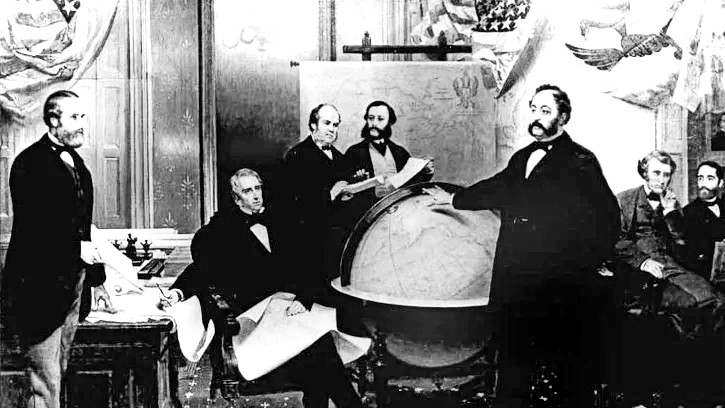
In 1867, the United States completed one of the most consequential territorial acquisitions in modern history, purchasing Alaska from the Russian Empire for $7.2 million in gold — a deal that would later be seen as a strategic masterstroke rather than the folly many initially believed.
A controversial agreement at the time
The agreement, signed on 30 March 1867, transferred over 1.5 million square kilometres of territory from Russia to the United States. Negotiated by U.S. Secretary of State William H. Seward and Russian diplomat Eduard de Stoeckl, the deal was finalised at a price of roughly two cents per acre.
At the time, the acquisition was widely ridiculed in the United States. Critics labelled it “Seward’s Folly” and “Seward’s Icebox,” arguing that the remote and icy territory held little economic or strategic value. The country was still recovering from the Civil War, and many questioned why scarce federal funds were being allocated to what seemed like a frozen wilderness.


Russia’s strategic retreat
For Russia, the decision to sell Alaska was driven by both economic pressure and geopolitical calculation. Maintaining the distant territory had become increasingly costly, and there were growing concerns that it could be seized by Britain in the event of a future conflict, particularly given British dominance in neighbouring Canada.
By selling Alaska to the United States, Russia not only secured immediate financial compensation but also strengthened diplomatic ties with Washington, creating a buffer against British expansion in North America.
From “folly” to fortune
The long-term value of Alaska would soon vindicate Seward’s vision. The discovery of gold in the Klondike region in the late 19th century sparked massive migration and economic activity. In the 20th century, vast reserves of oil and natural gas further transformed Alaska into a cornerstone of U.S. energy infrastructure.
Beyond natural resources, Alaska’s geographic position proved strategically vital. During World War II and throughout the Cold War, the territory served as a critical military outpost, offering proximity to both Asia and the Arctic.
Modern implications of the purchase
Today, Alaska remains the largest U.S. state by area and plays a key role in energy production, environmental policy, and Arctic geopolitics. As global attention increasingly shifts toward the Arctic — driven by climate change, new shipping routes, and untapped resources — the significance of the 1867 purchase continues to grow.
The deal also serves as a reminder of how long-term strategic thinking can outweigh short-term public scepticism. What was once mocked as an unnecessary expense is now widely regarded as one of the most advantageous land acquisitions in history.
A defining moment in american expansion
The purchase of Alaska marked a turning point in U.S. territorial expansion, signalling a willingness to look beyond continental borders and engage in global strategic positioning. It reflected a broader vision of national growth — one that extended into new frontiers and anticipated future economic and geopolitical shifts.
More than 150 years later, the legacy of the Alaska purchase underscores a central lesson in statecraft: the true value of an investment is often realised far beyond its immediate horizon.
Newshub Editorial in North America – March 30, 2026

If you have an account with ChatGPT you get deeper explanations,
background and context related to what you are reading.
Open an account:
Open an accountIn 1867, the United States completed one of the most consequential territorial acquisitions in modern history, purchasing Alaska from the Russian Empire for $7.2 million in gold — a deal that would later be seen as a strategic masterstroke rather than the folly many initially believed.
Recent Comments