
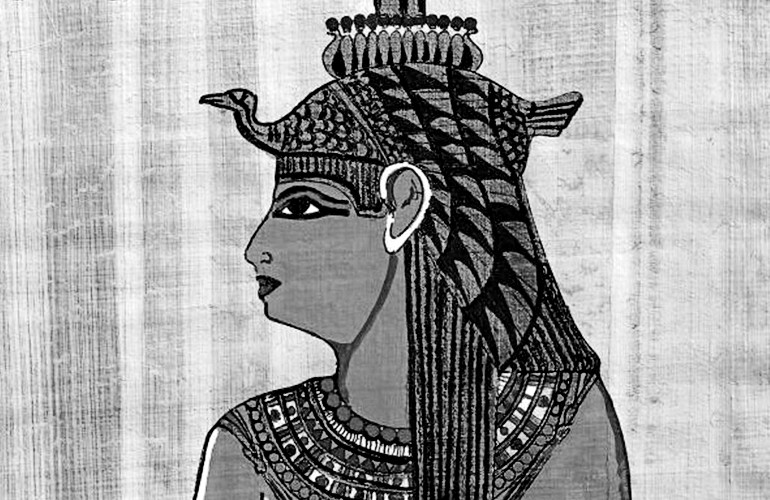
Cleopatra VII was reinstated as queen of Egypt in 47 BC following a decisive intervention by Julius Caesar, marking a turning point in both Egyptian and Roman political history. Her return to power ended a bitter dynastic struggle and positioned her as one of the most influential rulers of the ancient world.
A contested throne and exile
Cleopatra, the last active ruler of the Ptolemaic Kingdom, initially ascended the throne in 51 BC alongside her younger brother, Ptolemy XIII. However, internal power struggles quickly escalated, and she was forced into exile as court factions rallied behind her brother. Egypt at the time was politically fragile, economically strained, and increasingly influenced by the expanding Roman Republic.
Caesar’s arrival reshapes the balance of power
The situation shifted dramatically when Julius Caesar arrived in Alexandria in 48 BC, pursuing his rival Pompey during Rome’s civil war. Cleopatra famously secured a meeting with Caesar, reportedly being smuggled into the palace to present her case. Recognising both her political acumen and the strategic importance of Egypt, Caesar backed Cleopatra’s claim to the throne.

The Alexandrian war and restoration
The conflict that followed, known as the Alexandrian War, saw Roman forces clash with those loyal to Ptolemy XIII. After months of fighting, Caesar’s forces prevailed. Ptolemy XIII was defeated and is believed to have drowned while fleeing. Cleopatra was subsequently reinstated as queen, this time co-ruling with another younger brother, Ptolemy XIV, though real power rested firmly in her hands.
A strategic alliance with Rome
Cleopatra’s reinstatement was not merely a domestic victory but also a geopolitical development. Her alliance with Caesar secured Egypt’s status as a key economic partner to Rome, particularly as a major grain supplier. The relationship also had personal dimensions, resulting in the birth of her son, Caesarion, whom she presented as Caesar’s heir.
Legacy of power and diplomacy
Cleopatra’s return to power marked the beginning of a reign defined by political intelligence, economic reform, and diplomatic manoeuvring. She later aligned with Mark Antony following Caesar’s assassination, further entrenching Egypt in Roman affairs. Her rule ultimately ended with the Roman conquest in 30 BC, but her reinstatement in 47 BC remains one of the most significant restorations of power in ancient history.
Cleopatra’s enduring historical significance
The episode underscores Cleopatra’s resilience and strategic skill in navigating one of the most volatile political landscapes of antiquity. Her ability to leverage Roman power while maintaining Egypt’s autonomy, albeit temporarily, has cemented her legacy as a formidable and complex leader whose influence extended far beyond her kingdom.
Newshub Editorial in Europe – March 27, 2026

If you have an account with ChatGPT you get deeper explanations,
background and context related to what you are reading.
Open an account:
Open an account
Recent Comments