
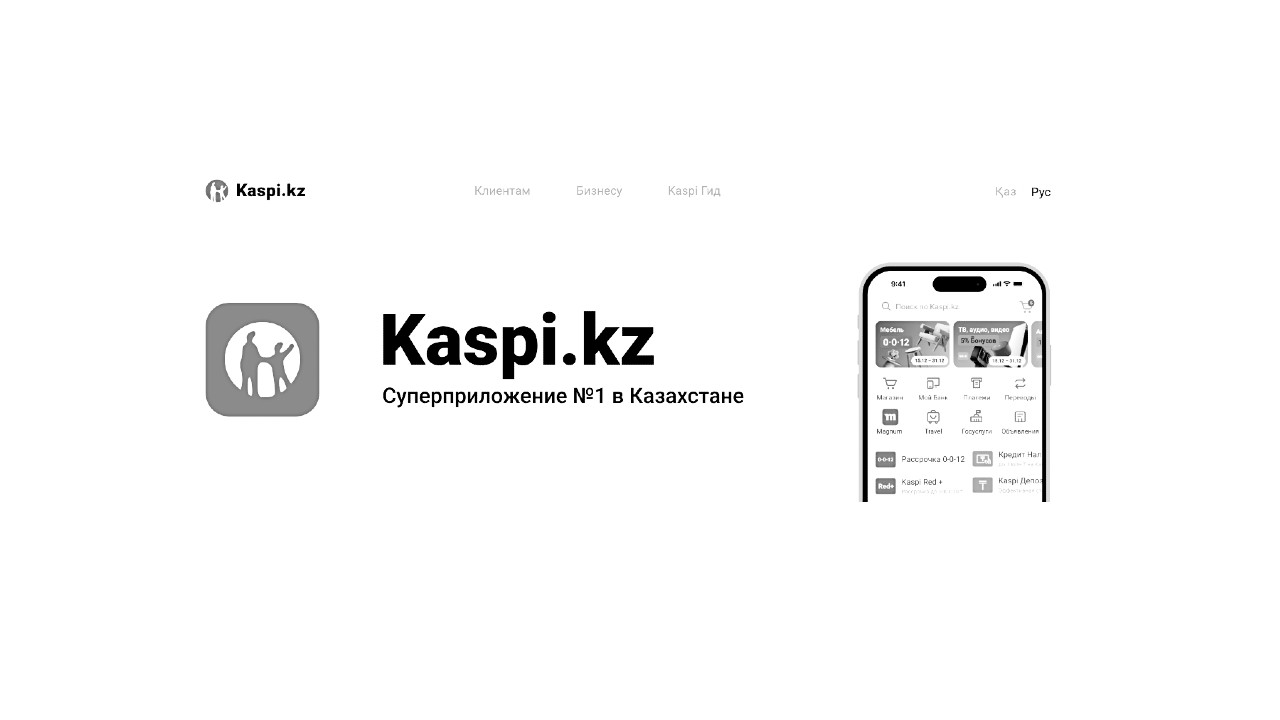
A Kazakh super app has become one of the clearest examples of how a company in an emerging market can thrive by building daily-life services around the smartphone. Kaspi.kz, based in Kazakhstan, has turned mobile payments, shopping, consumer finance, travel bookings and merchant tools into one integrated ecosystem, creating a model that is increasingly relevant far beyond Central Asia. The company describes itself as the country’s largest payments, marketplace and fintech ecosystem, with all services brought together in one mobile app.
A super app built for routine use
What makes Kaspi.kz notable is not simply that it offers digital finance. It has embedded itself into everyday consumer behaviour. According to its 2024 annual report, the Kaspi.kz Super App had 14.7 million average monthly active users at the end of 2024, with a 68% DAU-to-MAU ratio and 73 monthly transactions per active consumer. That is a high level of engagement by any standard, and especially striking in an emerging-market context.
The app’s utility is broad. Consumers can make person-to-person transfers, pay household bills, use QR-based payments in-store and online, shop in the marketplace, arrange delivery, book travel and access financial products. Merchants, meanwhile, use Kaspi Pay tools for payments, tax reporting, invoicing and business accounts. This creates a two-sided network effect in which consumer activity drives merchant adoption, and merchant adoption reinforces consumer loyalty.

Strong numbers confirm the model is working
Kaspi.kz’s latest financial results show that this smartphone-led ecosystem is not merely popular but highly profitable. In full-year 2024, revenue rose 32% year on year to KZT2.5 trillion, while net income increased 25%. Marketplace GMV rose 44% for the year, payments transaction volume continued to expand strongly, and e-commerce GMV surged 85%. The company also said its payments and marketplace platforms together accounted for 69% of consolidated net income in 2024, underlining the commercial strength of smartphone-based usage.
This matters because many emerging markets share similar structural conditions: high mobile adoption, uneven legacy banking infrastructure, fragmented retail channels and a large opportunity to leapfrog directly into app-based commerce and finance.
Why the Kaspi.kz story matters
Kaspi.kz demonstrates that in emerging markets, the smartphone is no longer merely a communication device. It is becoming the primary gateway to payments, credit, retail, logistics and day-to-day economic participation. Companies that can integrate these functions elegantly, securely and at scale can build very powerful positions.
The model also carries broader strategic significance. Rather than copying a Western single-service platform, Kaspi.kz has built a local ecosystem shaped by the practical needs of consumers and merchants in Kazakhstan. That is often where the strongest emerging-market businesses win: not by replicating Silicon Valley, but by solving local friction points better.
A blueprint for the next wave
Kaspi.kz is therefore more than a successful Kazakh company. It is a case study in how smartphone-centred services can drive financial inclusion, digital commerce and sustained profitability in an emerging market. For investors, founders and policymakers, it offers a clear signal that some of the most important digital business models of the next decade may come not from mature economies, but from markets where the smartphone has become the operating system of everyday life.
Newshub Editorial in Asia – March 20, 2026

If you have an account with ChatGPT you get deeper explanations,
background and context related to what you are reading.
Open an account:
Open an account
Recent Comments