
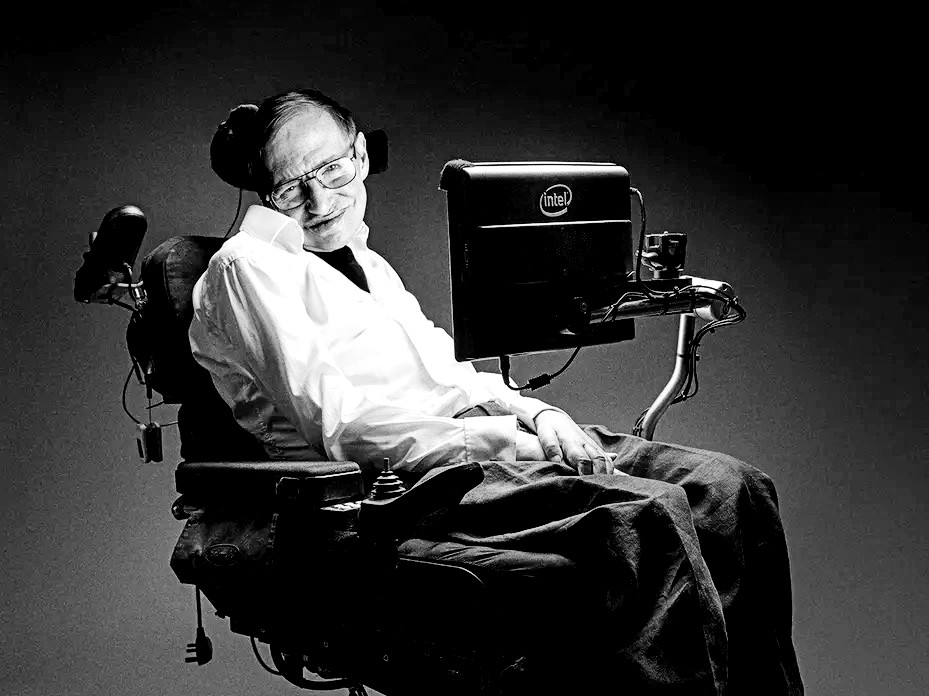
Stephen Hawking, one of the most influential theoretical physicists of the modern era, transformed humanity’s understanding of black holes, cosmology and the fundamental laws of the universe. Despite being diagnosed with a debilitating motor neurone disease at the age of 21, Hawking produced groundbreaking work that bridged the worlds of quantum mechanics and general relativity, while becoming a global symbol of scientific perseverance and curiosity.
Early life and academic rise
Born on 8 January 1942 in Oxford, England, Stephen William Hawking grew up in a household that valued education and intellectual curiosity. His father was a medical researcher and his mother an active academic thinker, shaping an environment where scientific discussion was common.
Hawking studied physics at the University of Oxford before moving to Cambridge for graduate work in cosmology. During his early doctoral studies, he received the devastating diagnosis of amyotrophic lateral sclerosis (ALS), a progressive neurological disease expected to end his life within a few years. Instead, Hawking defied medical expectations and continued working for more than five decades.

At Cambridge, Hawking began exploring fundamental questions about the origin and structure of the universe. His early research, conducted alongside mathematician Roger Penrose, demonstrated that Einstein’s theory of general relativity implied the existence of singularities — points where spacetime curvature becomes infinite — such as those believed to exist at the centre of black holes and at the beginning of the universe.
The discovery of Hawking radiation
Hawking’s most famous contribution came in 1974 when he proposed that black holes are not completely “black”. By applying principles of quantum mechanics to the event horizon of a black hole, he showed that particle–antiparticle pairs could form near the boundary and allow energy to escape.
This theoretical process, now known as Hawking radiation, suggested that black holes slowly lose mass and can eventually evaporate entirely. The idea shocked the physics community because it linked gravity, quantum theory and thermodynamics in a single framework — a step toward the long-sought theory of quantum gravity.
The concept also introduced the famous “black hole information paradox,” raising profound questions about whether information that falls into a black hole can ever be recovered. That puzzle remains one of the central unresolved problems in theoretical physics.
A public face of science
Beyond academic research, Hawking became one of the most recognisable scientists in the world. His 1988 book A Brief History of Time brought complex cosmological ideas to a mass audience and sold more than 25 million copies worldwide.
The book explained concepts such as the Big Bang, black holes and the nature of time in language accessible to non-scientists. Hawking believed strongly that understanding the universe should not be limited to specialists and often spoke about humanity’s place in the cosmos.
Confined to a wheelchair and communicating through a speech-generating device after losing his natural voice, Hawking nevertheless travelled widely, lectured internationally and appeared frequently in popular culture. His distinctive electronic voice became instantly recognisable, symbolising both resilience and intellectual brilliance.
Scientific legacy and final years
Hawking held the prestigious Lucasian Professorship of Mathematics at the University of Cambridge from 1979 to 2009 — a chair once held by Isaac Newton. Over his career he published numerous influential papers and collaborated with leading physicists worldwide.
His later work explored topics such as the multiverse, cosmic inflation and the quantum structure of spacetime. Hawking also warned about global risks, including uncontrolled artificial intelligence and environmental threats, urging humanity to think long-term about survival and exploration.
Stephen Hawking died on 14 March 2018 at the age of 76. His death marked the passing of one of the most extraordinary scientific minds of the past century, yet his ideas continue to shape modern physics and cosmology.
Today, Hawking’s work remains central to the ongoing effort to understand the deepest laws governing the universe — from the birth of spacetime to the mysterious fate of black holes.
Newshub Editorial in Europe — March 14, 2026

If you have an account with ChatGPT you get deeper explanations,
background and context related to what you are reading.
Open an account:
Open an account
Recent Comments