
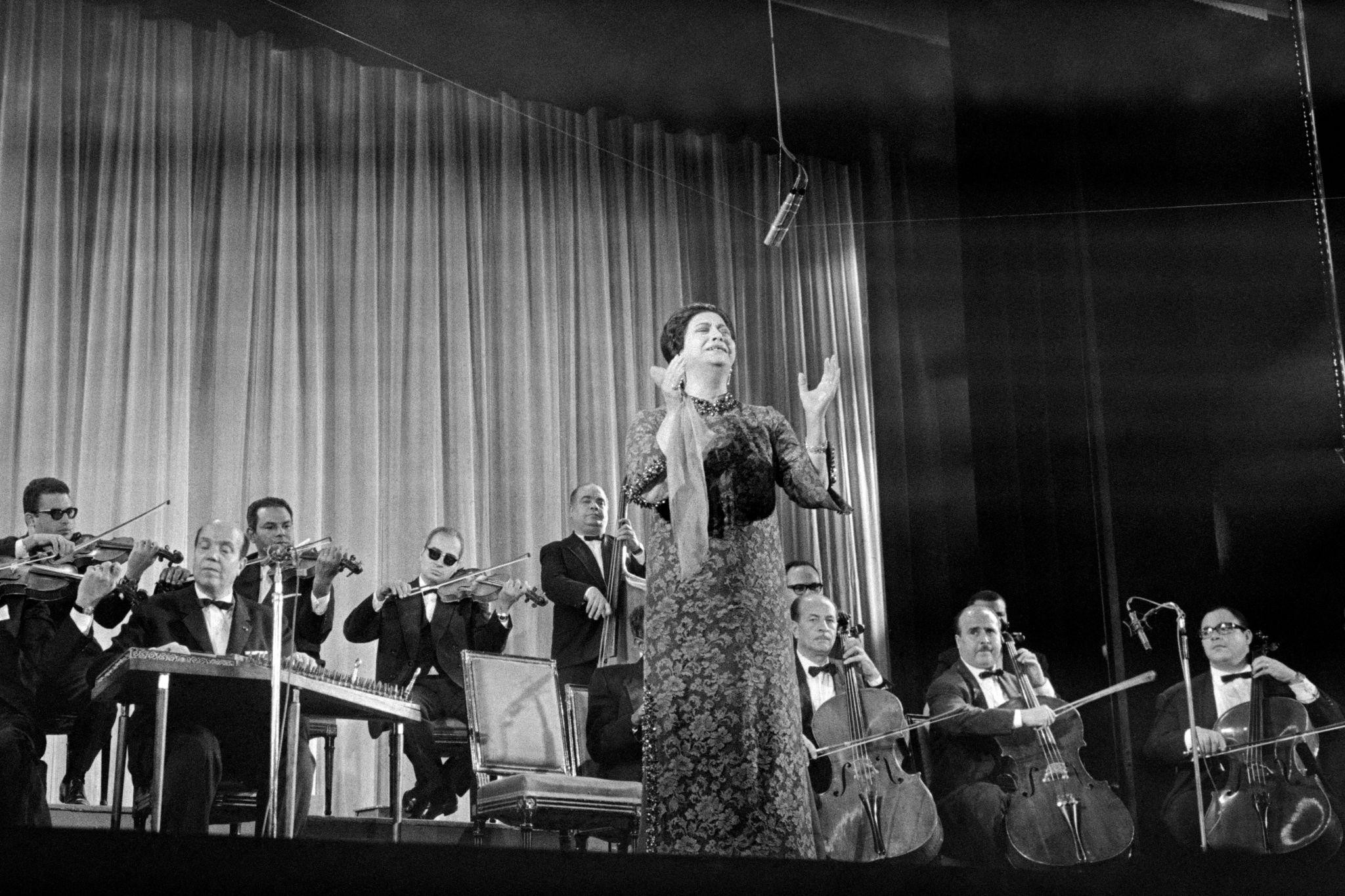
Umm Kulthūm was more than a singer. She was a national institution, a political symbol, and a unifying cultural force whose voice defined Arabic music for the twentieth century. Her influence reached far beyond Egypt, shaping artistic identity across the Middle East and the wider Arab diaspora.
From rural Egypt to Cairo’s grand stages
Born in rural Egypt at the turn of the century, Umm Kulthūm began her musical life performing religious chants. Her extraordinary vocal control and emotional precision quickly set her apart. After moving to Cairo in the 1920s, she entered a rapidly modernising cultural scene, where traditional Arabic forms were being reshaped for radio, cinema, and mass audiences. She mastered this transition without abandoning classical foundations, becoming both guardian and innovator of Arab musical heritage.
A voice built on discipline and authority
Umm Kulthūm’s performances were defined by vocal power, extended improvisation, and absolute command of rhythm and language. Her concerts often featured a single song lasting over an hour, with verses repeated and reshaped in response to audience reaction. This interactive form, known as tarab, created a shared emotional experience that turned concerts into collective rituals rather than passive entertainment.

Music and politics intertwined
Her career became closely linked with Egyptian national identity, particularly during the era of President Gamal Abdel Nasser. Umm Kulthūm performed patriotic songs that supported post-colonial pride and pan-Arab unity. At the same time, her artistic authority allowed her to remain independent of political cycles. She was respected not merely as a cultural figurehead, but as a serious artist whose work stood on its own merit.
Media, technology, and mass reach
The rise of radio was central to Umm Kulthūm’s reach. Her monthly live broadcasts effectively stopped public life across much of the Arab world, with streets emptying and cafés filling as listeners gathered around radios. Recordings of these performances circulated widely, giving her an unmatched presence long before the age of global streaming and digital media.
Economic and institutional impact
Umm Kulthūm’s concerts generated significant revenue, and her benefit performances helped fund national causes, including military and reconstruction efforts. She demonstrated how cultural capital could translate into economic and institutional power, reinforcing the idea that artists could act as pillars of national infrastructure rather than peripheral entertainers.
Enduring legacy
Decades after her death, Umm Kulthūm remains a benchmark for vocal excellence and artistic seriousness. Her recordings continue to be studied by musicians and revered by audiences across generations. In an era of rapidly changing media formats, her career stands as evidence that depth, discipline, and authenticity can sustain relevance far beyond a single lifetime.
Bottom line
Umm Kulthūm was not simply Egypt’s greatest singer. She was a cultural system in herself, shaping taste, identity, and collective memory across the Arab world. Her legacy endures because it was built on mastery, authority, and a rare ability to turn music into shared national experience.
Newshub Editorial in Africa – 3 February 2026

If you have an account with ChatGPT you get deeper explanations,
background and context related to what you are reading.
Open an account:
Open an account
Recent Comments