
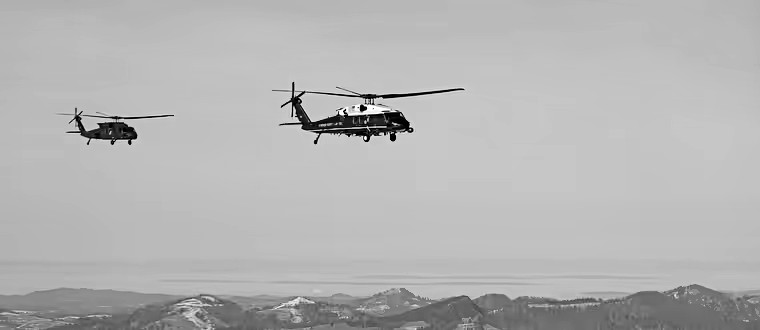
Donald Trump made a highly symbolic return to the World Economic Forum in Davos on Tuesday, arriving by helicopter and drawing one of the longest queues seen at the conference in recent years, underlining both his polarising influence and enduring global relevance.
Security was tight as the helicopter touched down near the Congress Centre, a familiar scene in Davos but one that carried added weight given Trump’s status as the current US president and his disruptive approach to global politics. His arrival immediately dominated the informal conversations that ripple through the Alpine resort during WEF week, with delegates, investors and policymakers recalibrating their schedules to secure a seat at his address.
An unusually long queue for a single speech

Well before the scheduled start, lines stretched through corridors and outdoor security checkpoints as attendees waited to hear Trump speak. WEF veterans remarked that queues of this scale are typically reserved for moments of acute crisis or landmark announcements. The anticipation reflected not just curiosity, but a recognition that Trump’s words can move markets, shift diplomatic expectations and reshape narratives well beyond the conference halls.
Unlike many Davos speeches that emphasise consensus and multilateralism, Trump’s appearances are often viewed as events rather than policy briefings. Attendees expected blunt language, clear positioning, and signals aimed as much at domestic audiences as at the global elite gathered in Switzerland.
A contrast with the Davos consensus culture
Trump’s presence stood in sharp contrast to the traditional tone of the World Economic Forum, which has long promoted cooperation, climate commitments and institutional stability. For many delegates, the queue itself became a metaphor for the current global moment: uncertainty, fragmentation and the search for clarity in a shifting order.
Executives from Europe and Asia noted privately that they were listening less for diplomatic overtures and more for hints about trade, tariffs and currency policy. In that sense, the long wait to hear Trump was also a reflection of how dependent global business remains on US political direction.
Symbolism as strategy
Arriving by helicopter was not merely a logistical decision. In Davos, symbolism matters. The visual reinforced Trump’s image as a leader who operates above conventional frameworks, comfortable with spectacle and direct engagement. Supporters saw strength and decisiveness; critics saw theatricality. Either way, attention was guaranteed.
For the World Economic Forum, Trump’s appearance ensured global headlines and reaffirmed Davos as a stage where power, politics and capital intersect. For Trump, it offered a chance to speak directly to an audience that has often been sceptical of his worldview, while reminding them that his policies continue to shape their operating environment.
Global reactions beyond the mountain resort
As Trump took the stage, reactions were already rippling beyond Davos. Financial markets, policy circles and media outlets worldwide parsed not only his remarks but the scale of interest they generated. The long queue became a story in itself, signalling that despite deep divisions, Trump remains one of the few leaders capable of commanding near-universal attention in a fragmented world.
Whether embraced or resisted, his Davos appearance underscored a simple reality: in today’s geopolitical climate, few voices carry as much weight—or provoke as much anticipation—as Donald Trump’s.
Newshub Editorial in Europe – 21 January 2026

If you have an account with ChatGPT you get deeper explanations,
background and context related to what you are reading.
Open an account:
Open an account
Recent Comments