
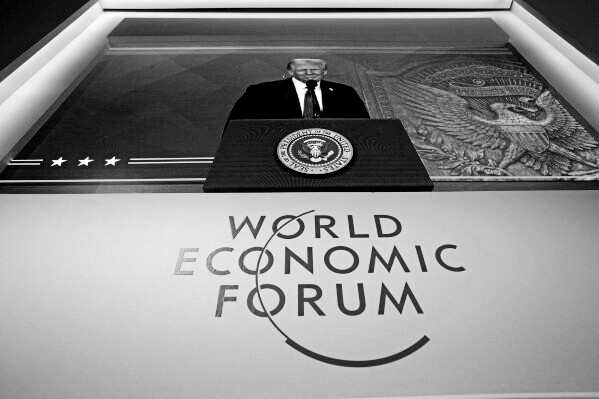
Former central bank governor Mark Carney delivered a stark message to global leaders at the World Economic Forum in Davos, declaring that the old world order is “not coming back” as geopolitical fragmentation accelerates and Donald Trump prepares to re-enter the global stage in Switzerland.
Speaking to political and business leaders in the Swiss Alps, Mark Carney argued that the assumptions underpinning globalisation over the past three decades have fundamentally broken down. According to Carney, the combination of strategic rivalry, economic nationalism, and weakened multilateral institutions has permanently altered how power, trade, and capital flow across borders.
A decisive break with the post-Cold War era
Carney’s remarks framed the current moment as a structural rupture rather than a temporary disruption. He said the era defined by open markets, predictable rules, and U.S.-led economic coordination has given way to a fragmented system shaped by national security priorities and political leverage. In this environment, he warned, countries and corporations can no longer rely on global frameworks that once guaranteed stability and efficiency.

Trump’s presence sharpens the message
The timing of Carney’s comments carried particular weight as Donald Trump headed to Switzerland, reinforcing Davos’ focus on political power and economic confrontation. Trump’s return to international prominence has revived debates around tariffs, currency pressure, and transactional diplomacy. For many delegates, Carney’s warning reflected the reality that these policies are not an anomaly, but part of a broader shift away from consensus-driven global governance.
Markets and institutions under pressure
Carney highlighted that financial markets are already adapting to this new reality. Capital allocation is increasingly influenced by geopolitics rather than pure efficiency, while supply chains are being redesigned for resilience and control rather than cost optimisation. He cautioned that institutions built for cooperation now face legitimacy challenges, as national governments prioritise domestic stability over global coordination.
A call for strategic realism
Rather than offering nostalgia for the past, Carney urged policymakers and corporate leaders to accept the permanence of change. He stressed the need for strategic realism: understanding that economic policy is now inseparable from security considerations, and that global shocks are likely to become more frequent and more political. Adaptation, he argued, will define success more than resistance.
Implications for Europe and the global economy
For Europe, the message was particularly pointed. Carney suggested that the continent must rethink its economic dependencies, regulatory frameworks, and defence of strategic industries. More broadly, his speech underscored that the future global system will be multipolar, contested, and less predictable — a world where power is exercised openly rather than embedded quietly in institutions.
Carney’s intervention at World Economic Forum set a sober tone for discussions in Davos. As leaders gathered against the backdrop of renewed political confrontation, his conclusion was unambiguous: the old order is not paused, it is finished — and planning for its return is a strategic mistake.
Newshub Editorial in Europe – 21 January 2026

If you have an account with ChatGPT you get deeper explanations,
background and context related to what you are reading.
Open an account:
Open an account
Recent Comments