
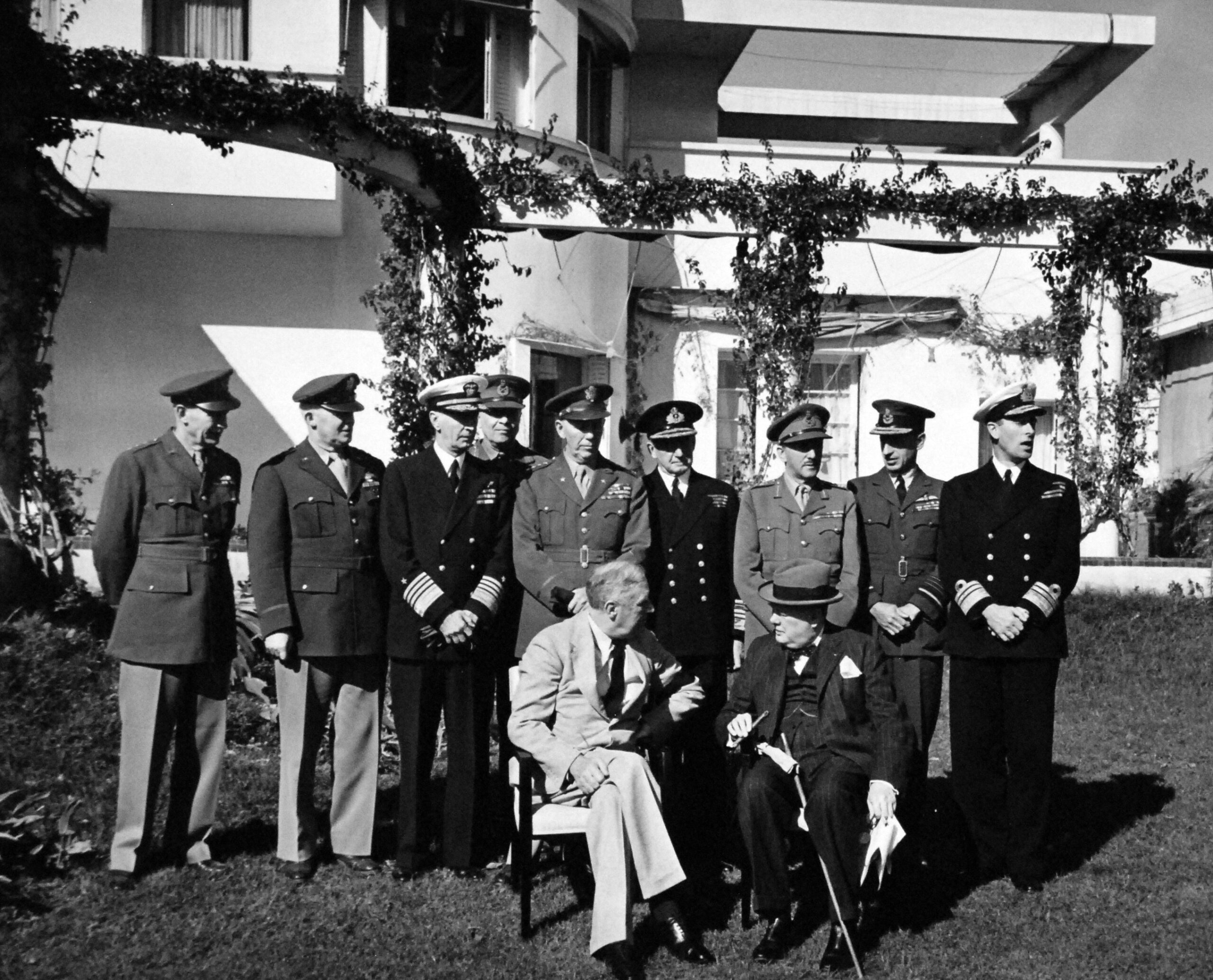
In January 1943, British Prime Minister Winston Churchill and U.S. President Franklin D. Roosevelt met in wartime secrecy in Morocco for a pivotal summit that would redefine Allied strategy in the Second World War. The meeting, later known as the Casablanca Conference, marked a decisive moment in Anglo-American cooperation and set a clear political and military direction for the remainder of the conflict.
A clandestine gathering in North Africa
Held in the Moroccan port city of Casablanca shortly after Allied forces landed in North Africa, the conference brought together senior Allied leaders under tight security. At the time, North Africa had become a critical theatre following Operation Torch, and the Allies were consolidating their foothold against Axis forces. The location reflected both strategic necessity and political symbolism: the Allies were meeting on territory freshly secured from Axis influence, underscoring momentum and confidence.
Strategic priorities and hard choices
Churchill and Roosevelt used the conference to align their military priorities for 1943. A central question was where to strike next. While the Soviet Union pressed for an immediate second front in Western Europe to relieve pressure on the Eastern Front, the Western Allies concluded that an invasion of France was not yet feasible. Instead, they agreed to continue operations in the Mediterranean, targeting Sicily and Italy to weaken the Axis from the south, stretch German resources, and gain further operational experience.

The declaration of “unconditional surrender”
The most enduring outcome of the conference was the announcement that the Allies would accept nothing less than the unconditional surrender of the Axis powers. Roosevelt publicly articulated this policy at a press conference at the end of the meeting, with Churchill standing alongside him. The declaration was intended to present unity, remove ambiguity about Allied aims, and prevent any separate peace deals. It also sent a clear signal to both enemies and occupied populations that the war would end only with the total defeat of Nazi Germany, Fascist Italy, and Imperial Japan.
Alliance politics and leadership dynamics
The Casablanca meeting highlighted the evolving balance within the Allied leadership. Roosevelt, constrained by disability, undertook a risky wartime journey, demonstrating the importance Washington attached to direct coordination with London. Churchill, seasoned and rhetorically powerful, played a key role in shaping the Mediterranean strategy. Their partnership, while not without tensions, was characterised by mutual respect and a shared understanding that political resolve was as important as military planning.
Consequences for the wider war
The decisions taken at Casablanca had far-reaching consequences. The Mediterranean campaign ultimately led to Italy’s surrender later in 1943, removing one Axis power from the war. At the same time, the unconditional surrender doctrine hardened German resistance but also simplified Allied diplomacy and post-war planning. The conference reinforced the image of a united Anglo-American front, providing reassurance to the Soviet Union while signalling long-term commitment to victory.
Casablanca in historical perspective
Today, the Casablanca Conference stands as a defining moment in Allied wartime coordination. It illustrated how strategy, politics, and messaging were intertwined at the highest level. The meeting between Churchill and Roosevelt did not merely plan battles; it articulated a vision for how the war would be fought and how it would end, leaving a lasting imprint on twentieth-century history.
Newshub Editorial in Africa – 17 January 2026

If you have an account with ChatGPT you get deeper explanations,
background and context related to what you are reading.
Open an account:
Open an account
Recent Comments