
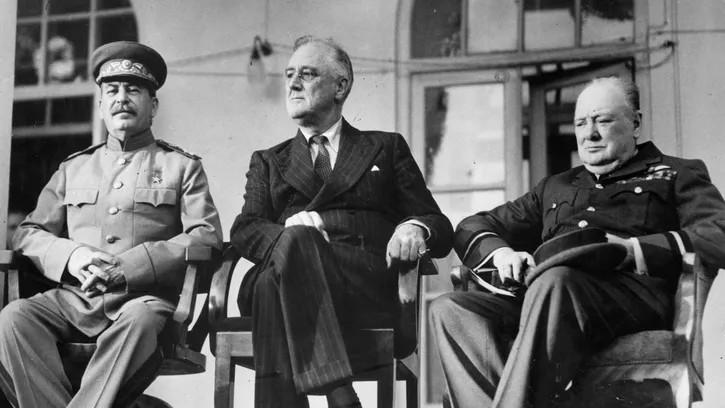
Held in the Iranian capital in late 1943, the Tehrān Conference brought together Franklin D. Roosevelt, Winston Churchill, and Joseph Stalin for the first face-to-face meeting of the ‘Big Three’, forging key decisions that shaped the final phase of the Second World War and the post-war order.
Strategic priorities take centre stage
The conference, held from 28 November to 1 December 1943, marked a turning point in Allied cooperation. With the Axis powers still formidable, Roosevelt, Churchill, and Stalin met to coordinate military strategies on a global scale. The most decisive outcome was the agreement to launch Operation Overlord — the long-awaited Allied invasion of Nazi-occupied Western Europe. This operation, later known as D-Day, was confirmed as a priority, addressing Stalin’s repeated call for a second front to relieve pressure on the Soviet Union’s vast and costly eastern campaign.
Managing tensions within the alliance
The personal dynamics among the three leaders were as influential as the formal agenda. Roosevelt sought to build a direct rapport with Stalin, believing that mutual trust was essential for both wartime success and post-war stability. Churchill, while advocating a Mediterranean focus, conceded to the joint decision on Northern France. Despite ideological differences and competing visions for Europe’s future, the leaders displayed a degree of unity rare for such a complex alliance.


Decisions that shaped post-war Europe
Beyond battlefield coordination, the Tehrān discussions laid the groundwork for major geopolitical changes. The leaders reaffirmed their commitment to the unconditional surrender of Germany and touched on the future of Eastern Europe, notably Poland. Although the details would be revisited at later conferences, Tehrān established the foundations of what would eventually become the post-war sphere-of-influence structure across the continent. Their talks also considered the formation of a new global organisation to preserve peace, an idea that would later evolve into the United Nations.
The human cost and urgency of cooperation
All three leaders understood that Allied unity was essential to end a conflict that had already claimed millions of lives. Stalin emphasised the immense Soviet sacrifices on the Eastern Front, while Roosevelt pressed the need for rapid and coordinated action. Churchill, drawing on Britain’s earlier years of resistance, stressed the moral and strategic imperative to defeat the Axis powers decisively. The sense of urgency permeated every discussion, underscoring the high stakes of the negotiations.
A moment that defined the Allied partnership
The Tehrān Conference succeeded in aligning strategies, reducing tensions among the Allied leaders, and accelerating military plans that ultimately hastened the end of the war in Europe. It also marked the emergence of Roosevelt, Churchill, and Stalin as the central architects of both victory and the geopolitical landscape that followed. Though later conferences would test their cooperation further, Tehrān remains a pivotal moment in the wartime alliance.
Newshub Editorial in Europe – 2025-11-28
Held in the Iranian capital in late 1943, the Tehrān Conference brought together Franklin D. Roosevelt, Winston Churchill, and Joseph Stalin for the first face-to-face meeting of the ‘Big Three’, forging key decisions that shaped the final phase of the Second World War and the post-war order.
Recent Comments