
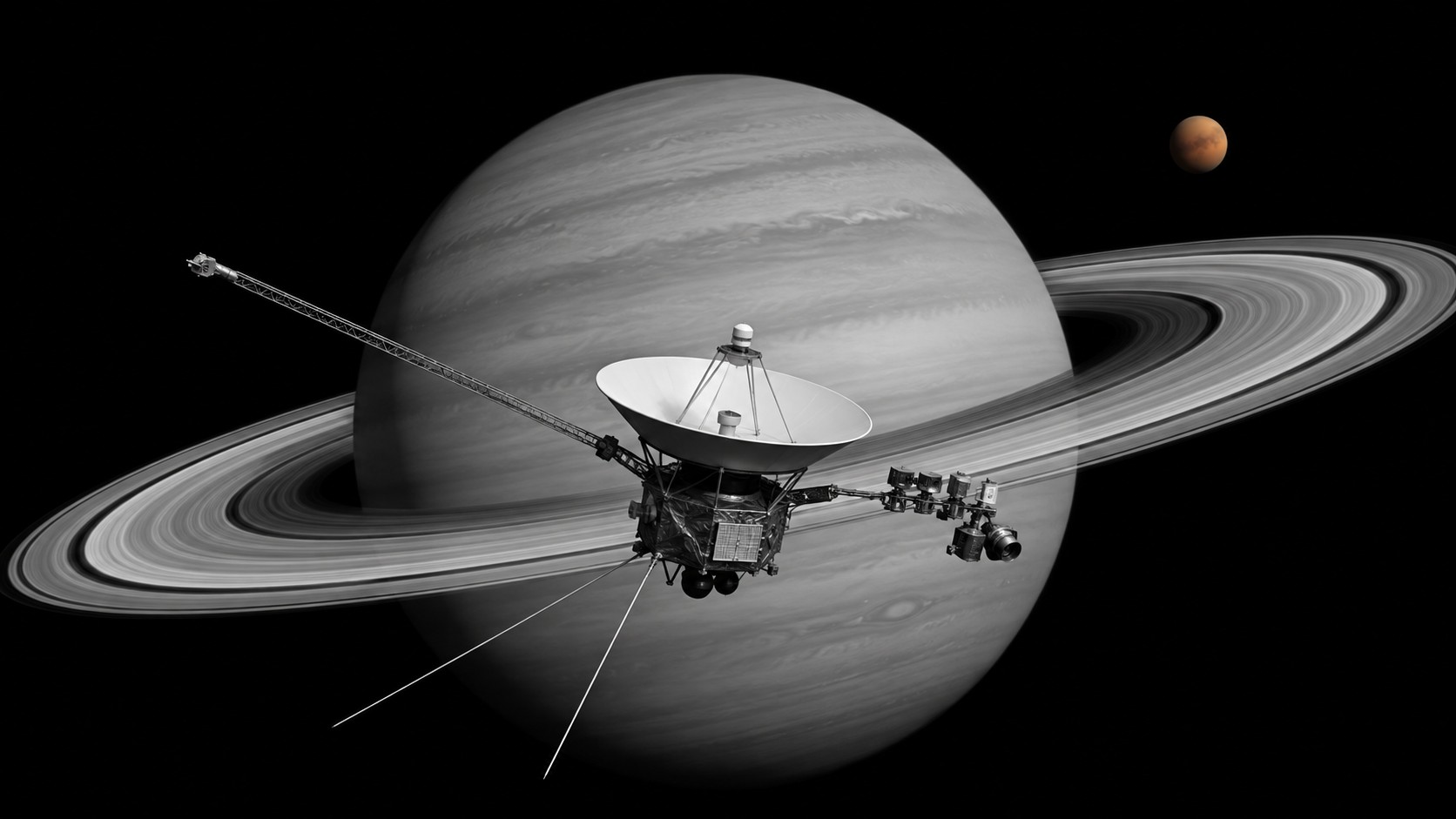
NASA’s Voyager 1 swept past Saturn on 12 November 1980, passing about 126,000 kilometres above the planet’s cloud tops. The flyby revealed fine structures in the rings and found that Saturn’s largest moon, Titan, was wrapped in a thick, nitrogen-rich atmosphere.
A closer look at Saturn’s rings
Voyager 1 reached Saturn three years after its launch and 20 months after its encounter with Jupiter. At its closest approach, at 23.46 UTC, the spacecraft was completing a passage through a planetary system whose rings had been studied from Earth for centuries. Its cameras showed that the broad bands visible through telescopes were made up of hundreds of narrow ringlets. Even some of the apparent gaps contained rings of their own.
The encounter also gave scientists a closer look at the relationship between Saturn’s rings and its small moons. Near the narrow F ring, the gravity of so-called shepherd moons helped shape the paths of ring particles. Voyager photographed several of Saturn’s larger moons during the encounter, including Mimas, Enceladus and Rhea.


Titan’s surface stayed hidden
Voyager 1 passed within about 4,000 kilometres of Titan earlier that day. A thick haze kept the surface out of view, but the spacecraft’s instruments showed that nitrogen dominated the atmosphere. They also detected methane and more complex hydrocarbons, giving scientists a reason to investigate the chemistry taking place beneath the haze.
That close pass came with a trade-off. The trajectory needed to study Titan sent Voyager 1 out of the plane in which most planets orbit the Sun, ruling out further planetary flybys. Its twin, Voyager 2, went on to visit Uranus and Neptune.
Titan’s surface remained unseen at close range until January 2005, when the European Space Agency’s Huygens probe descended by parachute and sent back photographs from the ground. It was the first spacecraft landing in the outer solar system. Voyager 1, meanwhile, continued on the course that took it into interstellar space in 2012.
NewsHub Finance | History | 12 November 2026
NASA’s Voyager 1 swept past Saturn on 12 November 1980, passing about 126,000 kilometres above the planet’s cloud tops. The flyby revealed fine structures in the rings and found that Saturn’s largest moon, Titan, was wrapped in a thick, nitrogen-rich atmosphere.

Recent Comments