
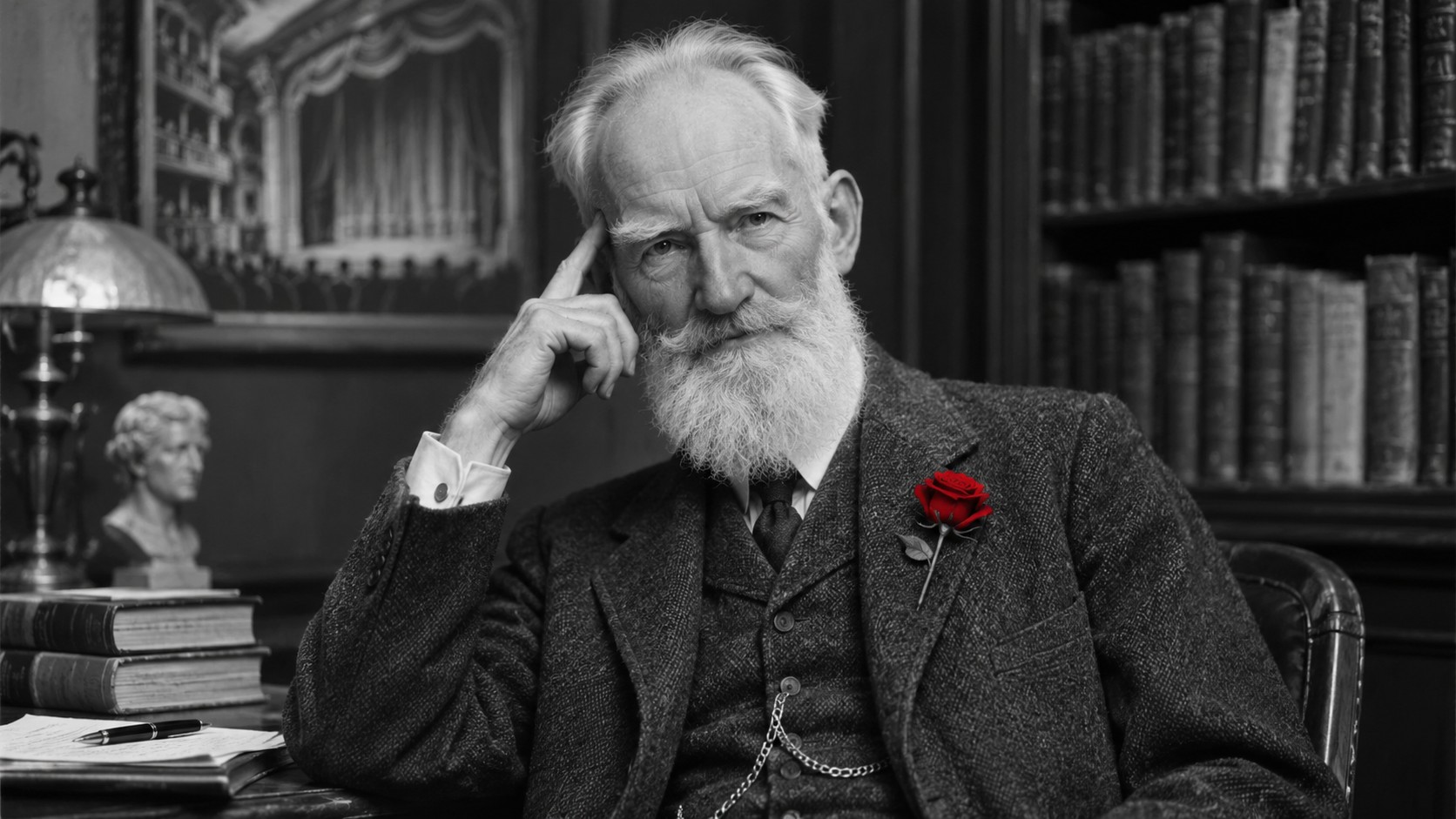
On 2 November 1950, Irish playwright, critic and Nobel laureate George Bernard Shaw died at his home in England, aged 94. One of the most influential literary figures of the modern era, Shaw transformed British theatre through his sharp wit, political commentary and relentless challenges to social conventions.
From Dublin to literary greatness
Born in Dublin on 26 July 1856, Shaw moved to London in 1876, initially struggling to establish himself as a writer. He worked as a journalist, music critic and theatre reviewer before becoming one of the most celebrated dramatists of his generation.
His plays frequently challenged traditional attitudes towards marriage, class, religion, economics and politics. Unlike many contemporary playwrights, Shaw believed theatre should provoke intellectual debate rather than merely entertain audiences.


Among his most acclaimed works were Pygmalion, Man and Superman, Major Barbara and Saint Joan. His dialogue, combining humour with social criticism, helped redefine modern drama.
A Nobel Prize with an unusual response
In 1925, Shaw was awarded the Nobel Prize in Literature, recognising his exceptional contribution to drama and his distinctive combination of idealism, humanity and satire.
However, his response was characteristically unconventional. Although he eventually accepted the honour, he refused the accompanying prize money, suggesting it should support the translation of Swedish literature into English.
The award cemented his international reputation as one of the greatest playwrights since William Shakespeare.
nobelprize.org+1
From the theatre to Hollywood
Shaw’s influence extended beyond the stage. His celebrated play Pygmalion, exploring language, education and British class divisions, was adapted into a successful film in 1938.
The screenplay earned Shaw an Academy Award, making him the first individual to receive both a Nobel Prize in Literature and an Oscar.
The story would later inspire the immensely successful stage musical and film My Fair Lady, introducing Shaw’s characters and social observations to new generations.
A remarkable life comes to an end
Despite advancing age, Shaw remained intellectually active and continued writing into his nineties.
His health deteriorated following a fall while gardening at Shaw’s Corner, his home in Ayot St Lawrence, Hertfordshire. He died on 2 November 1950, leaving behind an extraordinary literary legacy spanning more than six decades.
His ashes were eventually combined with those of his wife, Charlotte, who had died in 1943, and scattered in their garden.
Dictionary of Irish Biography+1
Seventy-six years after his death, Shaw remains a defining figure in modern literature. His fearless criticism of inequality, institutional hypocrisy and established authority continues to resonate with audiences worldwide.
NewsHub Finance | History | 2 November 2026
On 2 November 1950, Irish playwright, critic and Nobel laureate George Bernard Shaw died at his home in England, aged 94. One of the most influential literary figures of the modern era, Shaw transformed British theatre through his sharp wit, political commentary and relentless challenges to social conventions.

Recent Comments