
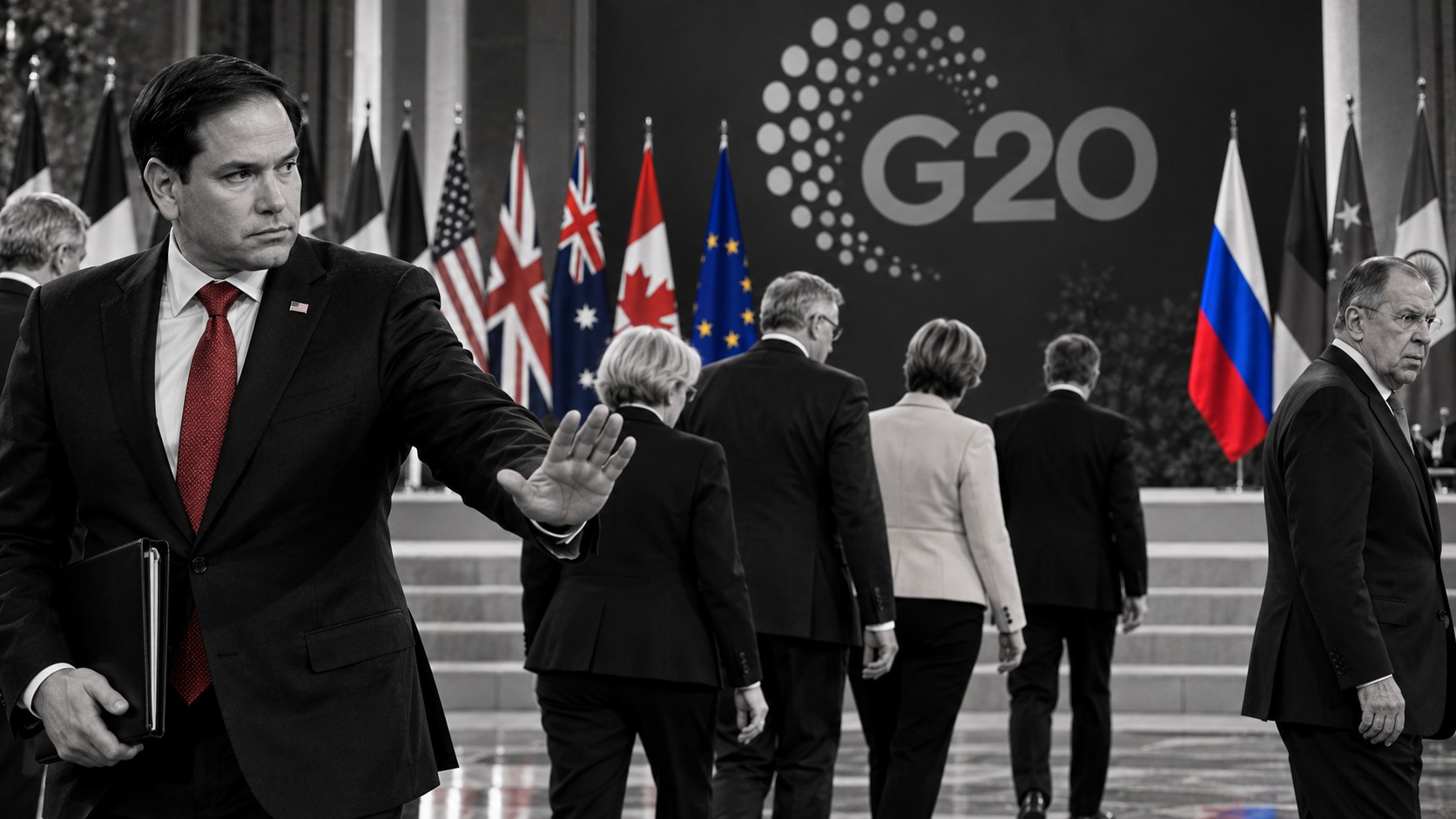
US Secretary of State Marco Rubio cancels the traditional G20 group photograph after Britain, Australia, Canada and several European nations refuse to appear alongside Russian Foreign Minister Sergei Lavrov, exposing deep divisions over the war in Ukraine.
ATLANTA, 31 October 2026 – A diplomatic confrontation overshadowed the opening of the G20 foreign ministers’ meeting in Atlanta on Friday when the United States cancelled the traditional group photograph after approximately one-third of participating countries objected to being pictured alongside Russia’s foreign minister, Sergei Lavrov.
The decision, taken by US Secretary of State Marco Rubio, reflected growing disagreements between Western governments and Moscow, despite Washington’s efforts to encourage international cooperation on economic and security challenges.


Western nations reject normal relations with Moscow
Britain, Australia, Canada and several European countries made clear they would not participate in a photograph including Lavrov.
German Foreign Minister Johann Wadephul argued that appearing together would send the wrong message while Russia continued its invasion of Ukraine.
British Foreign Secretary Ed Miliband also opposed the photograph, reflecting London’s longstanding policy of avoiding normal bilateral engagement with Russian ministers following the February 2022 invasion.
Australian Foreign Minister Penny Wong’s office supported the American decision, emphasising that Russia’s military actions could not be treated as normal international conduct.
Rubio moves to prevent diplomatic spectacle
American officials reportedly considered arranging two separate photographs, one including Lavrov and another excluding him.
However, Rubio ultimately cancelled the ceremony entirely, concerned that a public confrontation would overshadow the meeting’s broader agenda.
The US Secretary of State urged participating nations to focus on mounting geopolitical and economic challenges, including disruptions to global energy supplies, international trade and food security.
Nevertheless, the cancelled photograph illustrated the difficulties facing Washington as it attempts to bring competing powers together.
Ukraine and Poland deepen divisions
The dispute extended beyond diplomatic symbolism.
Russia opposed Poland’s efforts to obtain G20 membership, while the Trump administration’s decision not to invite South Africa, a founding member, generated additional tensions.
Ukraine was also absent from the gathering, despite its war with Russia remaining one of the central subjects of discussion.
European governments remain concerned about Washington’s recent engagement with Moscow, including decisions involving Russian energy purchases and sanctions exemptions.
Global cooperation faces growing obstacles
The G20 represents the world’s major advanced and emerging economies, making its meetings important for international financial stability and economic coordination.
However, divisions over Ukraine, the Middle East, trade restrictions and international security have increasingly complicated attempts to reach common positions.
Diplomats acknowledged that producing a joint communiqué would be difficult, although participating governments expressed their intention to continue discussions ahead of December’s G20 leaders’ summit in Florida.
The cancellation of a single photograph may appear symbolic, but it revealed a deeper reality: even the world’s most influential economies are struggling to present a united diplomatic front.
NewsHub Finance | Global Politics | 31 October 2026
US Secretary of State Marco Rubio cancels the traditional G20 group photograph after Britain, Australia, Canada and several European nations refuse to appear alongside Russian Foreign Minister Sergei Lavrov, exposing deep divisions over the war in Ukraine.
Recent Comments