
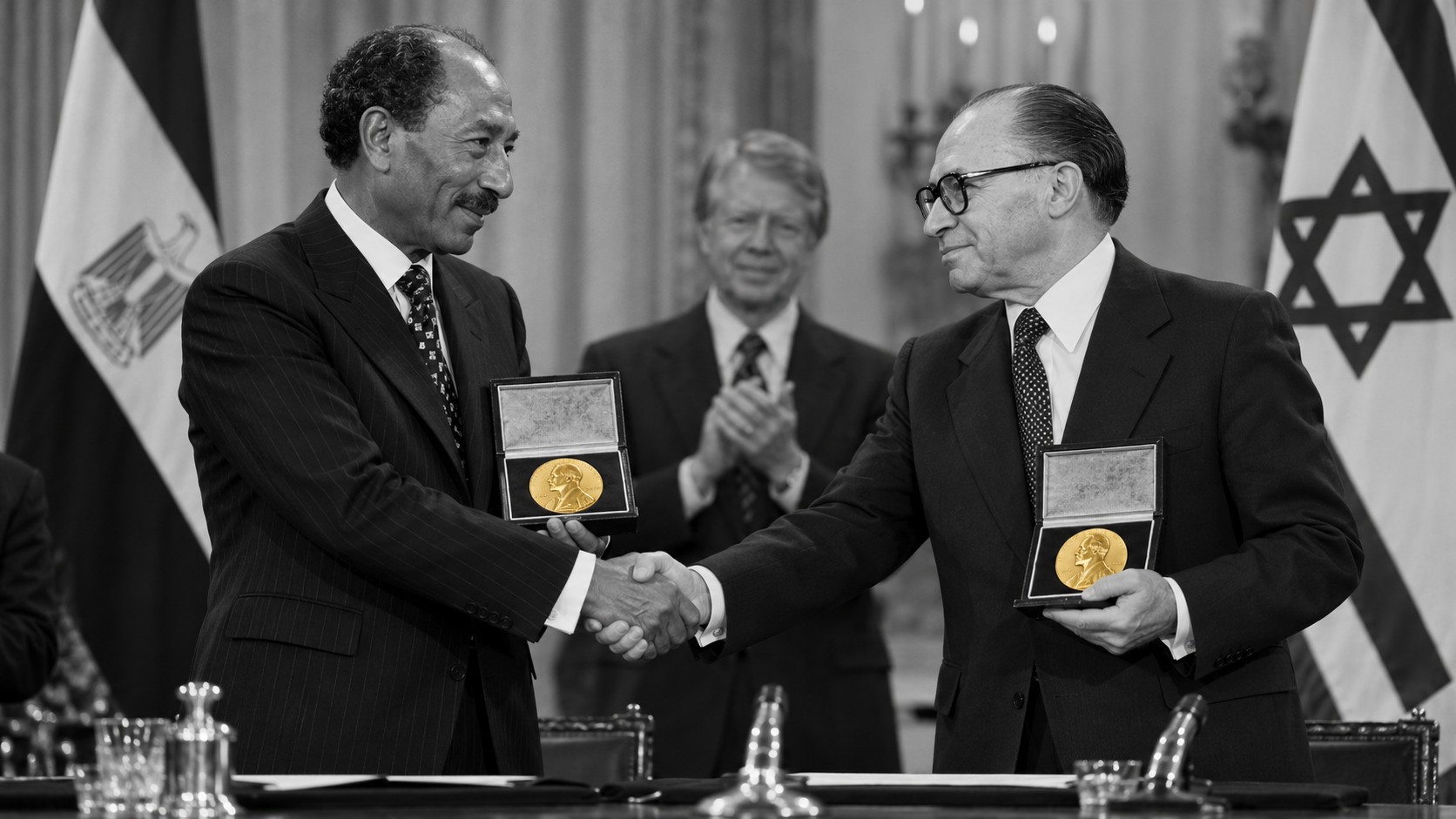
On 27 October 1978, Egyptian President Anwar Sadat and Israeli Prime Minister Menachem Begin were jointly awarded the Nobel Peace Prize, recognising their extraordinary efforts to end decades of hostility between their nations. Their achievement marked a turning point in Middle Eastern diplomacy and demonstrated that even the most entrenched conflicts could be challenged through negotiation.
A historic journey towards peace
The foundations of the agreement were laid in November 1977, when Sadat made an unprecedented visit to Jerusalem, becoming the first Arab leader to address Israel’s parliament.
His initiative was politically risky. Egypt and Israel had fought several wars, including the devastating conflicts of 1967 and 1973, and diplomatic relations between the two countries had been virtually unimaginable.


Sadat nevertheless believed that recovering the Sinai Peninsula and establishing lasting peace required direct engagement with Israel.
Begin, a former underground militant who became Israeli prime minister in 1977, accepted the challenge despite deep political and ideological differences.
The Camp David breakthrough
In September 1978, US President Jimmy Carter brought both leaders together at Camp David, the presidential retreat in Maryland.
Following thirteen days of difficult negotiations, the three leaders announced the Camp David Accords on 17 September.
The agreements established a framework for peace between Egypt and Israel, including Israeli withdrawal from Sinai, while outlining proposals for Palestinian self-government.
Carter’s mediation proved essential, although the Nobel Committee selected Sadat and Begin as the recipients of the 1978 prize.
Recognition amid controversy
The Nobel announcement generated international admiration but also considerable opposition.
Many Arab governments condemned Sadat’s decision to negotiate separately with Israel, fearing that Egyptian interests had been prioritised over broader Palestinian demands.
Begin also faced criticism over Israeli policies towards occupied territories.
Nevertheless, the diplomatic breakthrough culminated in the Egyptian–Israeli peace treaty signed in Washington on 26 March 1979, making Egypt the first Arab country to formally recognise Israel.
A legacy of courage and unfinished peace
Sadat paid a terrible personal price for his policies. On 6 October 1981, he was assassinated by Egyptian Islamist extremists opposed to his leadership and peace initiative.
Begin remained prime minister until 1983, while the treaty between Egypt and Israel survived political upheavals and subsequent regional wars.
Nearly five decades later, the 1978 Nobel Peace Prize remains a powerful reminder that diplomatic courage can transform relations between longstanding enemies.
Yet the unresolved Palestinian question also illustrates the limitations of agreements that achieve peace between governments without resolving the wider conflict.
NewsHub Finance | History | 27 October 2026
On 27 October 1978, Egyptian President Anwar Sadat and Israeli Prime Minister Menachem Begin were jointly awarded the Nobel Peace Prize, recognising their extraordinary efforts to end decades of hostility between their nations. Their achievement marked a turning point in Middle Eastern diplomacy and demonstrated that even the most entrenched conflicts could be challenged through negotiation.
Recent Comments