
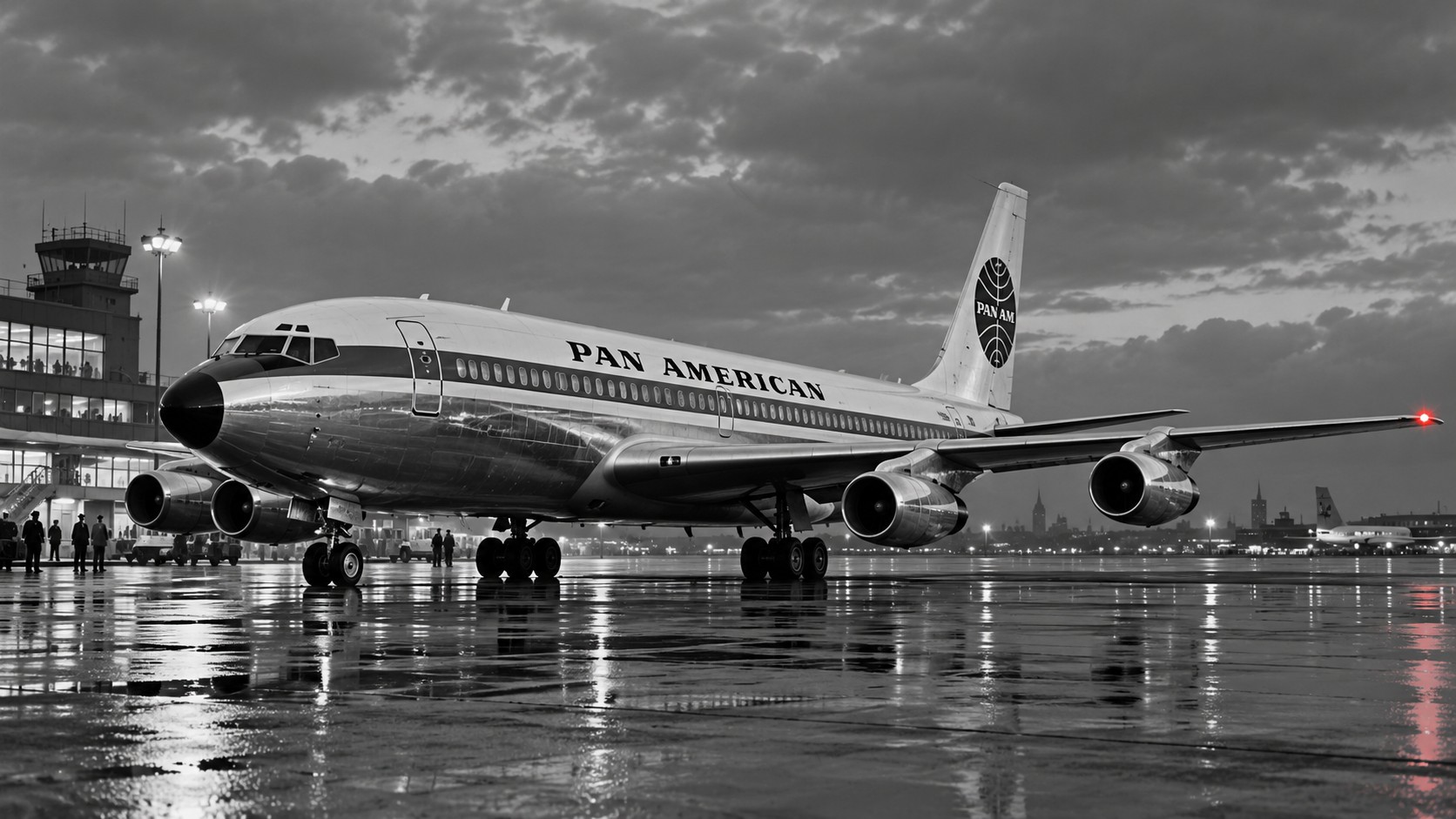
On 26 October 1958, American aviation entered a new era when Pan American World Airways introduced the Boeing 707 into commercial passenger service. The historic flight from New York to Paris transformed international aviation, dramatically reduced travelling times and helped establish the modern age of global air transport.
A historic departure from New York
On the evening of 26 October 1958, 111 passengers boarded a Pan American Boeing 707, named Clipper America, at New York’s Idlewild Airport, now John F. Kennedy International Airport.


Accompanied by a military band and considerable public attention, the aircraft departed for Paris. Strong headwinds necessitated a refuelling stop in Gander, Newfoundland, before the aircraft arrived at Le Bourget Airport after a journey of approximately eight hours and 41 minutes.
The flight marked the beginning of scheduled commercial jet operations by an American airline, although Britain’s de Havilland Comet had pioneered passenger jet services several years earlier.
The aircraft that changed aviation
Developed by Boeing during the 1950s, the four-engine 707 represented a technological breakthrough.
Powered by Pratt & Whitney turbojet engines, the aircraft could cruise at approximately 900 kilometres per hour, substantially faster than the propeller-driven aircraft that dominated international routes.
Its greater passenger capacity and speed offered airlines significantly improved productivity, allowing more passengers to travel longer distances in less time.
Pan American’s visionary leader, Juan Trippe, recognised that jet aircraft would fundamentally change the economics of international aviation.
In 1955, his airline ordered 20 Boeing 707s, helping secure Boeing’s position in the emerging commercial jet market.
Making the world smaller
The Boeing 707 rapidly became a symbol of modernity, prosperity and international mobility.
Transatlantic journeys that previously required much of a day could now be completed in approximately eight hours. Airlines expanded their networks, tourism accelerated and international business became increasingly dependent on rapid air connections.
The aircraft also stimulated major investments in airport infrastructure, including longer runways, larger terminals and improved air traffic control systems.
During the 1960s, the 707 became one of the most recognisable aircraft in the world, serving airlines across Europe, Asia, Africa and the Americas.
A legacy that continues today
The Boeing 707 helped establish the foundations of modern mass aviation and paved the way for later generations of passenger aircraft, including the revolutionary Boeing 747.
Its success also helped transform Boeing into a dominant manufacturer of commercial jetliners.
Sixty-eight years after that historic departure from New York, the Boeing 707 remains one of aviation’s most influential aircraft.
What began as a pioneering transatlantic flight on 26 October 1958 ultimately helped reshape international commerce, tourism and human connectivity.
NewsHub Finance | History & Aviation | 26 October 2026
On 26 October 1958, American aviation entered a new era when Pan American World Airways introduced the Boeing 707 into commercial passenger service. The historic flight from New York to Paris transformed international aviation, dramatically reduced travelling times and helped establish the modern age of global air transport.
Recent Comments