
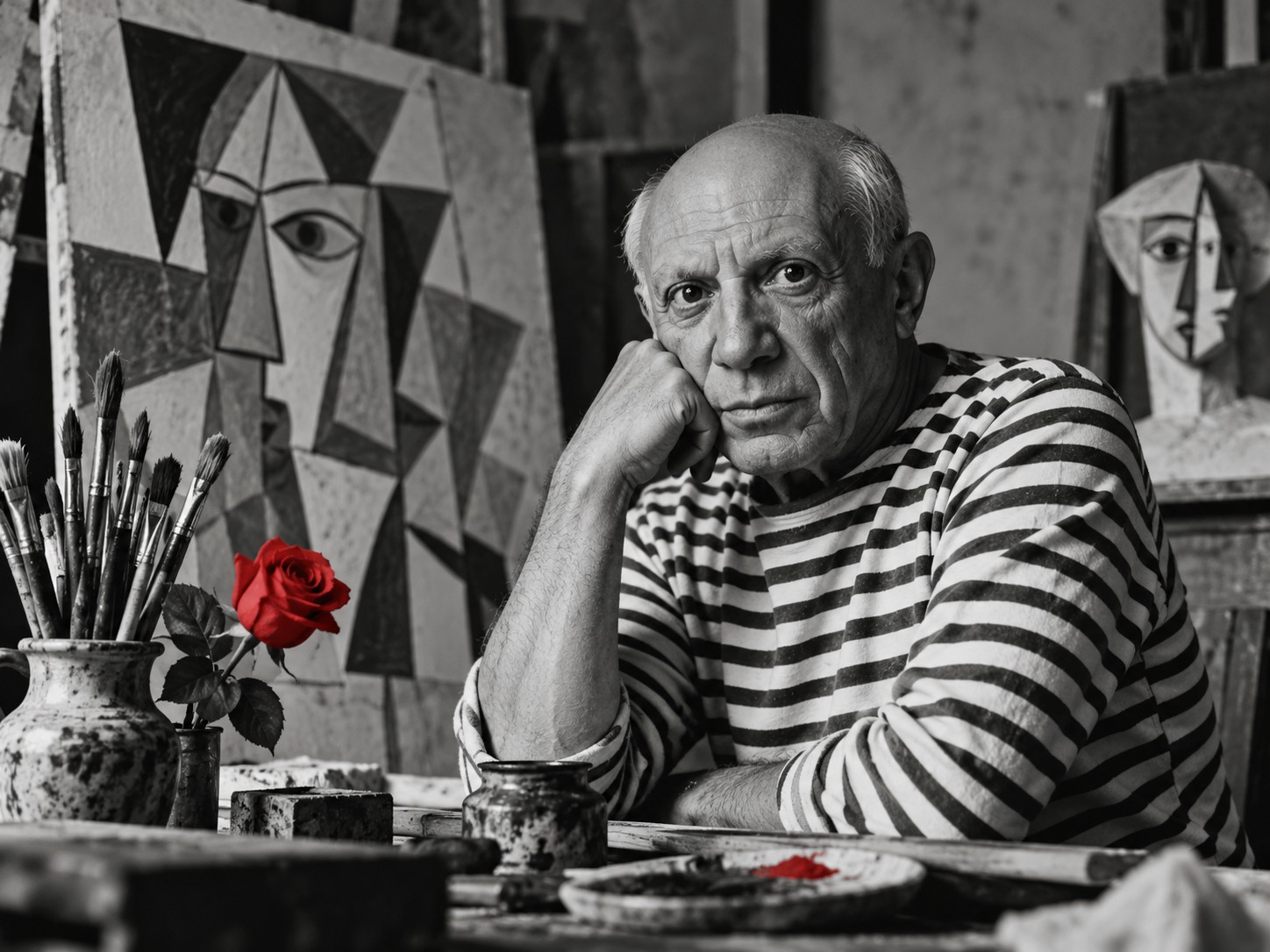
On 25 October 1881, Pablo Picasso was born in Málaga, Spain. Few artists would go on to transform the visual language of the modern world as profoundly as the man whose extraordinary creativity challenged centuries of artistic tradition. Today marks the 145th anniversary of his birth.
A remarkable talent from childhood
Born Pablo Ruiz Picasso, he was the son of José Ruiz Blasco, a painter and art teacher who recognised his son’s exceptional abilities at an early age. The family later moved to Barcelona, where Picasso developed his artistic education before travelling to Paris in 1900.
By 1904, he had settled in the French capital, becoming part of an influential community of artists, writers and intellectuals. His early paintings reflected poverty, isolation and human suffering, particularly during his celebrated Blue Period, followed by the more optimistic Rose Period.


The birth of a new artistic language
Picasso’s greatest revolution came through Cubism, which he developed alongside French artist Georges Braque.
Rather than presenting objects from a single perspective, Cubism fragmented forms into geometric shapes, allowing multiple viewpoints to coexist within one composition.
His groundbreaking 1907 painting Les Demoiselles d’Avignon challenged conventional representations of the human figure and helped prepare the way for one of modern art’s most influential movements.
Picasso continued experimenting throughout his career, working across painting, sculpture, ceramics, printmaking and theatrical design.
Art as a political statement
In 1937, Picasso created Guernica, his monumental response to the bombing of the Basque town during the Spanish Civil War.
The enormous black-and-white composition became an international symbol of civilian suffering and opposition to the brutality of war.
Although Picasso lived predominantly in France, his Spanish identity and the political upheavals of his homeland remained important influences.
A complicated man and an enduring legacy
Picasso’s personal life was frequently turbulent. His relationships with women, including fellow artists and his artistic subjects, have increasingly attracted critical examination, complicating the traditional image of the celebrated genius.
He died on 8 April 1973, aged 91, leaving an artistic legacy that continues to influence generations of creators.
His works now occupy some of the world’s most prestigious museums and command extraordinary prices in the international art market.
145 years after his birth, Picasso remains a defining figure in the history of modern art — an artist who fundamentally changed how humanity sees and represents the world.
NewsHub Finance | History | 25 October 2026
On 25 October 1881, Pablo Picasso was born in Málaga, Spain. Few artists would go on to transform the visual language of the modern world as profoundly as the man whose extraordinary creativity challenged centuries of artistic tradition. Today marks the 145th anniversary of his birth.
Recent Comments