
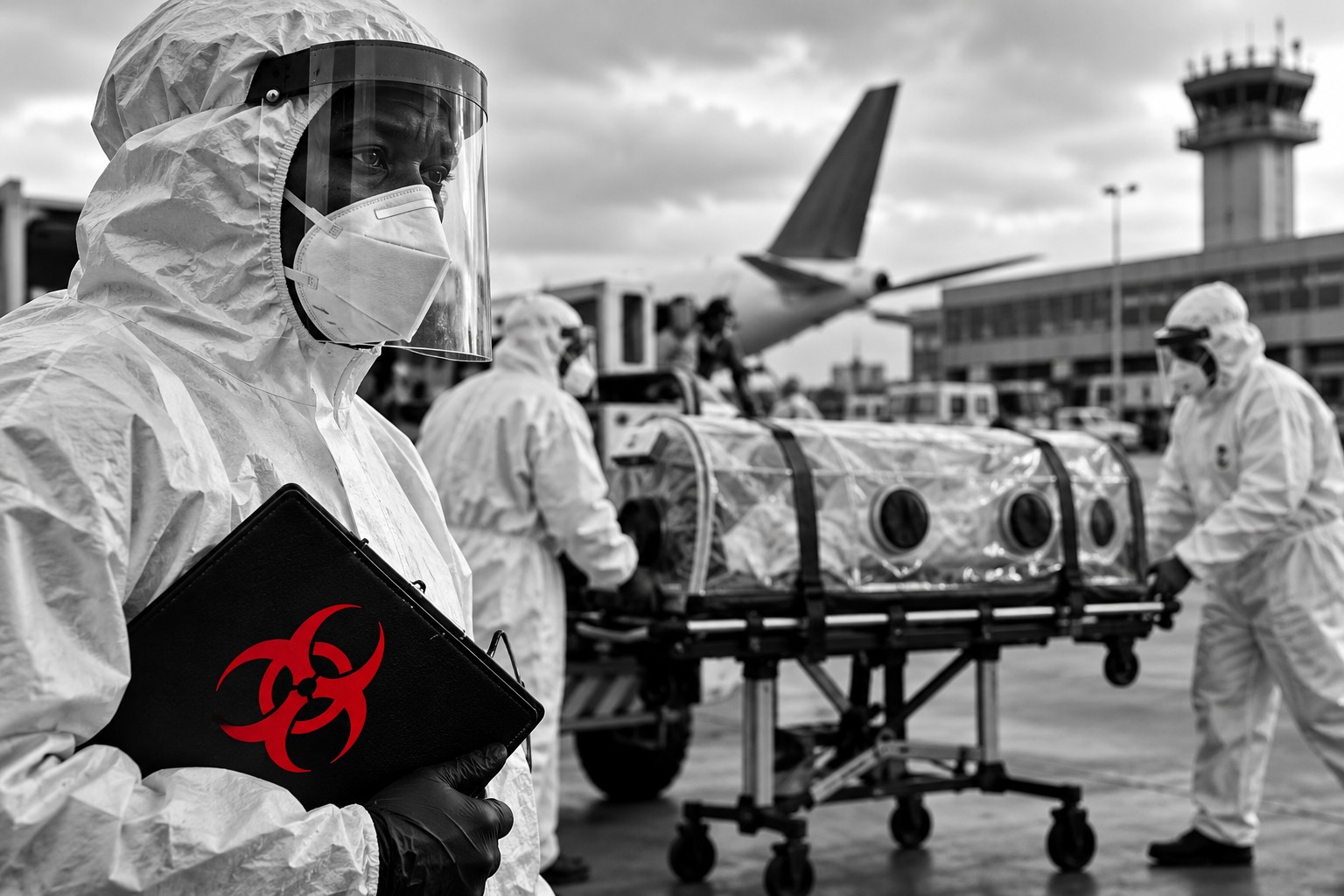
Health authorities are investigating the unexplained source of Nigeria’s first confirmed Ebola case in more than a decade, after Switzerland revealed that the infected patient is the wife of a Swiss diplomat and may have contracted the virus while travelling in Uganda. Conflicting accounts of her movements have raised concerns about the spread of an outbreak already affecting several African countries.
Conflicting reports complicate investigation
The patient, a Ugandan-born Swiss national living in Abuja, tested positive for the Bundibugyo strain of Ebola on 20 October.
Switzerland’s foreign ministry confirmed that the woman had travelled to Uganda with her husband but had not visited the Democratic Republic of Congo, where the current outbreak originated.


This contradicts earlier statements from Ugandan authorities suggesting that she had travelled to eastern Congo before returning to Nigeria.
Uganda maintains that it has no active Ebola cases, having been declared free of the virus in August following an earlier outbreak.
The conflicting information has complicated efforts to determine where and how the woman became infected.
Health authorities trace possible contacts
The woman returned to Abuja on 3 October and developed symptoms four days later. She subsequently sought treatment at a private medical facility before laboratory testing confirmed the infection.
Nigeria’s health ministry identified 44 people who may have been exposed to the patient and placed them under monitoring.
Her husband has also been isolated, although Swiss authorities reported that he had not developed symptoms.
The World Health Organization and Africa Centres for Disease Control and Prevention are working with national authorities to reconstruct the woman’s travel history and identify potential transmission routes.
Outbreak spreads beyond Congo
The latest infection comes amid an extensive Ebola outbreak originating in the Democratic Republic of Congo in May.
Cases have subsequently been identified in Uganda, Kenya and Nigeria, demonstrating the difficulties of controlling transmission across international borders.
According to Africa CDC figures reported this week, the outbreak has claimed approximately 4,700 lives.
In Kenya, authorities have also investigated possible links between infected travellers who passed through Uganda’s Entebbe International Airport.
Regional preparedness faces renewed scrutiny
Ebola spreads through direct contact with the blood or bodily fluids of infected individuals and can cause severe, frequently fatal illness.
Early diagnosis, isolation, contact tracing and appropriate medical care remain essential for containing transmission.
The WHO has emphasised the importance of strengthened surveillance, particularly at border crossings and international transport hubs, while advising against general travel and trade restrictions.
For Nigeria, Africa’s most populous country, the appearance of an imported case represents a serious test of emergency preparedness.
Until investigators establish the source of the infection, uncertainty will persist over whether additional transmission has occurred beyond the already identified cases.
NewsHub Finance | Africa | 25 October 2026
Health authorities are investigating the unexplained source of Nigeria's first confirmed Ebola case in more than a decade, after Switzerland revealed that the infected patient is the wife of a Swiss diplomat and may have contracted the virus while travelling in Uganda. Conflicting accounts of her movements have raised concerns about the spread of an outbreak already affecting several African countries.

Recent Comments