
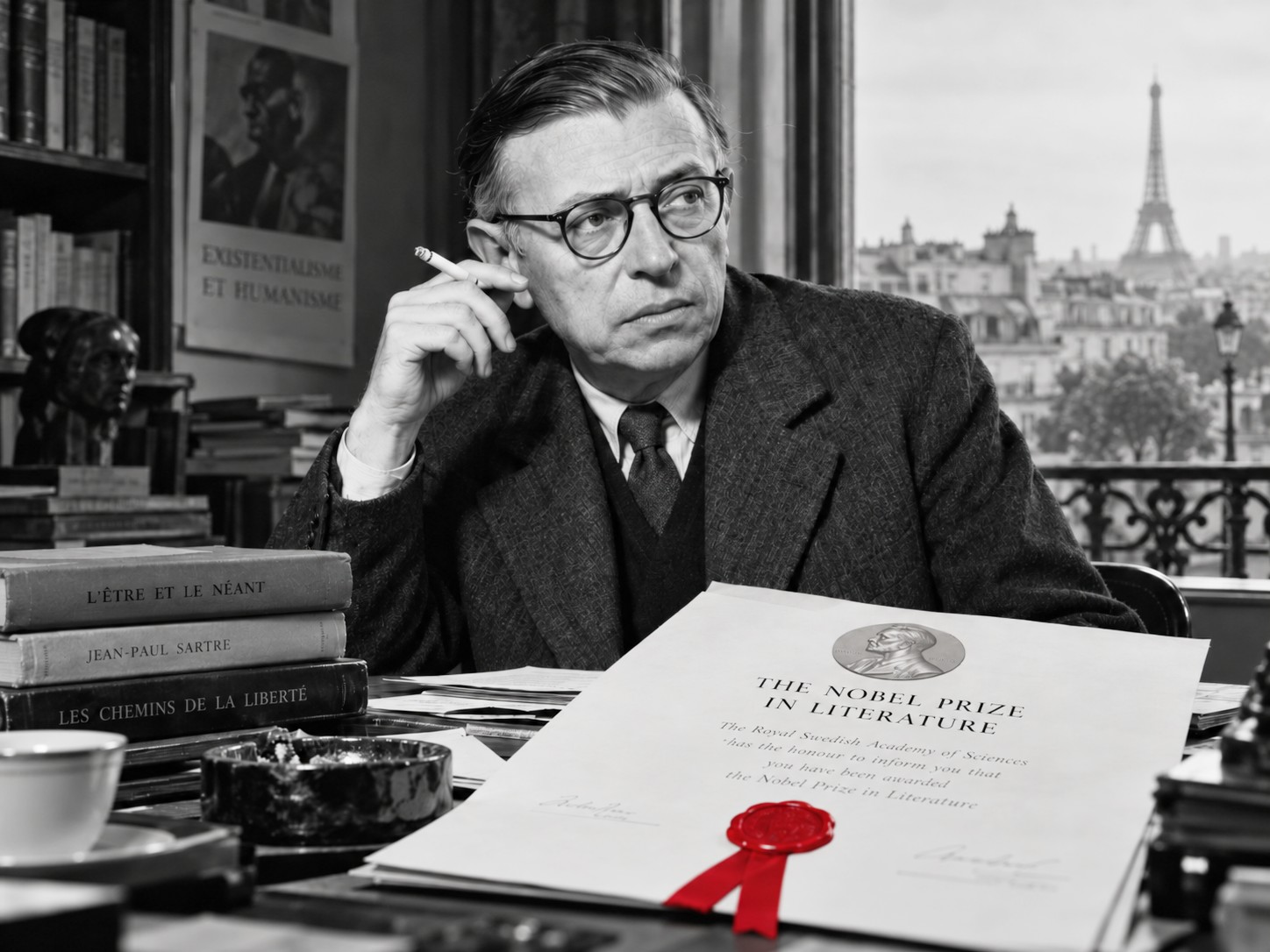
On 22 October 1964, French philosopher, novelist and playwright Jean-Paul Sartre was announced as the winner of the Nobel Prize in Literature. What should have been the crowning achievement of his literary career became one of the most extraordinary moments in Nobel history when Sartre refused to accept the honour.
The Swedish Academy recognised Sartre for his intellectual influence, his commitment to freedom and his search for truth. But the 59-year-old philosopher believed that accepting an institutional distinction would compromise the independence that defined his work.
His refusal was not a rejection of literature or the Academy itself. It was a statement about the relationship between writers, political power and personal freedom.


A philosopher of freedom and responsibility
Born in Paris on 21 June 1905, Sartre became one of the central figures of existentialism, a philosophical movement exploring human freedom, individual responsibility and the search for meaning.
His 1938 novel Nausea examined alienation and existence, while his 1943 philosophical masterpiece Being and Nothingness established his international reputation.
Sartre argued that human beings are not born with a predetermined purpose. Instead, individuals create meaning through their choices and must accept responsibility for their actions.
Together with his lifelong intellectual companion, Simone de Beauvoir, Sartre helped transform post-war Paris into a centre of philosophical and political debate.
Why Sartre refused the prize
Sartre had already rejected France’s Legion of Honour in 1945 and consistently avoided official distinctions.
When reports emerged that he might receive the Nobel Prize, he wrote to the Swedish Academy asking not to be selected. His request failed to prevent the announcement.
Sartre maintained that writers should remain independent of institutions, governments and political establishments. He also feared that international honours could turn individual thinkers into representatives of ideological or cultural interests.
His refusal attracted worldwide attention and raised questions about whether recognition might become a form of intellectual constraint.
A legacy beyond awards
Sartre continued writing, campaigning and participating in political debates until his death in Paris on 15 April 1980.
His philosophical influence extended far beyond literature, shaping debates about ethics, politics, personal identity and human responsibility.
More than six decades after his Nobel refusal, Sartre remains among the most influential intellectual figures of the twentieth century.
The Swedish Academy never withdrew its decision. Official Nobel records still identify him as the 1964 Literature laureate.
Sartre had rejected the prize, but history never removed his name from it.
NewsHub Finance | History & Culture | 22 October 2026
On 22 October 1964, French philosopher, novelist and playwright Jean-Paul Sartre was announced as the winner of the Nobel Prize in Literature. What should have been the crowning achievement of his literary career became one of the most extraordinary moments in Nobel history when Sartre refused to accept the honour.
Recent Comments