
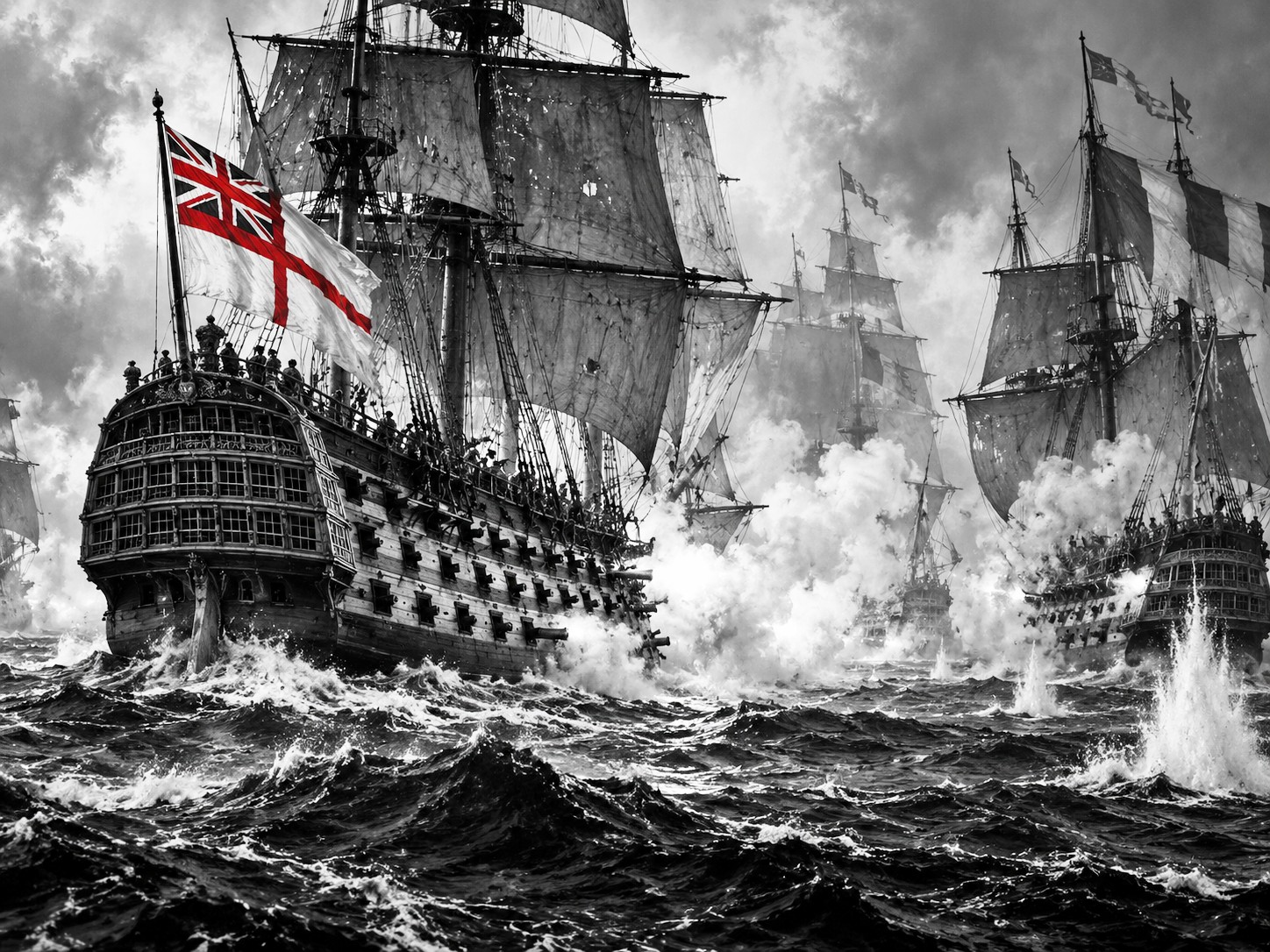
On 21 October 1805, a naval battle off the coast of Spain changed the balance of power in Europe. Britain’s Royal Navy defeated the combined fleets of France and Spain, establishing a maritime dominance that would endure for generations. But the victory came at an extraordinary price: the death of Admiral Horatio Nelson.
Napoleon’s challenge to Britain
By 1805, Napoleon Bonaparte dominated much of continental Europe. Britain remained his principal opponent, protected by the English Channel and its powerful navy.
France’s alliance with Spain offered Napoleon an opportunity to challenge British naval supremacy. A combined Franco-Spanish fleet, commanded by Admiral Pierre-Charles Villeneuve, assembled near Cádiz in southern Spain.


Waiting offshore was Nelson, commanding 27 British ships of the line against 33 French and Spanish vessels.
A revolutionary naval strategy
Rather than engage in the traditional parallel formation, Nelson divided his fleet into two columns and directed them towards the enemy line.
The manoeuvre exposed British ships to concentrated cannon fire during their approach, but it offered a decisive advantage once they broke through the opposing formation.
Nelson led one column aboard HMS Victory, while Vice-Admiral Cuthbert Collingwood commanded the other aboard HMS Royal Sovereign.
As the fleets closed, Nelson ordered his famous signal: “England expects that every man will do his duty.”
Victory and tragedy
The fighting was ferocious. Cannonballs shattered wooden hulls, while marines and sailors exchanged gunfire at close range.
During the battle, Nelson was struck by a musket ball fired from the French warship Redoutable. Mortally wounded, he was carried below deck.
He died later that afternoon, having learned that his fleet had secured victory.
The British captured or destroyed much of the opposing fleet without losing a single ship in battle. Thousands of men were killed or wounded.
The beginning of British naval supremacy
Trafalgar did not end the Napoleonic Wars. Fighting continued until Napoleon’s final defeat in 1815.
Nevertheless, the battle eliminated the immediate prospect of a successful French naval challenge to Britain and reinforced British control of vital maritime routes.
That dominance would support Britain’s expanding trade networks, financial influence and global empire throughout the nineteenth century.
Nelson became a national hero, commemorated in monuments, literature and public ceremonies.
More than two centuries later, 21 October remains Trafalgar Day, marking a victory that helped shape the modern world’s political and economic geography.
NewsHub Finance | History | 21 October 2026
On 21 October 1805, a naval battle off the coast of Spain changed the balance of power in Europe. Britain's Royal Navy defeated the combined fleets of France and Spain, establishing a maritime dominance that would endure for generations. But the victory came at an extraordinary price: the death of Admiral Horatio Nelson.
Recent Comments