
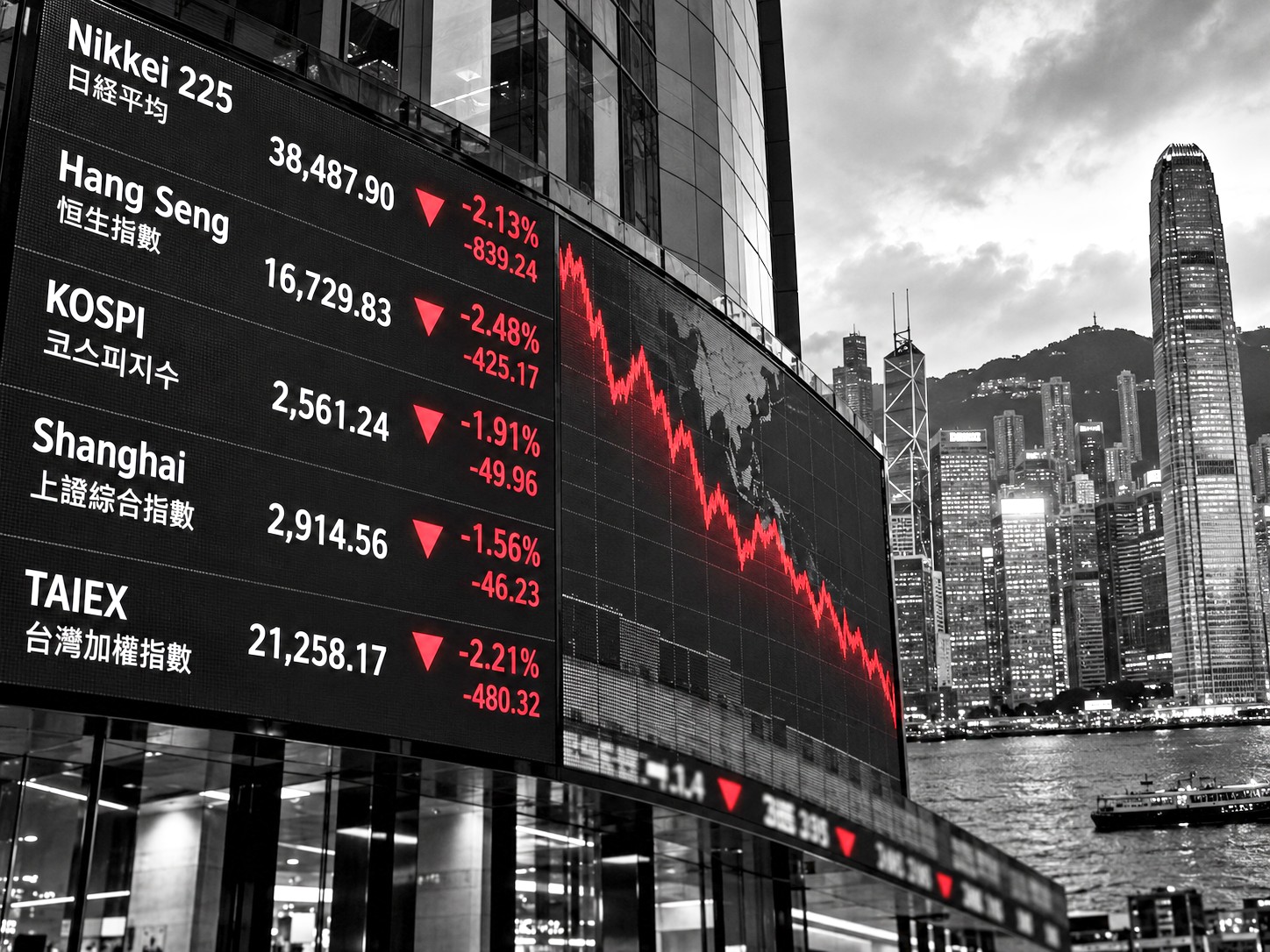
TOKYO — Asian stock markets ended Tuesday, 20 October, predominantly lower as renewed concerns over artificial intelligence investments, rising oil prices and global economic uncertainty weighed on investor confidence. South Korea suffered the heaviest losses, while Japan, Hong Kong and Taiwan also retreated despite a technology-led recovery on Wall Street overnight.
The sell-off highlighted growing doubts about whether the enormous capital flowing into artificial intelligence infrastructure will generate sufficient profits to justify elevated technology valuations.
Investors also remained concerned about higher energy costs and geopolitical tensions in the Middle East.


South Korea: Chipmakers lead the decline
South Korea’s KOSPI was the region’s worst-performing major benchmark, falling approximately 4% to close at 5,539.05.
Semiconductor giants Samsung Electronics and SK Hynix came under significant selling pressure as investors reassessed the outlook for AI-related hardware demand and investment spending.
The disappointing market debut of South Korean AI cloud company Elice added to the negative sentiment, with its shares losing almost one-third of their value.
The decline came ahead of the Bank of Korea’s monetary policy meeting on Thursday, when policymakers are expected to leave interest rates unchanged.
Japan: Nikkei retreats despite Wall Street recovery
Japan’s Nikkei 225 declined 1.3% to finish at 64,075.42.
Technology and semiconductor-related shares were among the weakest performers, reflecting concerns about the sustainability of the global AI investment boom.
The downturn contrasted with Monday’s performance on Wall Street, where the technology-heavy Nasdaq Composite gained 1.1%.
The divergence suggested that Asian investors were becoming increasingly selective about technology valuations and the financial risks associated with expanding AI infrastructure.
China and Hong Kong: Cautious trading
Hong Kong’s Hang Seng Index declined approximately 1.1% to 23,927.47, with technology companies facing renewed pressure.
Mainland Chinese shares performed comparatively better, although trading remained subdued. Shanghai’s Composite Index finished around 3,726 points, with reported figures indicating a marginal decline.
Investors continued assessing China’s latest economic data, including third-quarter GDP growth of 4.5%, alongside uncertainties surrounding global trade and domestic demand.
Taiwanese technology shares also weakened, with the TAIEX declining approximately 1.1%.
Oil prices add to inflation concerns
Rising crude prices contributed to the negative regional sentiment.
Brent crude traded above US$110 per barrel amid persistent fears of energy supply disruptions associated with the Middle East conflict.
Higher oil prices present a particular challenge for energy-importing Asian economies, increasing pressure on businesses, consumers and central banks.
Investors await technology earnings
Attention now turns to upcoming corporate results from major US technology companies, including Meta and Tesla.
Investors will be looking for evidence that substantial AI infrastructure expenditure can translate into sustainable earnings growth.
Tuesday’s Asian session demonstrated that enthusiasm for artificial intelligence is no longer sufficient to support technology shares indiscriminately.
With oil prices elevated and monetary policy uncertainty continuing, financial markets remain vulnerable to further volatility.
NewsHub Finance | Asian Markets | 20 October 2026
TOKYO — Asian stock markets ended Tuesday, 20 October, predominantly lower as renewed concerns over artificial intelligence investments, rising oil prices and global economic uncertainty weighed on investor confidence. South Korea suffered the heaviest losses, while Japan, Hong Kong and Taiwan also retreated despite a technology-led recovery on Wall Street overnight.
Recent Comments