
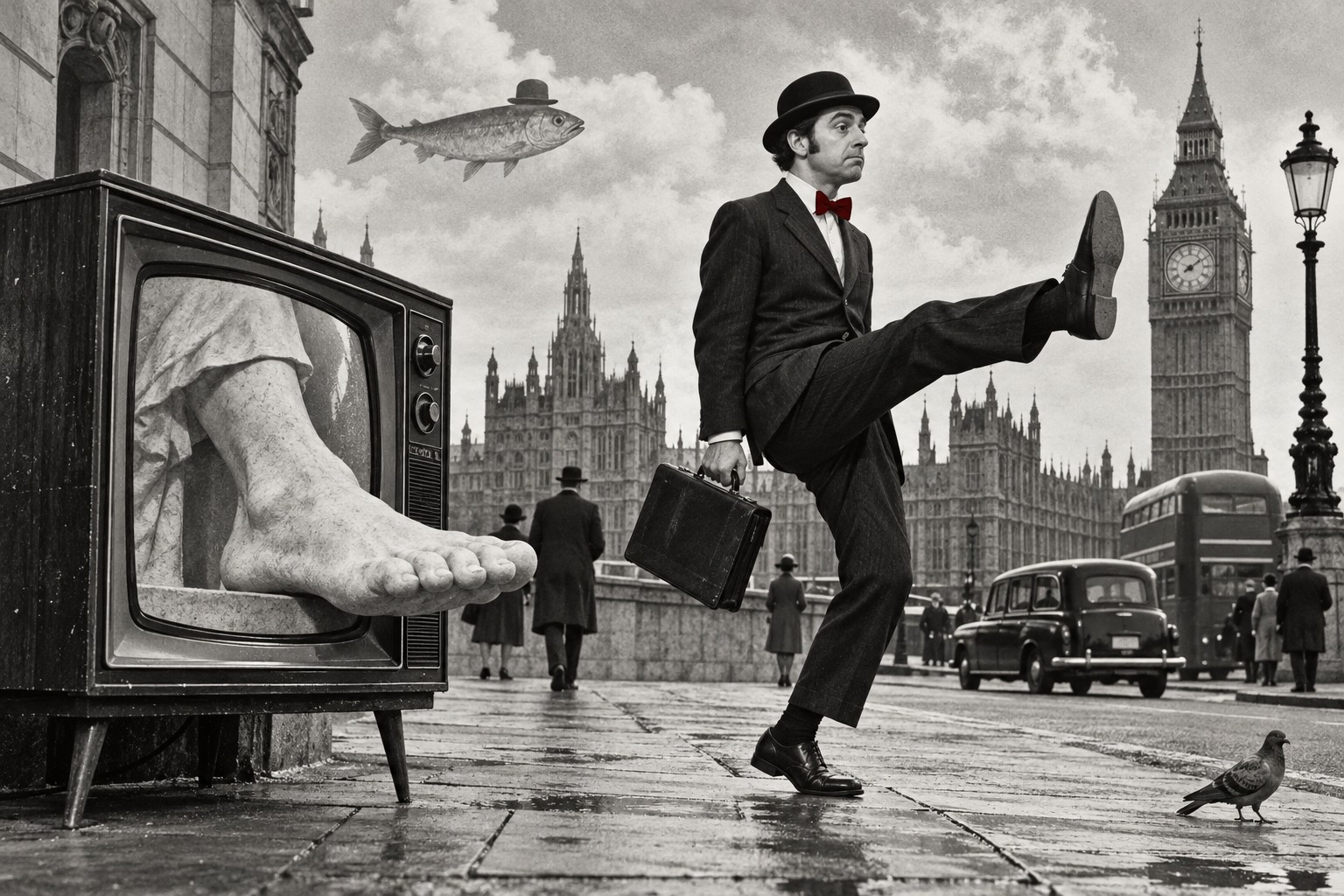
On 5 October 1969, Monty Python’s Flying Circus made its debut on BBC1, introducing viewers to a style of comedy that challenged the conventions of television. Fifty-seven years later, its mixture of satire, surrealism and deliberate absurdity remains a landmark in British entertainment.
The programme brought together Graham Chapman, John Cleese, Eric Idle, Terry Jones, Michael Palin and American animator Terry Gilliam. Its first broadcast began at 10.55pm on a Sunday, an unassuming slot for a series that would eventually attract an international following.
A different kind of sketch show
The opening episode, titled “Whither Canada?”, established the group’s unusual approach. Viewers encountered Mozart presenting famous deaths, an interview with a composer overshadowed by questions about his sheds, and a wartime story involving a lethally funny joke.


The performers were also their own writers. Cleese and Chapman developed material together, as did Palin and Jones, while Idle generally wrote independently. Their contributions were then assembled into scripts, with Gilliam’s cut-out animations helping connect otherwise unrelated scenes.
Familiar television formats became material for parody. Interviews and advertisements retained their recognisable presentation while their contents slipped into nonsense. The contrast between formal delivery and ridiculous situations became central to the programme’s humour.
Breaking the rules of television
The team deliberately moved away from sketches built around a predictable beginning, middle and final punchline. Scenes could be interrupted, abandoned or absorbed into something entirely different.
Even the structure of a television broadcast became part of the joke. Opening titles could arrive halfway through an episode, while closing credits could appear at the beginning. Gilliam’s animations gave the programme a visual freedom that conventional studio comedy rarely attempted.
From late-night curiosity to international audience
Recognition developed gradually. The first series introduced material including the dead parrot sketch and the Lumberjack Song, but Cleese later recalled that critics took time to identify what distinguished the programme.
Across four series between 1969 and 1974, Flying Circus produced 45 episodes. American public television helped broaden its audience, while records, books, live performances and films carried the group’s work beyond the BBC.
The significance of that October debut lay in the creative freedom it demonstrated: television comedy could dispense with familiar structures and still find an audience.
On 5 October 1969, Monty Python’s Flying Circus made its debut on BBC1, introducing viewers to a style of comedy that challenged the conventions of television. Fifty-seven years later, its mixture of satire, surrealism and deliberate absurdity remains a landmark in British entertainment.
Recent Comments