
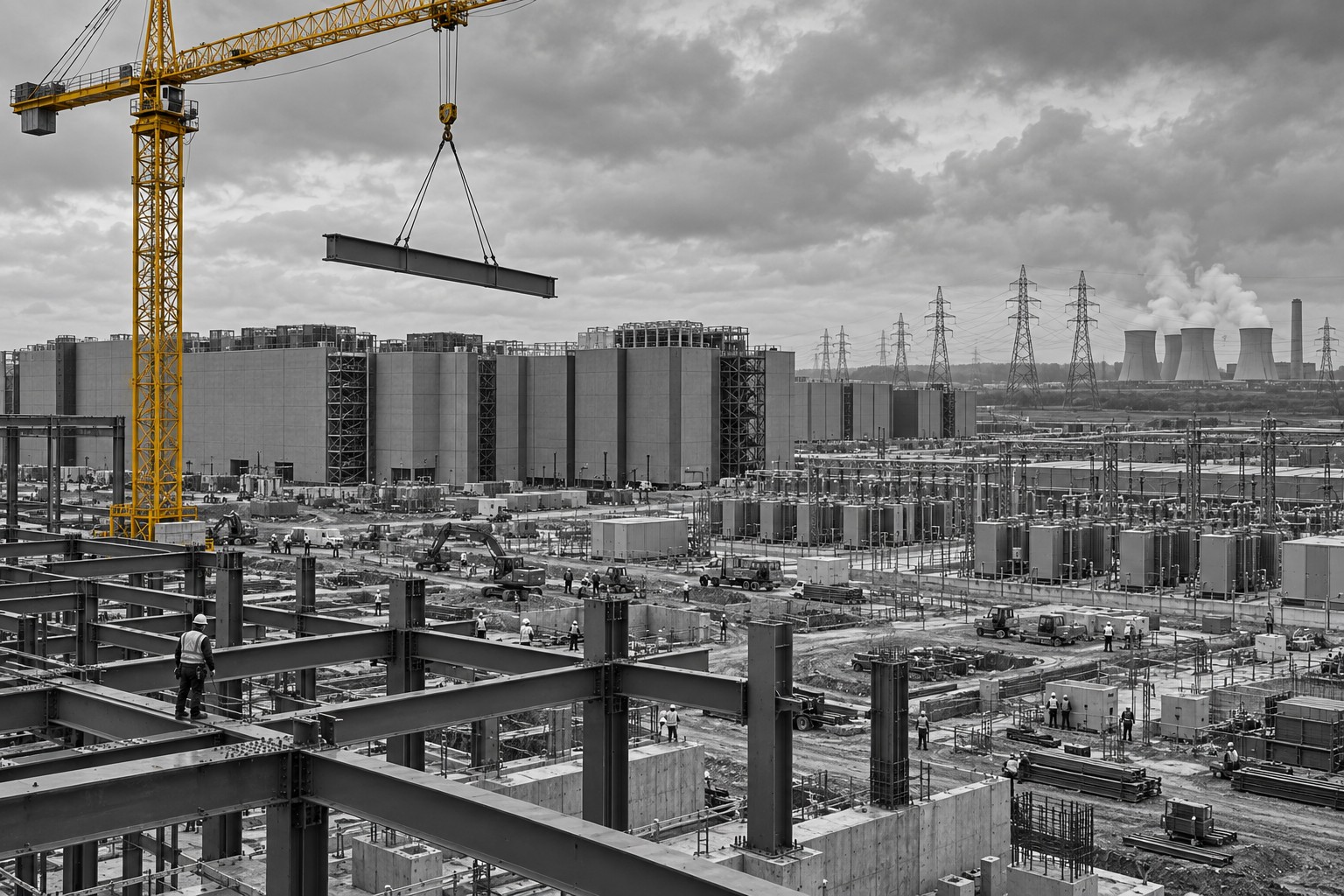
Artificial intelligence is driving a physical construction boom extending far beyond software. Semiconductor factories, data centres, power stations and electricity networks are becoming essential foundations of the technology, linking its commercial success to industrial capacity, energy supplies and increasingly complex financing.
The cloud depends on buildings, machinery and electricity. Behind each new generation of AI models lies a supply chain connecting chip designers such as Nvidia, manufacturers including TSMC, and technology groups investing in computing infrastructure.
Nvidia’s manufacturing partnerships illustrate that connection: Blackwell chips are being produced at TSMC’s Arizona facilities, alongside plans for US supercomputer assembly plants. Digital expansion requires substantial physical production.


Electricity becomes a strategic resource
The International Energy Agency projects that global data-centre electricity consumption will reach around 950 terawatt-hours by 2030 in its base case, approximately 3% of worldwide demand. That forecast covers data centres overall, rather than AI alone.
Renewables and natural gas are expected to lead the additional electricity supply. Nuclear power is also attracting long-term commitments from technology companies seeking dependable generation.
On 30 September, Constellation and Amazon announced a 20-year agreement covering 690 megawatts, including a planned 190-megawatt expansion at Maryland’s Calvert Cliffs nuclear plant. Such contracts connect computing demand with investments expected to operate for decades.
Debt extends the financial exposure
The financing challenge reaches beyond buying chips. Developers must fund land, construction, cooling equipment and power connections before facilities generate sufficient income.
The IMF warns that increasingly debt-financed AI investment could disappoint if anticipated returns fail to materialise. It also identifies risks where companies become one another’s customers, investors and financiers, allowing difficulties at one business to spread through interconnected commitments.
That makes utilisation and paying customers as consequential as technical performance. Rapidly improving models do not automatically guarantee profitable infrastructure.
Who ultimately pays?
For businesses and households, the critical question is how electricity-system expansion is financed. Where infrastructure costs are shared across customers, the allocation of those costs becomes a public-policy issue; higher household bills are not an inevitable outcome.
The economic test is whether AI produces enough additional value to support the assets being built around it. Its expansion is increasingly a story about construction schedules, energy contracts and repayment obligations—with consequences reaching well beyond the technology sector.
Newshub Editorial in North America – 4 October 2026
Artificial intelligence is driving a physical construction boom extending far beyond software. Semiconductor factories, data centres, power stations and electricity networks are becoming essential foundations of the technology, linking its commercial success to industrial capacity, energy supplies and increasingly complex financing.
Recent Comments