
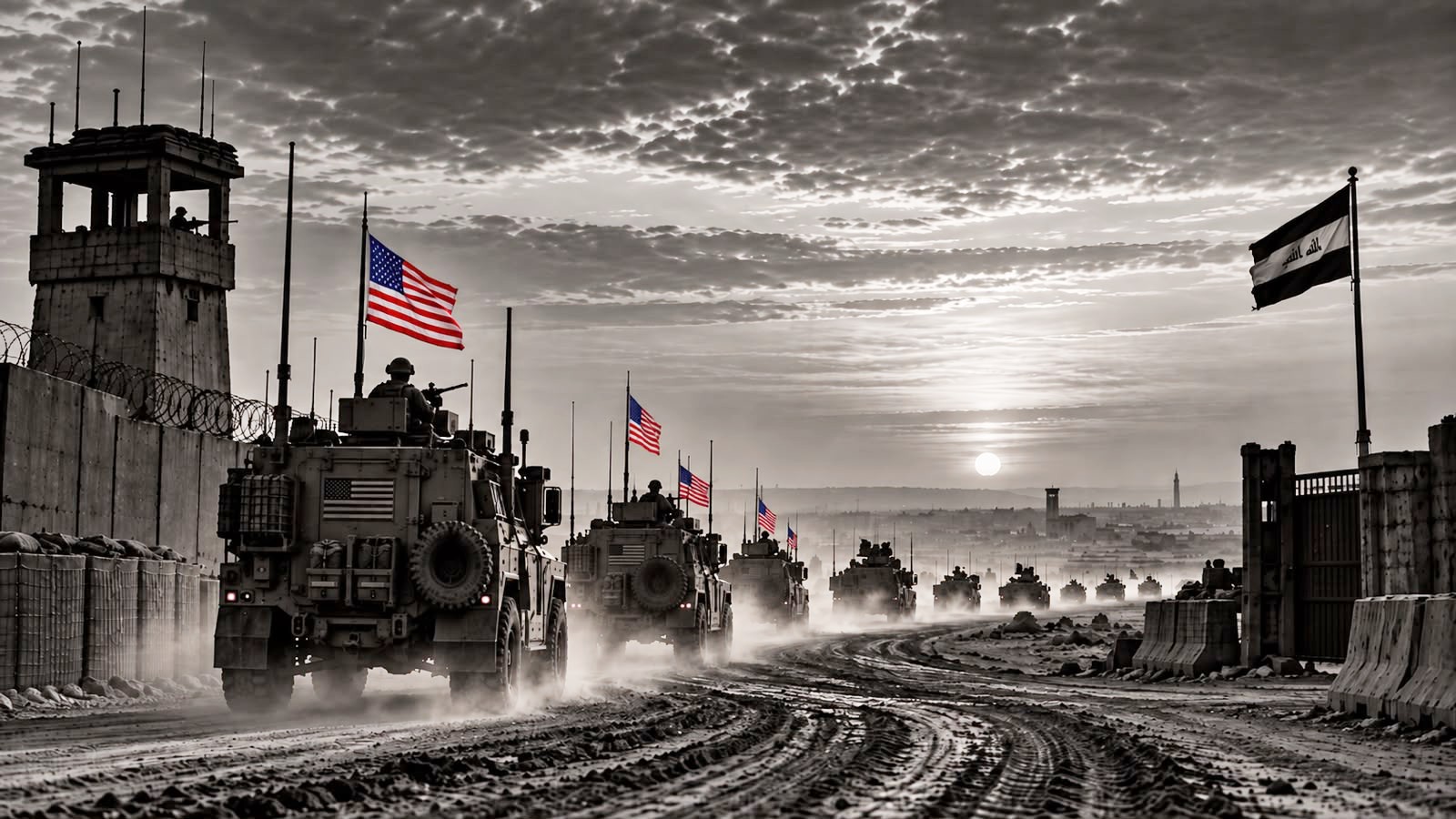
The United States is withdrawing from its remaining military bases in Iraq on Wednesday, 30 September, marking a major turning point 23 years after the invasion that toppled Saddam Hussein. The departure places greater responsibility on Baghdad while raising questions about Iranian influence, Islamic State and regional stability.
The withdrawal follows an agreement reached between Washington and Baghdad in 2024 under President Joe Biden and implemented by Donald Trump’s administration.
It does not end an uninterrupted deployment. American forces withdrew in 2011 before returning in 2014 to support the campaign against Islamic State, after the organisation seized extensive territory in Iraq and Syria.


Sovereignty brings new responsibilities
For Iraq, the departure represents an important assertion of sovereignty. It also tests whether national institutions can manage competing armed groups and maintain security with a reduced American military presence.
Iran already holds considerable influence through political relationships and allied militias. Tehran and its partners have portrayed the withdrawal as a victory, while Iraqi analysts warn that these groups could seek greater influence over government decisions.
However, increased Iranian control is not a predetermined outcome. Baghdad’s ability to strengthen state authority will help determine the balance that emerges.
Islamic State remains a threat
Although Islamic State has lost its territorial stronghold, its networks remain a security concern.
American intelligence, surveillance and logistical capabilities have supported Iraqi and Kurdish operations against the organisation. Replacing that assistance presents a practical challenge, particularly in areas where militants can exploit gaps between security forces.
A resurgence is not inevitable, but preventing one will require sustained coordination, intelligence gathering and effective local control.
Oil connects Iraq’s security to the global economy
Iraq’s importance as a major oil producer gives the transition an economic dimension extending well beyond its borders.
The withdrawal itself does not imply disrupted production. However, attacks on energy infrastructure or a wider deterioration in security could threaten exports and increase uncertainty over regional supplies.
For oil-importing economies, any resulting price increase could feed into transport costs, inflation and pressure on household incomes.
The central issue is therefore how Iraq manages the transition. Greater sovereignty could strengthen national institutions, but unresolved militia power and persistent extremist activity could undermine that progress.
The departure changes Iraq’s security framework. Whether it delivers greater stability will depend on what follows.
Newshub Editorial in Asia – 30 September 2026

Ask NF GPT
If you have an account with ChatGPT you get deeper explanations,
background and context related to what you are reading.
The United States is withdrawing from its remaining military bases in Iraq on Wednesday, 30 September, marking a major turning point 23 years after the invasion that toppled Saddam Hussein. The departure places greater responsibility on Baghdad while raising questions about Iranian influence, Islamic State and regional stability.
Recent Comments