
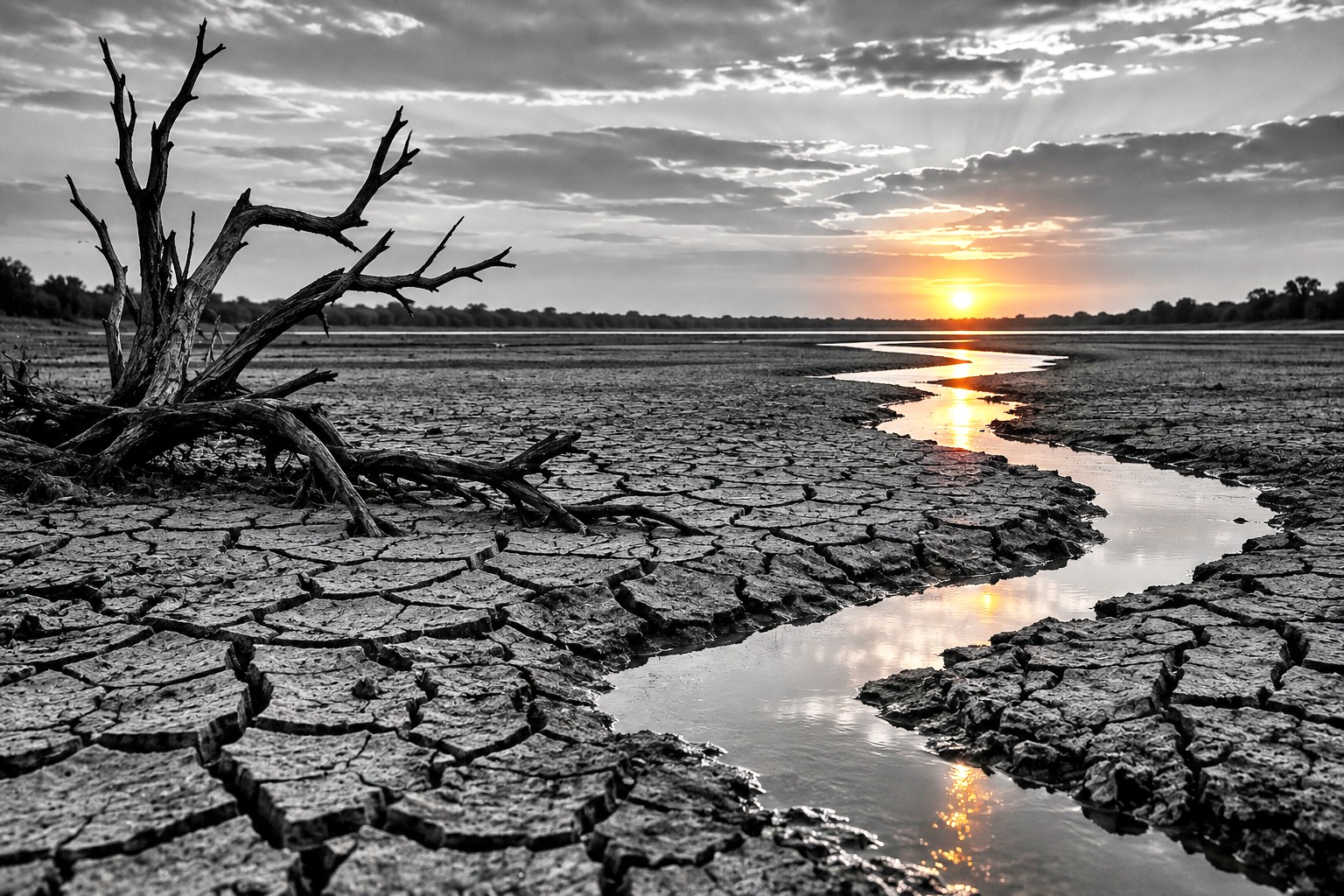
The world’s rivers experienced one of their driest years in more than three decades in 2025, while freshwater stored in soils, lakes, groundwater, snow and ice continued a long-term decline. A new global assessment warns that the natural reserves humanity depends on during dry periods are being steadily depleted.
GENEVA — September 17, 2026
The World Meteorological Organization’s State of Global Water Resources 2025 report found that 36 per cent of the world’s river basin area experienced below- or much-below-normal river flows last year.


Only around a third of rivers recorded flows within their normal range.
It was one of the driest years for global river discharge in the past 35 years and continued an unusual pattern: for seven consecutive years, normal river conditions have been in a clear minority.
The water savings account
The problem extends far beyond rivers.
Terrestrial water storage measures freshwater held across the landscape, including groundwater, lakes, rivers, soil moisture, snow and ice.
In 2025, terrestrial water storage was below normal across 42 per cent of the world’s land area.
WMO Secretary-General Celeste Saulo compared these slowly accumulated reserves to a savings account that helps societies survive difficult periods.
That account is being depleted.
Global terrestrial water storage has been declining since around 2014–16, creating what the WMO describes as a persistent decade-long signal.
Glaciers are disappearing too
Another part of that natural reserve is shrinking.
All 19 of the world’s major glacier regions lost ice for the fourth consecutive year in 2025.
The estimated loss during the year was approximately 400 gigatonnes of ice, contributing around 1.1 millimetres to global sea-level rise.
Glaciers are particularly important because they store water and release it gradually into river systems.
Losing them therefore affects more than sea levels. It can eventually alter the availability of freshwater downstream.
Too little – and too much
The emerging problem is not simply that the planet is becoming uniformly drier.
The global water cycle is becoming more erratic.
While large areas experienced drought and low river flows, other regions experienced unusually high flows and destructive flooding. Asia and Africa together accounted for at least half of recorded water-related extreme events over the past five years and more than 80 per cent of reported associated deaths.
That instability matters economically.
Rivers supply drinking water, irrigate agriculture, cool power stations, generate hydroelectricity, support industry and transport goods.
Low water levels can therefore become an energy problem, a food problem, a transport problem and ultimately an economic problem.
Water becomes an economic issue
The report reveals something easily overlooked when discussing climate change.
Water is infrastructure.
Modern economies have been built around assumptions about where water will be available, how much will arrive and when it will arrive.
Those assumptions are becoming less reliable.
The world’s freshwater savings account is still enormous.
But the direction identified by the WMO is increasingly clear.
Humanity is withdrawing from it faster than nature is replenishing parts of it — while the rivers connecting that reserve to societies are becoming increasingly unpredictable.
Newshub Editorial – 17 September 2026
The world's rivers experienced one of their driest years in more than three decades in 2025, while freshwater stored in soils, lakes, groundwater, snow and ice continued a long-term decline. A new global assessment warns that the natural reserves humanity depends on during dry periods are being steadily depleted.